



Southern actor Prakash Raj has landed in legal trouble after his remarks on the Ramayana resurfaced online, sparking outrage and a formal complaint alleging that his statements hurt religious sentiments.
He described Lord Rama as a North Indian migrant ‘stealing fruits’ and Ravana as a South Indian tribal – a flourish that may have pleased a certain gallery, but has clearly not travelled well beyond it.
There was a time when actors played roles. Now some live inside one – the permanent dissenter, the professional contrarian, the man who must, at all times, be seen to be ‘speaking truth’.
Prakash Raj has perfected that role. The difficulty is not that he speaks. It is that he speaks in one direction.
The convenience of courage
On X, his convictions arrive with remarkable punctuality – especially when the subject is Hindu faith, Hindu symbols, Hindu epics, or Hindu leaders. Here, he is fearless. Irreverent. Uncompromising. But courage, if it is to be taken seriously, cannot be so selective in its appointments.
On matters that are less fashionable – or less rewarding in terms of applause – the same voice acquires a studied restraint. The outrage meter suddenly develops a tolerance level that would impress a seasoned diplomat. This is not dissent. This is curation.
And it is here that the sharper charge arises – that Prakash Raj is a Christian by faith and an atheist by convenience, deploying disbelief as a public posture while retaining belief when it suits him personally.
Atheist, but with footnotes
Prakash Raj calls himself an atheist. Fair enough – belief, or the lack of it, is a personal matter. But his atheism comes with a set of carefully drafted exemptions.
When his mother passed away recently, he ensured a Christian funeral in accordance with her beliefs. He defended it as a matter of respect. And he was right. That is what civilised societies do – they respect the faith of others, even when they do not share it.
The question then is straightforward. Why does that respect not travel beyond the gates of one’s own home? If belief deserves dignity in private, it cannot be treated as a punchline in public.
More pointedly, why is the Hindu faith the easiest target for ridicule, while other belief systems are treated with a caution bordering on silence?
Rewriting epics, reducing nuance
His recent remarks on the Ramayana were presented as creative reinterpretation. That is the polite description. The less polite one is casual trivialisation dressed up as intellectual play.
India has never been short of reinterpretations of its epics. Scholars, poets, playwrights – all have engaged, questioned, debated. But they did so with a certain seriousness of purpose.
Turning a civilisational text into a convenient political metaphor, complete with punchlines and provocation, is not quite the same thing. It invites reaction – and then, predictably, the performer retreats behind the well-worn shield of ‘freedom of expression’. Freedom, it turns out, is most vigorously defended after the provocation has done its work.
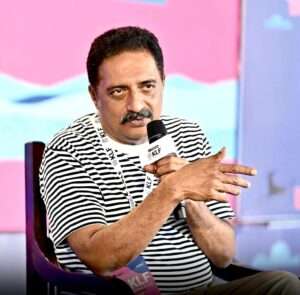
The eloquence of silence
More revealing than what Prakash Raj says is what he does not. His social media timeline, so energetic when it comes to targeting Hindu beliefs, falls curiously silent on other fronts. There is little to no outrage when radical or jihadi elements make headlines. There is no comparable urgency when offensive remarks emerge from other quarters.
He has not found his voice on the TCS conversion and sexual exploitation controversy that has stirred public debate. Nor has he deemed it necessary to respond when political leaders like Tamil Nadu Chief Minister Stalin and his son make sweeping, provocative remarks on Sanatan Dharma.
Even statements from sections of the clergy – including the astonishing claim by a Tamil Nadu pastor that he wears shoes to avoid ‘defiling’ his feet on a land worshipped by Hindus — have not invited his trademark indignation. Silence, too, is a statement. And repeated silence begins to look like a position.
A gentle reminder from Nagababu
Telugu actor Nagababu’s intervention cut through the noise with surprising clarity. Atheism, he said, is a rational position – but rationality does not require ridicule. Questioning belief is legitimate; mocking believers is something else entirely.
He also reminded Prakash Raj of something personal – that he had respected his own mother’s faith during her funeral. Extending that same courtesy to millions of others, he suggested, should not be difficult.
It was not a thunderous rebuttal. It did not need to be. It simply pointed out what should have been obvious.
India’s public life has always had space for the dissenter. The credible ones, however, shared a certain discipline – they were equal-opportunity critics. They questioned power, not just preference. They challenged dogma, not just selected traditions.
The actor and the act
Prakash Raj remains a fine actor. On screen, he can inhabit complexity. Off-screen, he increasingly appears trapped in a simpler role – one that demands a line, a familiar target, and applause on cue. The performance continues. The credibility, however, is beginning to wear thin.
No one is asking Prakash Raj to be silent. That would defeat the point of a democracy. The expectation is far more modest – apply the same yardstick everywhere. Extend the same respect outward that you claim inward. Question without caricaturing. Criticise without selecting.
Until then, the charge will linger, stubborn and inconvenient. Not that he speaks too much, but that he speaks too selectively.


Prakash Raj is no doubt an actor par excellence. But as a person he is an hypocrite. Very rightly pointed out, he is an atheist when the situation demands. Typical Urban…….
Prakash Raj has got a befitting reply from Nagababu. In a civilised society when one with illogical outspokenness tries to flourish, bound to get it back if not get trashed. Hence, Prakash Raj needs to think twice before he speaks as none are not going to sit here to listen such irresponsible and ignorant jibes hurting majority Hindu faiths.