
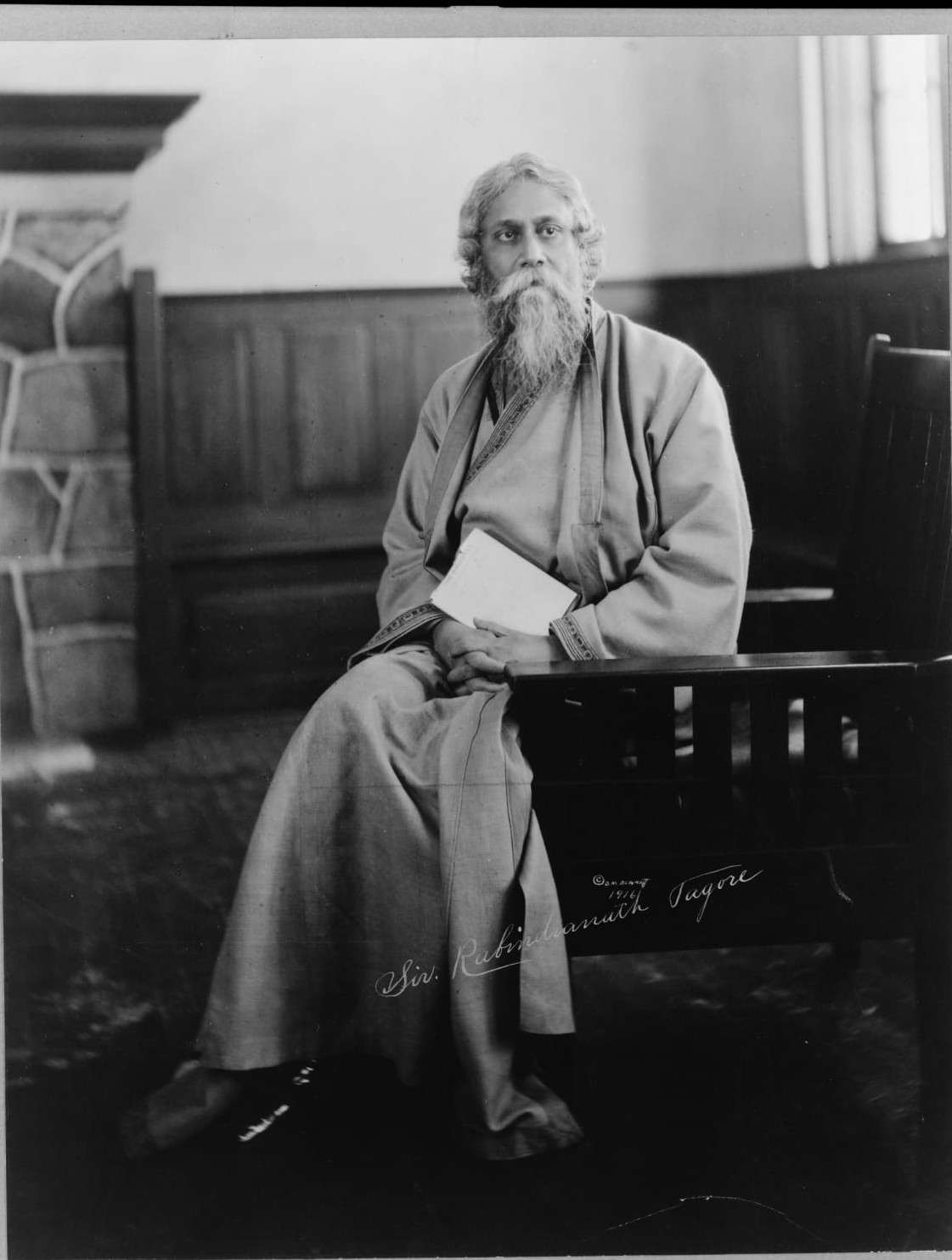
Today marks the birth anniversary of Rabindranath Tagore, one of India’s most luminous minds. Excellence, though it may surface in any individual at any moment, finds its fullest expression only in rare souls who transcend boundaries of discipline and thought. Tagore was one such extraordinary figure—his genius not confined to poetry and song, but extending into the realms of social responsibility, philosophy, and spiritual awakening. He holds the distinction of being the first non-European to be awarded the Nobel Prize in Literature, conferred upon him for his immortal work Gitanjali. This collection is far more than a series of poems; it is a profound spiritual journey, suffused with lyrical beauty and an intense yearning for the Divine. In its verses, Tagore is not a distant observer. He engages with God in a voice that commands, questions, prays, and persuades—with an intimacy that is both bold and deeply personal.
Yet, his pursuit of excellence did not remain confined to literature. It found powerful expression in shaping cultural and national identity. He composed “Jana Gana Mana,” later adopted as the national anthem of India, a composition that captures the unity and spirit of a diverse civilisation. Likewise, his “Amar Sonar Bangla” became the national anthem of Bangladesh, underscoring his enduring influence across borders. On this occasion, we remember not merely the man, but the spirit he embodied—a spirit of creativity, devotion, and universal humanism. As a humble tribute to this great soul, we present this article in reverence and admiration. — Editor
U Lakshman Rao
On this day of remembrance, when the birth of Rabindranath Tagore is recalled with quiet reverence, one does not merely celebrate the arrival of a poet, but the awakening of a voice that came to breathe through a nation’s conscience. His spirit, subtle yet pervasive, continues to vibrate in the solemn cadence of Jana Gana Mana, where every note carries both dignity and surrender—an offering of the individual to the greater soul of the collective. In that anthem, Tagore is not merely remembered; he is experienced.
Tagore’s genius was not confined to poetry alone; it flowed across literature, music, philosophy, and social thought with a rare unity of purpose. His creative expression arose from a mind deeply rooted in spiritual inquiry, yet courageously engaged with the realities of society. In his novel Gora, he dissects the rigidities of identity, religion, and nationalism, exposing the paradoxes of belonging and the illusion of constructed divisions. The narrative moves beyond mere fiction; it becomes a philosophical interrogation of what it means to be truly human in a society fractured by dogma.
Similarly, in The Post Office, the simplicity of a child’s longing unfolds into a profound meditation on freedom and transcendence. The child Amal, confined within walls, becomes a symbol of the soul yearning to break free from the limitations imposed by both body and society. Here, Tagore transforms suffering into a quiet illumination, suggesting that liberation is not always an outward act but an inward awakening.
In dramatic works like Chitrangada and Raja, Tagore ascends to yet subtler planes of thought. These works explore the interplay of love, identity, illusion, and divine presence. The characters are not merely individuals; they are archetypes navigating the eternal tension between appearance and truth. The stage becomes a philosophical space where the human soul encounters its own depths.
Yet, it is in Gitanjali that Tagore’s voice finds its most luminous and universal expression. This collection, which earned him the Nobel Prize in Literature, stands not merely as poetry, but as a sacred dialogue between the finite and the infinite. Each poem is a prayer, yet not bound by ritual; it is a spontaneous outpouring of devotion shaped by wonder, humility, and a deep sense of unity with existence.
The opening spirit of Gitanjali carries a quiet yet profound invocation: a surrender of the self to the divine will, not in submission, but in joyful participation. Tagore does not seek God in distant heavens; he finds the eternal in the dust of the road, in the toil of the worker, in the silent rhythm of nature. His philosophy dissolves the boundary between the sacred and the mundane, teaching that divinity resides in the ordinary moments of life.
This vision had a transformative impact on society. At a time when colonial subjugation had wounded the spirit of India, Tagore’s words restored an inner sovereignty. He reminded people that freedom was not merely political but spiritual—a liberation of thought, of fear, and of narrow identities. His establishment of Visva-Bharati University embodied this philosophy, creating a space where learning was not confined to classrooms but expanded into a holistic communion with culture, nature, and humanity.
In the present age, marked by rapid material advancement yet profound existential unrest, Tagore’s relevance deepens rather than diminishes. His call for harmony—between man and nature, between individuality and universality, between reason and spirituality—speaks directly to the fractures of modern life. In a world increasingly divided by ideology, his vision of unity offers not a rigid solution but a gentle, enduring path.
Tagore’s legacy is not merely in the works he left behind, but in the consciousness he awakened. Gitanjali continues to whisper that life, in its deepest essence, is an act of offering—that true fulfilment lies not in possession, but in participation with the infinite rhythm of existence. Through him, poetry became prayer, art became philosophy, and the human voice found its resonance in the eternal.