



Trusting Pakistan has never been a strategy—it has always been a gamble. And once again, events are proving that those who place faith in Islamabad do so at their own peril. The latest geopolitical manoeuvre by the Shehbaz Sharif–Asif Munir combine exposes a familiar pattern: say one thing to Washington, do quite another with Beijing—and quietly keep Tehran afloat in the process.
At the heart of this duplicity lies a calculated move that directly undermines American strategic objectives in West Asia. While former US President Donald Trump and his security establishment continue to project confidence that pressure tactics are “starving Iran of cash,” Pakistan has opened a backdoor that effectively neutralises that very strategy.
This is not conjecture. It is grounded in policy.
Under the “Transit of Goods through the Territory of Pakistan Order 2026,” Islamabad has formally allowed third-country goods to pass through its territory into Iran. What appears, at first glance, to be a bureaucratic trade adjustment is, in reality, a geopolitical pivot of serious consequence. By legalising this corridor, Pakistan has inserted itself into one of the most sensitive logistical theatres in the world.
Consider the timing. The Strait of Hormuz—the artery through which a significant portion of the world’s oil flows—has been under severe disruption. Iranian ports are under pressure, maritime routes are constrained, and over 3,000 containers meant for Iran were stranded at Karachi. In such a scenario, the US strategy hinges on squeezing Iran economically, cutting off supply chains, and forcing compliance.
Pakistan has just punched a hole through that strategy.
By activating an integrated network—Gwadar, Karachi, Port Qasim, Taftan, Gabd, Quetta, Khuzdar, and Ormara—Islamabad has effectively created a sanctions-resistant overland corridor. Goods that cannot reach Iran by sea can now flow seamlessly by land. The blockade weakens. The pressure dissipates. Iran breathes easier.
This is not neutrality. This is an intervention.
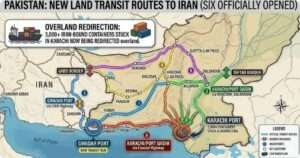
And it raises an uncomfortable question: is Pakistan misleading Washington while playing a deeper, long-term game aligned with China’s regional ambitions?
The answer lies in the map. Gwadar is not just a port—it is a crown jewel of the China-Pakistan Economic Corridor (CPEC), itself a flagship of China’s Belt and Road Initiative. By turning Gwadar and adjoining routes into a logistical bridge for Iran, Pakistan is not merely facilitating trade—it is strengthening a Beijing-Tehran-Islamabad axis that runs counter to American interests.
In effect, Pakistan is doing three things simultaneously: appeasing the US through diplomatic optics, assisting Iran in bypassing sanctions, and advancing China’s strategic footprint in the Arabian Sea.
That is not balancing. That is double-crossing.
Meanwhile, Washington appears caught between its rhetoric and reality. On one hand, the US justifies its prolonged involvement in the region by citing intelligence concerns—claims that Iran is inching closer to nuclear capability with external support. On the other, it is confronted with the fact that one of its long-time “partners” is actively diluting the impact of its economic warfare.
The domestic cost is mounting too. Reports suggest that the conflict has already drained over $25 billion from the US exchequer, fuelling political backlash. Critics argue that while American taxpayers foot the bill, Pakistan quietly reaps strategic dividends by positioning itself as an indispensable transit hub.
If this is not a classic case of geopolitical opportunism, what is?
Pakistan’s defenders may argue that this is economic pragmatism—a nation leveraging geography for trade. But that argument collapses when viewed against its simultaneous engagement with US leadership and intelligence agencies. You cannot claim partnership while undercutting your partner’s core strategy.
History offers a clear lesson: Pakistan has often thrived on playing both sides. From the Cold War to the War on Terror, it has mastered the art of extracting benefits while hedging its bets. What we are witnessing today is simply a modern iteration of that doctrine—only this time, the stakes are far higher, involving global energy flows, nuclear anxieties, and great-power rivalry.
For the US, the message should be unmistakable. Strategic ambiguity from Pakistan is not an exception—it is the norm. Any policy built on the assumption of reliability is bound to falter.
And for the rest of the world, this episode serves as yet another reminder: in the grand chessboard of geopolitics, Pakistan is not a pawn. It is a player—one that rarely reveals its true moves until the damage is already done.


Pure Hyderabadi language mein “ Pakistan is an international chindi chor hai “ ..so far it held nuisance value to India .. now a far wider world will face the menace 🤪
Shanker your starting statement “ Trusting Pakistan is not a strategy, it’s a gamble “ will now be understood in practice by all the countries world wide ! Too good an Article 👏🏻👏🏻