



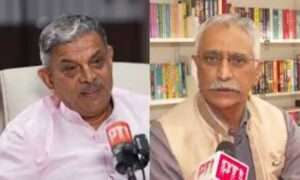
There was a time when the Rashtriya Swayamsevak Sangh commanded respect for discipline, ideological clarity and its role in preserving Hindu civilizational consciousness. It functioned as a cultural force that sought to awaken national pride and social service among Hindus. But increasingly, some of its top functionaries appear unable to distinguish between cultural nationalism and the sovereign responsibilities of an elected government. The latest remarks by RSS general secretary Dattatreya Hosabale advocating renewed dialogue with Pakistan raise serious and uncomfortable questions: Has the RSS begun overstepping its brief? Has it started behaving like a parallel foreign policy establishment?
At a time when India is led by one of the most experienced diplomatic teams in recent history — Prime Minister Narendra Modi and External Affairs Minister S. Jaishankar — such unsolicited interventions are not merely unnecessary, but potentially damaging. What exactly is the RSS trying to signal? That the government’s current Pakistan policy lacks maturity? That New Delhi should soften its stand despite decades of betrayal, cross-border terrorism, infiltration and bloodshed sponsored by the Pakistani deep state?
Dialogue with whom exactly, Mr. Hosabale? With the Pakistani Army that dictates the country’s policies from Rawalpindi? Or with the fragile civilian dispensations that survive at the mercy of generals and Islamist radicals? Every Indian knows the bitter truth — there is no stable democratic structure in Pakistan capable of sustaining peace with India. The real power centre remains the military establishment, which has historically thrived on anti-India hatred.
What makes the RSS remarks even more puzzling is the timing. India today enjoys unprecedented global diplomatic stature. From the United States to the Gulf nations, from Europe to the Indo-Pacific, India’s voice carries weight and credibility. Much of this has been achieved through calibrated diplomacy, strategic restraint and a firm national security doctrine under the Modi government. Why then should a cultural organisation attempt to inject confusion into such sensitive matters?
Even more disturbing is the endorsement of such views by former Army chief Manoj Naravane, whose tenure itself was not free from controversy. One expected retired military leaders to appreciate the enormous sacrifices made by Indian soldiers due to Pakistan-sponsored terror. Reopening old debates about engagement with Islamabad only sends mixed signals to the nation and its armed forces.
The RSS must understand a simple reality: patriotism does not automatically qualify one to shape foreign policy. Diplomacy is not a shakha debate. International relations require strategic patience, intelligence inputs, geopolitical balancing, and long-term calculations. Loose public commentary from ideological organisations only gives unnecessary ammunition to India’s adversaries and fodder to an otherwise directionless Opposition desperate to manufacture divisions within the nationalist ecosystem.
Ironically, the same RSS leadership that now lectures the government on diplomacy has often failed to introspect on its own social responsibilities within India. Bharat is not a mono-religious state. It is a civilizational nation where multiple faiths, languages and communities coexist. If the RSS genuinely wishes to strengthen the nation, let it focus on creating social harmony, reducing mistrust between communities, eliminating caste divisions and winning hearts through constructive outreach.
This is precisely where the RSS has frequently fallen short.
One cannot forget how comments by RSS chief Mohan Bhagwat on reservations ahead of the Bihar elections politically damaged the BJP. Whether intentional or not, such statements handed political weapons to rivals who portrayed the BJP as anti-Dalit and anti-backward classes. Why repeat the same mistake now by venturing into the highly volatile domain of Indo-Pak relations?
The RSS often claims to represent Hindu interests. Fair enough. But where was this organisational strength when Hindus in parts of West Bengal allegedly faced intimidation, political violence and displacement under the rule of All India Trinamool Congress? Where were the large-scale protective interventions? Where were the nationwide campaigns demanding justice for vulnerable Hindu families in border districts? If substantial work was indeed done, the RSS should publish a transparent white paper detailing its interventions, relief measures and ground-level mobilisation.
It is easy to issue broad geopolitical suggestions from conference stages. It is far more difficult to stand with vulnerable citizens facing violence and intimidation on the ground.
The truth is that the Modi government does not require ideological babysitting from anyone. It has repeatedly demonstrated administrative capability, diplomatic maturity, and electoral strength on its own merit. Under Modi’s leadership, India has witnessed stronger governance, better global recognition, decisive national security responses, and improved infrastructure at a scale unseen in decades. The BJP’s electoral successes cannot be simplistically attributed to RSS booth management alone. Charismatic leadership, welfare delivery, political messaging, and the Modi-Shah organisational machine have transformed the BJP into a formidable national force.
The RSS would do well to remember that cultural organisations earn respect when they operate with restraint and clarity of purpose. The moment they begin sounding like unofficial power centres on diplomacy, defence, and governance, they risk eroding their own credibility.
India today needs institutional discipline, not ideological cacophony.
The nation expects the RSS to contribute towards social cohesion, character-building, and cultural awareness — not freelance foreign policy prescriptions on Pakistan. Sensitive matters involving national security and diplomacy must remain the exclusive domain of the elected government and professional institutions tasked with safeguarding India’s interests.
Anything beyond that risks turning a respected cultural body into exactly what many now fear — a loose cannon.


