



If Parliament is the arena where a nation’s future is debated with seriousness and substance, then Friday’s spectacle in the Lok Sabha was a sobering reminder of how quickly standards can slip when responsibility is treated as optional. What should have been a focused, high-stakes discussion on constitutional amendments to empower women instead veered into the realm of theatrics—courtesy the Leader of the Opposition, Rahul Gandhi.
The debate revolved around critical reforms—delimitation and the long-overdue promise of 33% reservation for women in legislative bodies. These are not ornamental changes; they strike at the heart of representation and democratic fairness. Yet, when given the opportunity to articulate a coherent critique or present a substantive counterpoint, Gandhi chose a different route altogether—one paved with anecdotal diversions, rhetorical flourishes, and questionable analogies.
Dragging in personal childhood stories and invoking his grandmother, Indira Gandhi, might have been intended to add emotional weight. Instead, it exposed a troubling disconnect. After all, invoking a leader whose tenure is inseparable from the dark shadow of the Emergency in India—a time when democratic freedoms were suspended—while simultaneously sermonizing on democratic values, is not just ironic; it borders on political amnesia.
More perplexing was his choice of language. Branding Prime Minister Narendra Modi a “magician” and trivializing significant military operations like the Balakot airstrike and the three-day successful Operation Sindoor, reduces serious national security matters to flippant rhetoric. This is not sharp political critique; it is a dilution of discourse. One expects the Opposition to question, to challenge, even to attack—but with facts, logic, and a sense of proportion. What unfolded instead was a performance that seemed more eager for applause than for impact.
To be fair, Parliament is no stranger to heated exchanges. But there is a line between passion and irresponsibility, and it was crossed with alarming ease. Senior ministers like Rajnath Singh and Kiren Rijiju were compelled to intervene, urging that certain remarks be struck off the record for violating parliamentary norms. Speaker Om Birla displayed notable restraint, repeatedly reminding Gandhi to confine himself to the subject. His patience, arguably, prevented what could have escalated into a procedural confrontation.
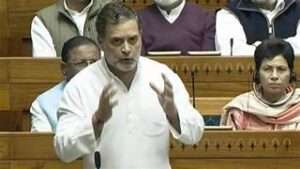
Equally disconcerting was the reaction from the Opposition benches. Instead of course-correcting, there was visible encouragement—desk-thumping and cheers that suggested endorsement rather than embarrassment. It gave the impression of a political echo chamber, where theatrics are rewarded and substance is optional. For viewers across the country, this was not just disappointing; it was deeply unsettling.
Contrast this with the tone adopted by members of the treasury benches. Their arguments, whether one agrees with them or not, were rooted in data, legislative history, and policy rationale. The push for women’s reservation, it must be remembered, is not new. It has been debated for decades, with earlier legislative attempts dating back to governments like that of H. D. Deve Gowda. Yet, despite periodic momentum, political consensus remained elusive—often stalled by the very party that now claims to champion it.
This is precisely why Friday’s debate mattered. It was an opportunity to rise above partisan reflexes and engage with a transformative policy. Instead, it was reduced to a spectacle that did little justice to the subject or to the institution.
Leadership—especially in Opposition—is not about occupying space; it is about elevating discourse. It demands clarity of thought, discipline in expression, and respect for the platform. When these are replaced by flippancy and theatrics, it weakens not just the individual, but the credibility of the entire Opposition.
Rahul Gandhi’s performance was not merely underwhelming; it was a disservice to the role he occupies. For a party that once set the terms of national debate, this should be a moment of reckoning. Because in the end, Parliament is not a stage for punchlines—it is a forum for purpose. And when that purpose is lost, the nation notices.


My heart goes for girl child seeking an opportunity to be born , to be raised , to lead a life of dignified existence , equal pay for equal work, safety in work places… and all these assurances can be best secured when our enterprising women rise in good number in parliament as policy makers with conviction and integrity. A political system which exemplifies significant feminine contribution qualitatively yet lacking quantitatively. So the issue needs to be understood, asserted with logic , reasoning and maturity in the context of National interests.