Kolkata: In a result laden with symbolism, political theatre and historical resonance, BJP’s Suvendu Adhikari on Monday defeated West Bengal Chief Minister Mamata Banerjee in Bhabanipur, puncturing what was long seen as her safest political refuge and delivering a decisive psychological blow to the TMC amid a sweeping saffron surge across West Bengal.
The margin — 15,105 votes after all 20 rounds of counting — told only part of the story. The real narrative lay in the arc of the contest: a commanding early lead for Banerjee, a steady erosion, and a late surge by Adhikari that mirrored, almost frame by frame, the dramatic script of Nandigram in 2021.
If Nandigram marked the rupture of a mentor-protege relationship and the first electoral defeat of Banerjee in decades, Bhabanipur has now cemented Adhikari’s emergence as the BJP’s principal challenger in Bengal– and the man who can beat her on both hostile and home turf.
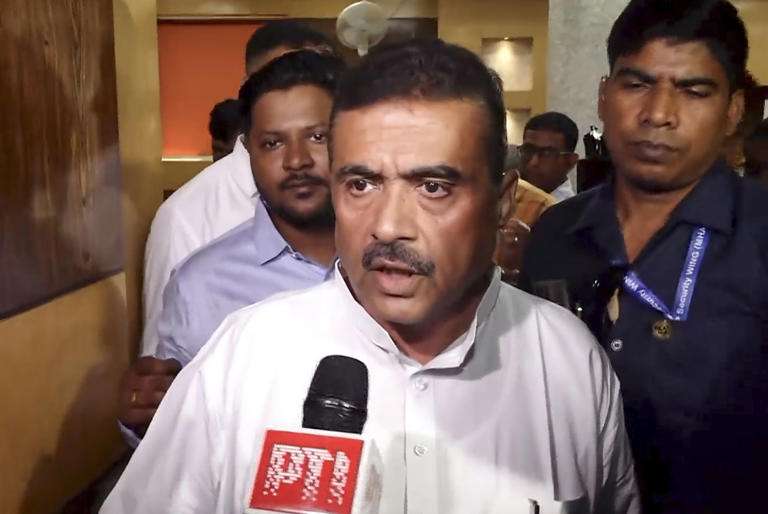
“This is a historic victory… a victory of Hindutva, a victory of Bengal, a victory of Modiji,” Adhikari said, holding his winning certificate outside the Sakhawat Memorial School counting centre, invoking both ideological and political triumph.
Banerjee, who had taken an early lead of over 17,000 votes by the seventh round, watched her advantage shrink gradually as counting progressed. By the 14th round, her lead had fallen below 4,000, before Adhikari overtook her in the closing stages and steadily widened the gap.
The chief minister, present at the counting centre through the day, alleged irregularities as trends turned against her.
“Do you think this is a victory? It is an immoral victory. More than 100 seats have been looted. The Election Commission is the BJP’s commission,” she said, also claiming that one of her counting agents was forced out and that she was “pushed and berated” inside the centre.
There was no immediate response from the Election Commission.
Bhabanipur is not just another assembly constituency in south Kolkata. It is the political address that has anchored Banerjee’s rise, her administrative authority, and her carefully cultivated image as “Didi”– the accessible neighbourhood leader who rose to dominate Bengal’s politics.
Her Kalighat residence lies within the constituency. Its clubs, locality networks and welfare outreach have long formed the backbone of her political machine. After losing Nandigram in 2021, it was Bhabanipur that restored her to the assembly through a bypoll victory by over 58,000 votes.
For the TMC, therefore, Bhabanipur was never merely a seat; it was an insurance policy.
For the BJP, breaching it meant something far greater than a numerical gain. It meant dismantling the aura of invincibility around Bengal’s most powerful leader.
That is precisely why the party fielded Adhikari here. Spread across a socially diverse electorate– Bengali bhadralok, Gujarati traders, Marwari and Jain families, Sikh households, and a sizeable Muslim population– Bhabanipur has often been described as “mini India”.
The BJP’s strategy was rooted in this diversity. Through months of booth-level mapping, the party sought to consolidate Hindu votes across linguistic and caste lines– Bengali and non-Bengali alike– while leveraging Adhikari’s image as a leader who had already defeated Banerjee once.
The contest was thus framed not just as an election, but as a referendum. Adhikari reinforced that narrative on Monday.
“I bow to the people of Bhabanipur… this victory belongs to them,” he said, thanking Hindu, Jain and Sikh voters, and dedicating the win to BJP workers who, he claimed, had died in political violence.
He also invoked Bharatiya Jana Sangh founder Syama Prasad Mookerjee, placing the victory within a larger ideological continuum.
Bengal’s political history has rarely witnessed a sitting chief minister losing their own seat.
The last comparable moment came in 1967, when Ajoy Mukherjee defeated incumbent CM Prafulla Chandra Sen after breaking away to form the Bangla Congress.
Adhikari’s victory now places him in that rare historical arc — a challenger who has twice unseated a sitting chief minister, first in Nandigram and now in her own stronghold.
The symbolism is unmistakable. In many ways, Bhabanipur completes a political circle that began in Nandigram.
In 2021, Adhikari, once Banerjee’s trusted lieutenant, rebelled against the TMC, joined the BJP, and defeated her in a bitterly fought contest that redefined Bengal’s political narrative.
Five years later, the duel shifted to Banerjee’s backyard and ended with the same result.
But if Nandigram was about betrayal and rebellion, Bhabanipur is about consolidation and expansion.
For the BJP, it signals that its challenge is no longer confined to rural or semi-urban pockets. It has now breached the urban, symbolic core of TMC’s power.
The implications of the result extend far beyond one constituency. For the TMC, Banerjee’s defeat raises uncomfortable questions about the durability of her personal connect with voters, particularly in urban strongholds that were once considered impregnable.
For the BJP, the victory is both strategic and psychological. It not only strengthens Adhikari’s stature as the party’s undisputed face in Bengal but also validates its long-term strategy of Hindu consolidation, micro-level electoral mapping, and high-voltage symbolic contests.
The Bhabanipur result has come alongside a broader statewide trend that places the BJP well past the 200-seat mark, positioning it to form its first government in West Bengal.
In that larger sweep, this single contest stands out. It began as a prestige battle, evolved into a cliffhanger, and ended as a defining moment, one that could reshape Bengal’s political trajectory.
As the dust settles, Bhabanipur will be remembered not just for who won, but for what it represented: the fall of a fortress, the rise of a challenger, and the rewriting of a political script that, until recently, seemed firmly in Mamata Banerjee’s control.