Upadhyayula Lakshman Rao
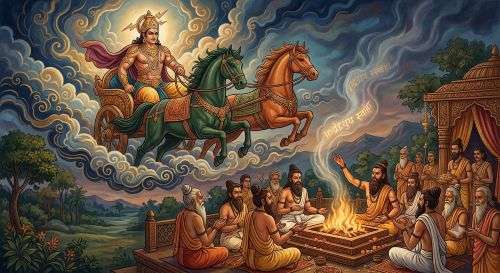
The sage Kakṣīvāntha, in the majestic cadence of Triṣṭubh within the hymns of the Rigveda, raises a luminous invocation to the divine dawn, the goddess Uṣā. She is envisioned not merely as the herald of morning, but as a cosmic principle of awakening, order, and renewal. Her chariot, vast and resplendent, is prepared for graceful movement across the heavens, bearing within it the immortal celestial beings who partake in her eternal journey. With her arrival, darkness is dispelled—not only as a physical phenomenon but as a symbol of ignorance—and from its depths she manifests as radiant beams of light, illuminating both the world and the inner consciousness of humanity.
Uṣā arises before all beings, preceding even the stirrings of life, as though she were the very impulse that awakens existence itself. She nourishes all creatures, providing sustenance and vitality to those who honor the sacred order. Self-luminous and regenerative, she embodies continuity, appearing anew each day while remaining eternal in essence. At the first invocation within the sacred precincts of yajña, she manifests with sanctity, sanctifying the ritual and its participants. Her birth is auspicious, and her governance extends over humankind, for she apportions light with precision and grace, ensuring that all beings partake in its life-giving presence.
In harmonious conjunction with Savitṛ, the divine source of motion and inspiration, Uṣā becomes the medium through which light attains meaning and purpose. Though Sun and Savitṛ are essentially one, they are perceived in distinct forms due to the differentiation of their cosmic functions—one as the visible orb, the other as the प्रेरक शक्ति, the impelling force behind all activity. Through this divine interplay, devotees are guided toward purity and faultlessness. Uṣā, the sister of the Sun, surpasses even the gods in her immediacy to human experience, for she touches every life each day, illuminating every sacred act and receiving oblations with silent grace.
She is the guide upon the righteous path, revered and venerable, and an adversary to those who perpetuate sorrow and disorder. With her aid, humanity overcomes adversity, both external and internal. She awakens the world sunk in darkness, reminding mankind of the eternal duty to speak truth with sweetness and to align thought with purposeful action. The sacred fire must ever be kept alive, for it is the earthly reflection of her celestial radiance. Thus, the rhythm of day and night unfolds in succession: night, symbolic of inertia and obscurity, yields to the chariot of Uṣā, which brings forth the day, suffused with clarity and energy.
Each dawn is a renewal, a promise that harmony shall return again. Uṣā is described as faultless, attending even to the waters—the sources of life—ensuring their purity and vitality. Though she appears to arise at a distance from the Sun, each ray of light is but her own extension, traveling through space and time, proclaiming the advent of day. Her manifestation within the sacred ritual space signifies the illumination of offerings, both material and spiritual, and her presence ensures their acceptance and transformation.
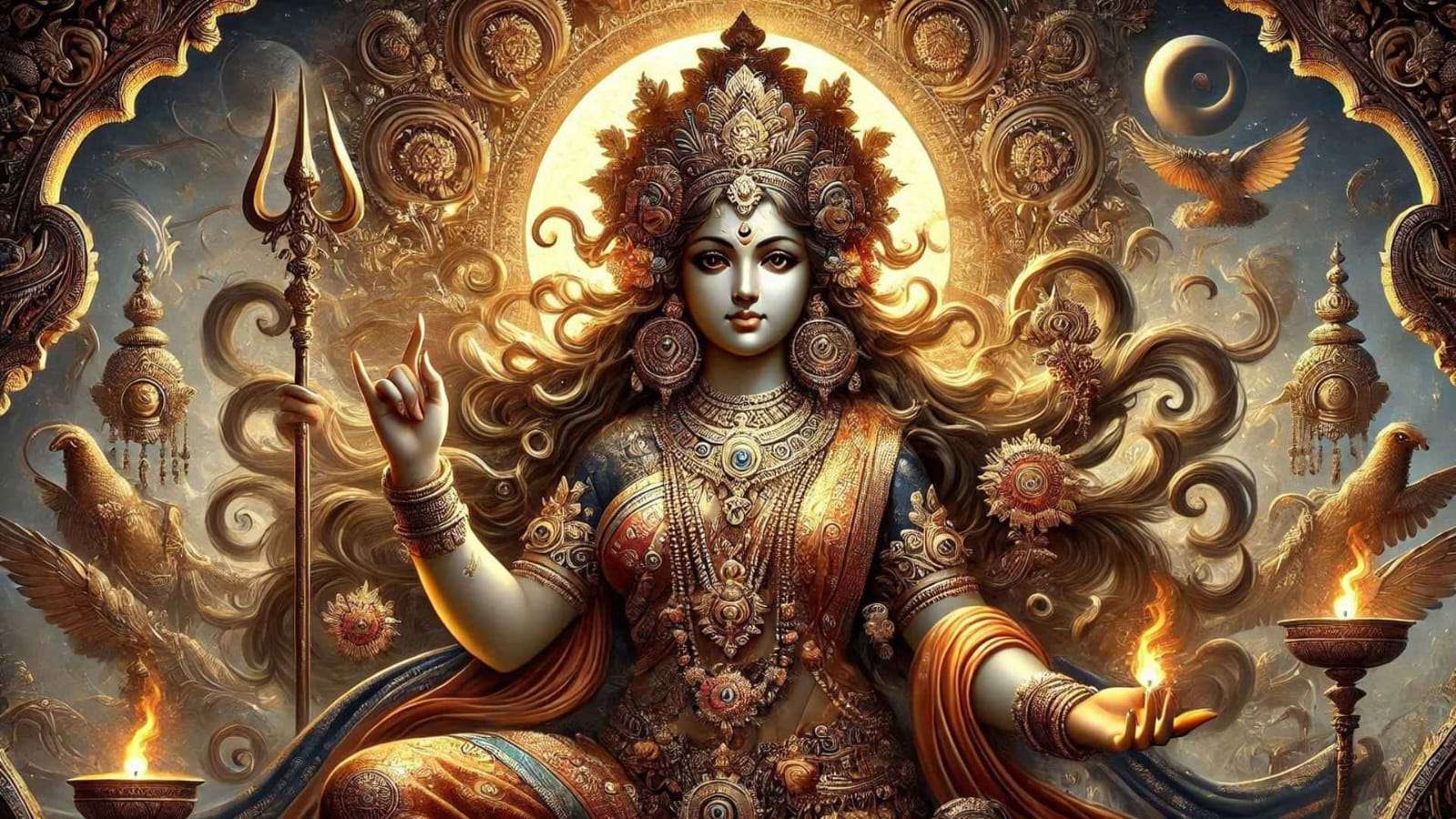
In her form, she is likened to an innocent maiden—gentle in smile, yet mature and powerful in her being. She stands adorned like a daughter lovingly decorated by her mother, revealing her splendor to all who behold her. Her rays carry comfort, warmth, and clarity, spreading across the worlds as blessings. None but she can dispel darkness so completely, and thus she is revered as the sovereign of horses, cows, and rays—symbols of energy, abundance, and illumination. Yet, as each dawn fades into day, the forms of Uṣā dissolve, only to re-emerge anew, reminding us of the transient yet cyclical nature of existence.
Clad in the सत्यरश्मि, the truthful rays of the Sun, Uṣā embodies the union of cosmic order and moral clarity. She bestows auspicious actions and prosperity upon those who revere her, guiding them toward harmony with the universe. In a deeper reflection aligned with scientific temperament, her daily emergence signifies the rotation of the Earth, the scattering of light through the atmosphere, and the rhythmic precision of cosmic laws. Thus, the Vedic seer, through poetic intuition, perceives both the spiritual symbolism and the natural phenomenon in one unified vision. Uṣā, therefore, stands as a bridge between the seen and the unseen, the material and the transcendental, eternally inviting humanity to awaken into light, truth, and purposeful existence.