



Bheemasena, bursting forth like a consuming inferno, advanced with terrible resolve, crushing elephants and their riders beneath the sweep of his mighty mace, intent upon scattering the Kauravas and their supporting hosts in that dreadful march of ruin. Abhimanyu and the valiant sons of Drupada guarded him on every side with their chariots, keeping distant the approaching warriors by an unceasing rain of arrows. Elephants fell in heaps like shattered hills, struck down by his mace that descended as a mountain hurled from the heavens, and streams of blood flowed so abundantly that both the fallen and the living were dyed crimson, as though those lordly beasts had been transformed into hills of ruby. Bathed in that sanguine flood, Bheema shone fearfully, and his resplendent mace gleamed as if carved from coral and precious stone. Turning then toward the forces of Magadha, he tore through them until flesh and bone were scattered in the mire of blood and broken limbs, and his aspect resembled the Lord of Death himself, wrathful upon the earth, as though the redemption of mankind were being wrought through his terrible duty.
The remaining elephants were driven away by the sons of Drupada and Abhimanyu as herds are guided by vigilant shepherds, while battalions fled in disorder like clouds rent asunder by violent winds. Alarm seized the Kaurava ranks, yet Duryodhana, with practiced skill, rallied and exhorted them to stand firm and fight with steadfast hearts. His effort stirred their enthusiasm like rising waves of the ocean, yet those waves broke and were silenced upon the unyielding shore called Bheemasena. Roaring like a lion and supported steadfastly by Abhimanyu and Drustadyumna upon his left and right, Bheema again scattered the Kaurava hosts, consuming them as a forest fire devours all creatures in its path. Still his wrath swelled, unspent and eager for destruction; striking the Kuru warriors upon head and limb, he felled them like dry trees uprooted by tempestuous winds, striding among them like a wild elephant trampling reed-beds by the riverbank, neither faltering nor weary though the labor was fierce. Even the celestial beings seemed to stand in applause at his wondrous course, while the Kuru warriors, astonished at his deadly advance, sought to restrain him from afar.
Bhishma, the commander of the army, moved by mingled anguish and ardor, confronted Bheema with whistling arrows that rivaled the music of his rolling chariot wheels. Renewed in spirit, the Kauravas pressed forward and assailed Satyaki. Then the rakshasa warrior Alambusa, descended from the line of Bakasura and Kirmira, cried aloud and loosed many shafts against him, for he had joined the Kauravas to avenge the death of Bakasura at Bheema’s hands. Satyaki, angered, struck the demon with four keen arrows, whereupon the latter turned away, as is the wont of such beings when met with resolute resistance. Proud of his success, Satyaki roared in triumph; but Bhurisrava, son of Somadatta, advanced and engaged him in direct combat, piercing him with nine arrows, which Satyaki answered with a torrent of shafts. Their clash was splendid to behold, and for a time Satyaki gained the upper hand, yet at length Bhurisrava cast him down and was about to thrust his sword into his fallen foe when Arjuna, at the behest of Krishna, leapt forward and severed Bhurisrava’s arm. Though such intervention defied the code of single combat, it was deemed righteous when undertaken for the protection of dharma, as declared by Sri Krishna.
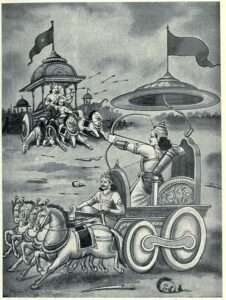
Sanjaya then spoke, saying, O King Drutharastra, your sons, together with Duryodhana, grew wrathful and hastened to support Bhurisrava, but Bheema in his ferocity drove them back. All your sons fled save Duryodhana, who pierced Bheemasena with nine arrows; whereupon Bheema, his eyes blazing like fire, mounted his chariot and struck him with ten shafts, then wounded his charioteer Nandaka with three. Duryodhana responded with sixty arrows, struck Visoka, the charioteer of Bheema, with three more, and shattered Bheema’s bow with a single shaft. Enraged, Bheema seized another bow and broke that of Duryodhana, who in turn grasped yet another and hurled a shaft like a thunderbolt, piercing Bheema in the chest so that he fell unconscious. Abhimanyu, the sons of Droupadi, and Drustadyumna then surrounded Duryodhana and assailed him from many sides with a rain of arrows. Regaining his senses, Bheema rose like Death renewed and swiftly attacked Salya, who stood guard over Duryodhana, and the Kaurava warriors shrank from him as elephants shrink from a lion.
When the sun stood high and blazing, your sons Sushena, Sulochana, Bheema, Bheemaradha, Bheemabahu, Duspradharsha, Durmukha, Vivitsa, Vikata, Ugra, Alolupa, Sama and others, fourteen in number, encircled Bheema with a storm of arrows; yet he fell upon them like a tiger upon tender deer, severed the head of one, slew Jalasandha, tore down Sushena and Bheemabahu, cut off Ugra’s head with a single shaft, and in swift succession destroyed Sulochana and the rest, so that all fourteen princes were laid low. Beholding this dreadful slaughter, the warriors fled for their lives until Bhishma rebuked them, asking whether it was fitting for charioteers to flee while Bheemasena ruthlessly slew the princes. Encouraged by his words, they gathered once more, and Bhagadatta advanced upon his mighty elephant, assailing Bheema and drenching him in blood, the sight resembling the bright sun encircled by dark clouds. Bhagadatta, famed as a master of elephants, rode Suprateeka, renowned for strength and training, and the encounter promised immortal glory to the victor. Abhimanyu and the others loosed volleys upon that great beast, which, bleeding and terrible, moved wildly, crushing the Pandava forces and spreading fear.
The faltering spirit of the Pandavas emboldened Duryodhana, who seized the moment to charge Bheema and strike him heavily in the stomach with a sharp shaft, so that Bheema staggered and steadied himself against his banner-staff while the Kauravas shouted in premature triumph. The sight enraged Ghatotkacha, son of Hidimba and Bheemasena, who burst forth and hastened to defend his father in that hour of peril. Thus, Sanjaya narrated to King Drutharastra the tumultuous course of battle, with a voice grave and impassioned, recounting the rise and fall of warriors beneath the relentless tide of war.

