
Indian politics periodically develops a sudden fascination for ancient civilisation, usually after election results produce a sufficiently dramatic map.
Television anchors begin sounding like archaeology lecturers. Political strategists discover forgotten kingdoms. WhatsApp universities reopen ancient trade routes overnight.
This time, the resurrection phrase is ‘Anga-Banga-Kalinga’. And unlike many political slogans assembled in a digital marketing basement, this one arrives with serious historical baggage.
More importantly, it also arrives in delicious contrast to one of the strangest political soundtracks in recent Indian politics – Mamata Banerjee’s immortal ‘hamba hamba, ramba ramba, kamba kamba, dumba dumba…’
The 2026 Bengal verdict may eventually be remembered as the election where one side spoke in the language of history while the other sounded like a percussion rehearsal gone wrong.
The forgotten eastern arc
Long before India became a republic of states and television debates, eastern India was defined by three powerful civilisational entities – Anga, Banga, and Kalinga.
Anga roughly covered parts of present-day Bihar. It was among the sixteen Mahajanapadas and occupies a prominent place in the Mahabharata. Karna becoming king of Anga after Duryodhana’s intervention was not symbolic generosity. It was a recognition of Anga’s political stature.
Banga represented ancient Bengal, which was commercially vibrant, culturally influential, and deeply connected to maritime trade routes extending into Southeast Asia.
Kalinga, corresponding largely to modern Odisha, was among the subcontinent’s great maritime powers. Its traders travelled widely across Asia centuries before global trade became fashionable conference jargon. Kalinga also permanently entered history through Ashoka’s devastating war there – a conquest so brutal that it transformed an emperor.

Ancient texts even linked these regions through bloodline mythology. According to the Mahabharata, Anga, Vanga, and Kalinga were founded by brothers, sons of King Vali, through the sage Dirghatamas.
Dirghatamas was troubled by a bad marriage, unvirtuous sons, and, ultimately, abandonment by other sages and the community. His children grew up to be covetous, and they brought a bad name upon themselves and their father. Ultimately, the sages and students of Dirghatamas – [perpetual darkness] abandoned him, for having raised bad men.
In short, eastern India was never some disconnected collection of territories. It possessed its own civilisational coherence long before political consultants began discussing ‘regional clusters’.
From epic map to election map
The BJP’s invocation of ‘Anga to Kalinga’ after its Bengal breakthrough is politically clever because it compresses history, geography, and ideology into one phrase.
Bihar had already moved firmly into the NDA sphere. Odisha had ceased being an inaccessible terrain. Bengal remained the emotional and symbolic frontier.
With Bengal now falling into place, the BJP is presenting the eastern seaboard not merely as an electoral achievement, but as a restored continuum. That framing matters.
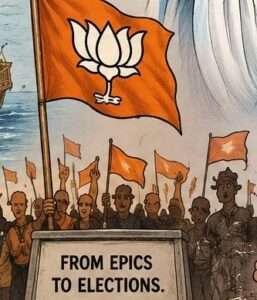
Winning states is routine politics. Reclaiming a civilisational arc sounds historic. The BJP increasingly prefers this style of politics – embedding contemporary victories inside larger historical narratives. It turns electoral success into something that appears inevitable, organic, almost preordained.
Critics may dismiss it as grand symbolism. But symbolism wins politics. Especially when the opposing side begins sounding increasingly unserious.
Enter ‘hamba hamba.’
Which brings us to Mamata’s now legendary 2021 performance from Murshidabad in ’hamba, hamba, ramba ramba, kamba kamba, dumba dumba…’
At the time, the phrase was intended as mockery directed at Trinamool defectors joining the BJP. Mamata was invoking Bengali proverb that implies better an empty cowshed than troublesome cattle.
In essence, she was calling defectors naughty cows. Politically, the point was understandable. Rhetorically, however, the result escaped into meme civilisation.
The phrase instantly acquired a second life on social media – remixes, reels, parody edits, mock speeches, comic soundtracks. What was meant to project defiance gradually became shorthand for theatrical incoherence.
That is the danger with performative politics. The crowd may laugh with you initially. Eventually, they begin laughing at you. And over time, the phrase acquired unintended symbolism.
As the BJP constructed layered narratives around nationalism, civilisational identity, and eastern resurgence, Mamata’s most viral contribution to political vocabulary remained ‘hamba hamba’. One side evoked Anga, Banga, and Kalinga. The other evoked a distressed cowshed.
The deeper message
The Bengal result is not merely an electoral defeat for the Trinamool Congress. It signals the collapse of the assumption that eastern India was a politically insulated terrain.
For decades, Bengal represented a unique political ecosystem – first Left dominance, then hyper-regional populism under Mamata. National parties struggled to fully penetrate that ecosystem. Now that the barrier has cracked.
The BJP’s rise in the east is therefore not just territorial expansion. It is ideological normalisation. The party is no longer confined to the Hindi belt stereotype that opponents once used dismissively.
That is why Anga-Banga-Kalinga resonates beyond slogan-making. It captures the emergence of a connected eastern political corridor stretching from Bihar through Bengal to Odisha.
Ancient geography has unexpectedly become modern electoral cartography. And somewhere in that transition lies the larger irony of this election.
History returned to the discourse through the language of kingdoms, trade routes, epics, and civilisations. Resistance returned through ‘ramba ramba’. The voters appear to have decided which sounded more convincing.