The sage Nodhas, born of the venerable lineage of Gotama, raises his contemplative voice in the sacred hymns of the Rigveda, composed in the measured cadences of Jagatī and Triṣṭubh metres. His vision is not confined to ritual utterance alone, but expands into a profound reflection on the unity between the human spirit and the vast cosmic order. Drawing inspiration from the simplest movements of nature, he elevates them into universal principles, revealing how the visible world mirrors the invisible rhythm of existence.
In his insight, the winds are not mere currents of air, but living manifestations of divine will, closely associated with Vayu and the radiant hosts known as the Maruts. The sage perceives that an honest and unadorned approach of the heart is the truest path to divine grace. What appears to be a simple conviction unfolds into a principle of immense significance, shaping the moral and spiritual fabric of humanity across immeasurable spans of time.
The seers of the Vedic age transcend the limitations of time, geography, and physical existence. Their consciousness flows freely, seeking the welfare of all beings. In this expansive vision, the winds become agents of life, releasing rains that nourish the earth. These rains are likened to sacred offerings, sustaining the cycle of fertility, bringing forth flowers and fruits, and ensuring the continuity of life. Thus, natural phenomena are interwoven with sacrificial symbolism, where the cosmos itself becomes a grand yajña.
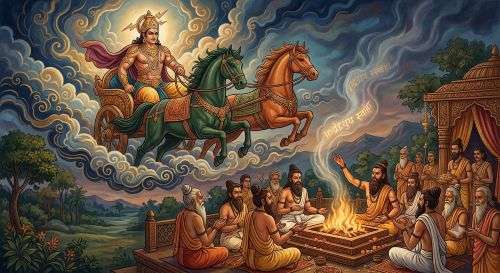
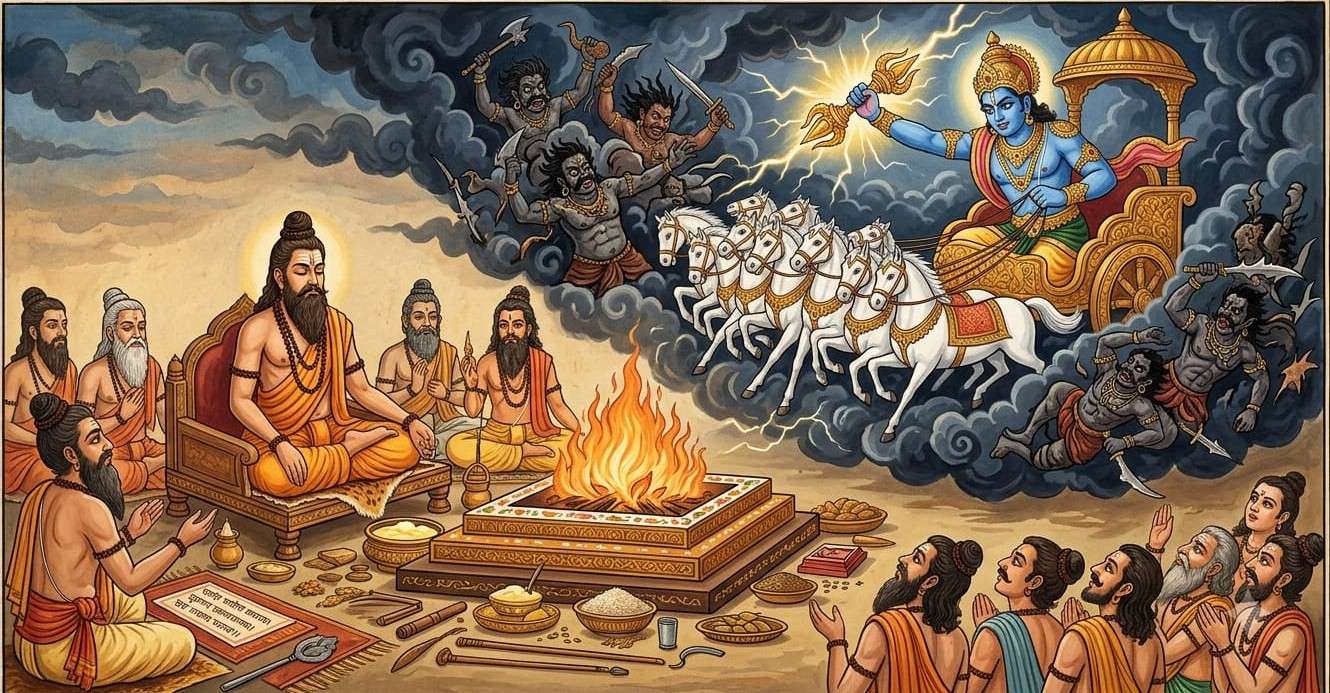
With folded hands and unwavering resolve, the sage invokes the winds: he declares his sincerity and courage, aligning his intent with the rhythm of nature. Just as clouds release rain for the fulfillment of sacrifice, he offers his hymns as an act of devotion. The Maruts, described as youthful, radiant, and invincible, are portrayed as the sons of Rudra—fearless, sinless, and resplendent like the sun. Their presence embodies both beauty and terror, for they are at once life-givers and formidable forces that command awe.
Their power is expressed through vivid imagery: adorned with shining ornaments, bearing weapons and quivers, riding chariots drawn by swift reddish steeds, they traverse the heavens with irresistible गति. Their voices resound like mountains trembling, their roars echo like lions, and their movements resemble mighty elephants crushing forests. These metaphors, while poetic, also reflect acute observation of natural forces—thunder, lightning, and storm winds—captured through a lens that unites imagination with empirical awareness.
The Maruts are depicted as controllers of clouds, harnessing them as one would tame powerful horses, releasing rains that are compared to nourishing milk. This imagery subtly conveys an early understanding of the water cycle: evaporation, condensation, and precipitation are perceived as coordinated acts of divine agency. Lightning and thunder are not random occurrences but expressions of an ordered energy that sustains and transforms the environment. Thus, the hymn reflects a scientific temperament embedded within spiritual symbolism.
In their collective strength, the Maruts are invincible. They move the immovable, shake the स्थिर, and remain themselves unshaken. Their omniscience signifies not merely divine awareness but an all-pervading natural law that governs the universe. They protect the devoted, reward the sincere, and destroy forces that oppose harmony. Their unity and mutual reliance symbolize the principle of cooperation, suggesting that strength arises not only from individual might but from collective alignment.
The sage further acknowledges their generosity and protective nature. Those who seek their grace are endowed with strength, nourishment, and prosperity. The winds, through their life-sustaining rains, enable agriculture, animal vitality, and human survival. This reflects an early ecological awareness, where human well-being is inseparably linked with the balance of natural forces. The Maruts thus become guardians of both physical sustenance and moral order.
In his concluding prayer, the sage seeks blessings not merely for himself but for future generations. He asks for a son who is righteous, strong, and unconquerable, and a grandson who is equally virtuous and long-lived. This aspiration reflects the Vedic emphasis on continuity, duty, and the transmission of values across generations. Strength, vitality, and prosperity are not ends in themselves but instruments for sustaining dharma and societal harmony.
Thus, the hymn of Sage Nodhas stands as a luminous synthesis of spirituality and observation. It reveals how the ancient mind perceived the universe—not as a collection of isolated phenomena, but as an interconnected whole where natural forces, moral principles, and human aspirations converge. In honoring the winds and the Maruts, the sage ultimately celebrates the dynamic equilibrium of existence, where every movement, from the smallest breeze to the mightiest storm, participates in the eternal order of the cosmos.