Upadhyayula Lakshman Rao
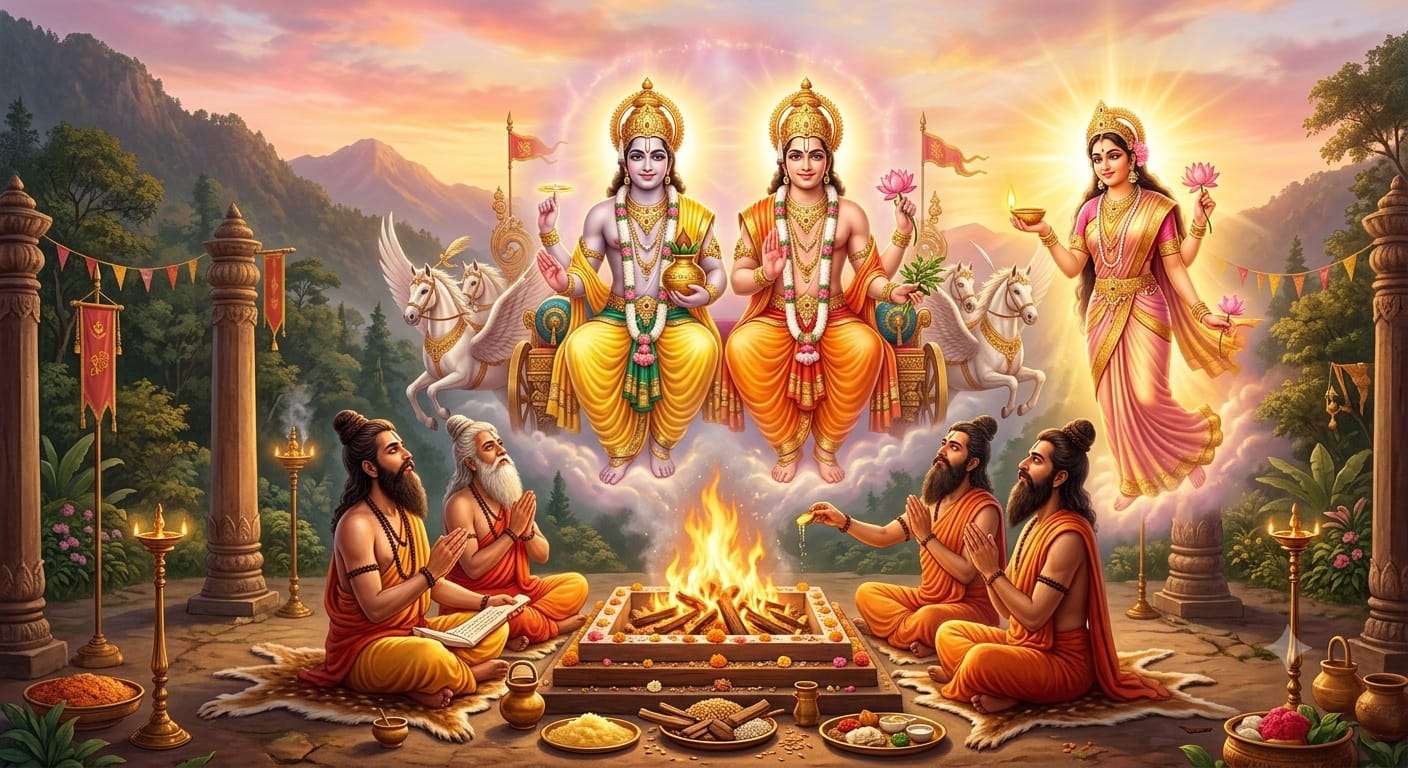
The sage Parāśara, immersed in the resonant cadence of Vedic chant, invokes Agni through the expansive rhythm of the Virāt chandas, wherein sound itself becomes a vehicle of revelation. His contemplative mind, sharpened by discipline and inward vision, penetrates the subtle workings of unseen forces that govern both the cosmos and the human condition. In this heightened awareness, thought stretches beyond ordinary bounds, attaining a vastness that perceives the interwoven unity of all existence. The hymn thus emerges not merely as praise, but as an exploration of the profound harmony that binds the elemental, the celestial, and the conscious.
With measured voice and ordered devotion, the sage celebrates Agni as the eternal recipient and transformer of oblations. Agni does not merely consume; he assimilates, refines, and elevates offerings into divine essence. In this sacred exchange, he becomes the luminous thread connecting mortals to celestial hosts, enshrining them in radiant continuity. His brilliance dispels the obscurity of night, illuminating the universe not only with physical light but with the clarity of awareness and purpose. Thus, Agni stands as both the visible flame and the invisible intelligence sustaining cosmic order.
Born from the friction of dry wood, Agni manifests through human effort, yet transcends it by embodying divine presence. The patron of the sacrifice, recognizing this mystery, approaches him with reverence, conducting rituals that align earthly intention with cosmic law. Through hymns of praise and offerings of devotion, worshippers are elevated, attaining a share in the celestial order by Agni’s grace. When invoked into the sacred enclosure, he becomes both guest and sovereign, receiving homage while sanctifying the very act of worship.
Those who faithfully sustain the ritual and offer oblations are blessed by Agni with prosperity and protection. He is the divine mediator who summons the gods and establishes their presence among men, while simultaneously sustaining human dependence upon higher principles. As the guardian of wealth and vitality, he dwells within beings as a latent seed of energy and consciousness. Those who recognize this inner presence abandon irrationality, cultivate discernment, and meditate upon him with their families, thus integrating spiritual awareness into the fabric of daily life.
The patron, guided by inherited wisdom, executes Agni’s ordinances with the obedience and trust of a son following a father’s command. In response, Agni stabilizes the sacrificial space, transforming it into a microcosm of the universe adorned with stars and divine forces. From this sacred center, the dawn is dispatched, unfolding the pathways for the sun’s rays to illuminate the world. Agni’s many-hued flames, self-luminous and ever-active, extend their influence across earth and sky, symbolizing the diffusion of energy and consciousness throughout all realms of action.
As the universal agent, Agni permeates every function, nurturing priests with the care of a father for his sons, while simultaneously acting as creator and executor of cosmic processes. Though supreme in power, he remains unassuming, embodying a quiet wisdom that enhances life’s sustenance, just as milk enriches food with taste and nourishment. In villages and homes, he is welcomed with humility, his presence cherished as essential and benevolent. The domestic fire, kindled with care, becomes a symbol of continuity, its birth likened to the arrival of a cherished child, and its service compared to the strength and reliability of a noble horse.
In every invocation, Agni is recognized as the embodiment of all deities, the organizing principle of sacrifice, and the bestower of comfort and order. He does not tolerate disruption; those who oppose the sacred order are driven away by his force, aided by the dynamic energies of the Maruts. Thus, the ritual proceeds unhindered, reflecting the triumph of harmony over chaos. His flames, radiant like the rising sun, absorb the offerings and project their brilliance into the vastness of space, uniting the terrestrial and the celestial.
Through such vision, the sages perceive the intricate interplay of cosmic events and translate them into living symbols that resonate with human intellect and spirit. Agni, in this grand synthesis, emerges as both a spiritual principle and a proto-scientific insight—an embodiment of energy, transformation, and continuity. The hymn, therefore, stands as a testament to a worldview where devotion and observation converge, revealing a universe that is at once sacred, dynamic, and profoundly interconnected.