



BJP’s historic victory in Bengal, political implications and the crisis for the opposition
The BJP swept the 2026 West Bengal Assembly elections, winning 165+ seats and ousting the TMC’s 15-year rule. Anti-incumbency, infiltration, corruption, and the CAA consolidated the Matua vote. Mamata Banerjee’s “invincible” image shattered, weakening the opposition. The National India Alliance suffered, and the BJP expanded in eastern India. The new government will focus on development and law and order, but curbing violence remains a challenge. This victory marks a shift in democracy.
The Bharatiya Janata Party (BJP)’s historic victory in the 2026 West Bengal Assembly elections not only ended the 15-year rule of Mamata Banerjee’s Trinamool Congress (TMC) but also forever changed the landscape of Indian politics. According to trends and final results, the BJP secured a clear majority by winning over 165 seats in the 294-seat assembly, while the TMC was reduced to around 100 seats. Traditional opposition parties like the Congress and CPI(M) were limited to 2-3 and 1-2 seats, respectively. This result is a stark contrast to the 2021 elections, when the TMC won a landslide majority with 213 seats. The BJP’s vote share increased from a mere 10% in 2016 to 39% in the 2024 Lok Sabha elections, and it has now become a force to reckon with.
Several multifaceted factors were at play behind this victory. First, the anti-incumbency wave was strongly evident. The Mamata Banerjee government faced serious allegations of corruption, bribery, infiltration, and political violence. The Special Intensive Revision (SIR) campaign removed 2.7 million allegedly fake names from voter lists, bringing the issue of Bangladeshi infiltration to the forefront. The Matua community—the largest vote bank of Bangladeshi Hindu refugees—fully supported the BJP after the implementation of the Citizenship Amendment Act (CAA). Furthermore, the deteriorating law and order situation, especially violence by TMC workers in rural areas, mobilized non-TMC voters. The record turnout of 92.88% in the first phase was a testament to this dissatisfaction.
Aggressive campaigning by Prime Minister Narendra Modi and Home Minister Amit Shah further fueled this wave. Modi championed BJP rule in “Ang-Bang-Kalinga” (Bengal, Bihar, Odisha), while Shah claimed a lead in 110 of the 152 seats. Uttar Pradesh Chief Minister Yogi Adityanath mobilized Hindu voters with Hindutva, development, and the image of “Bulldozer Baba.” The BJP countered opposition claims that the Women’s Reservation Bill was a failure of the central government, linking it to the TMC’s misgovernance. The high voter turnout brought out suppressed voters—especially women and youth—who were not swayed by the TMC’s “Khela Hoga” slogan.
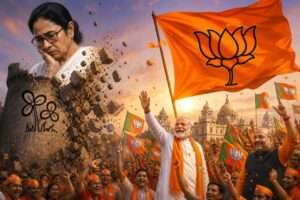
Mamata Banerjee’s image as “invincible Didi” was completely shattered with this defeat. The TMC, which has held power in Bengal since 2011, will now have to assume the role of opposition, an unfamiliar challenge for it. Fears of internal strife within the party have increased, as former TMC leaders like Suvendu Adhikari have proven successful in the BJP. Mamata termed the exit polls as “paid narrative by the BJP” and accused the central government of misusing government machinery, but the trends clearly pointed to losing the government. The TMC also questioned the Election Commission, but evidence of fairness—such as record voter turnout—undermined these claims. Reorganizing the TMC in the future will be difficult, as its grassroots organization has been tainted by corruption.
This victory has profound implications at the national level. Bengal provided a strong base for the Modi 2.0 government, which had a narrow majority, to form a full state government in the 2024 Lok Sabha elections. The BJP’s expansion in eastern India—now Bengal, along with Assam and Bihar—is a testament to the immense success of the Hindutva and development model. The INDIA alliance will be weakened as the TMC’s national stature will diminish. This will have a direct impact on the Uttar Pradesh 2027 and Bihar elections, where the BJP will be in a strong position. The Sangh Parivar’s organizational strength provided a tough fight to regional parties, which will influence future electoral strategies.
The opposition is now in a state of limbo. The insignificant role of the Congress and the Left Front continued into 2021, raising questions about the unity of the national opposition. Mamata Banerjee’s political career is now uncertain—will she become the leader of the opposition, or will a new generation emerge within the party? The opposition will have to adopt a new strategy: either a strong Congress-Left alliance, or a new regional front. Bengal has now become a stronghold of the BJP, further dimming the opposition’s voice on the national stage.
From a socio-economic perspective, the new BJP government will focus on development, law and order, and prevention of infiltration. The Matua community will benefit from the CAA, while Bengal’s faltering economy—which suffered under the TMC’s misrule—may receive a new direction. However, ending political violence and balancing the saffron wave with Bengali identity will be key challenges. Issues related to women, youth, and minorities—such as reservation, employment, and education—will remain on the new government’s agenda. A development model must be implemented while preserving Bengal’s cultural diversity.
The future prospects are interesting. The BJP must avoid internal strife, a long-standing weakness of its Bengal organization. The opposition needs regeneration—perhaps a new aggressive stance under Mamata Banerjee’s leadership or a revival of the Congress. This election proves that local issues define the national agenda. Bengal has proven that change is inevitable, and in a democracy, the will of the people is supreme. This victory is not only a strategic triumph for the BJP, but also marks the beginning of a new era in Indian politics.


