



The time has come for the nation to ask a blunt and unavoidable question: how long will Rahul Gandhi continue to enjoy unchecked liberty to make reckless, inflammatory, and deeply irresponsible statements against India’s constitutional institutions, elected leadership and national security apparatus? At a rally in Raebareli, Rahul Gandhi once again crossed every line of political decency by targeting Prime Minister Narendra Modi and Union Home Minister Amit Shah, claiming they would face the “wrath of the people” for allegedly trying to “sell the country.” Sell India to whom? On what evidence? Where are the facts? Or is wild accusation now the only remaining ideology of a defeated dynasty unable to digest political irrelevance? India deserves answers. Who truly weakened India’s sovereignty? Was it the present government, or was it the Congress era that witnessed the humiliating loss of Aksai Chin to China? Was it Modi who inserted Article 370 and 35A, creating a separate constitutional arrangement for Jammu & Kashmir, or was it the Congress leadership that institutionalised temporary provisions which later became permanent political tools for separatism? Who really assaulted the Constitution? Was it this government, or was it former Prime Minister Indira Gandhi, who imposed the Emergency in 1975, suspended civil liberties, jailed opposition leaders, censored the press, and turned democracy into a dictatorship? If Rahul Gandhi wishes to lecture the nation about constitutional morality, should he not first revisit the dark chapters authored by his own family? And what about Dr. B. R. Ambedkar? Congress leaders today invoke Ambedkar selectively for electoral convenience. Yet history records the political hostility he faced during the Nehru era. It was not the BJP that humiliated Ambedkar politically. It was the Congress establishment that systematically sidelined him. Who overturned the Supreme Court’s verdict in the Shah Bano case merely to appease conservative Muslim clerics? Was it not the Congress government under Rajiv Gandhi? Who pushed vote-bank politics to such dangerous extremes that national interest became secondary to appeasement?
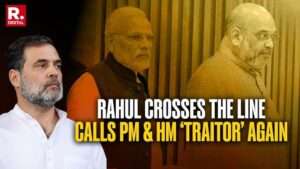
Rahul Gandhi speaks as though the nation has forgotten history. But India remembers. The Congress ecosystem also owes answers on repeated attempts to undermine India’s security narrative. Why do Congress leaders repeatedly question surgical strikes, military operations and national security actions in a manner that directly benefits hostile propaganda from Pakistan and sections of Western media? Why does every major national security achievement get met with suspicion, sarcasm or political sabotage from the same political ecosystem? Who exactly damages India’s global image? Is it Modi, under whose leadership India rose from the world’s 10th largest economy to the fourth largest in barely a decade? Is it Modi whose government expanded highways, digital infrastructure, airports, defence manufacturing, semiconductor investments, space technology, and welfare delivery at unprecedented speed? Or is it those who routinely travel abroad to portray Indian democracy as collapsing while seeking validation from foreign platforms hostile to India’s rise? Why are dozens of nations honouring Modi with their highest civilian awards if India is supposedly being “destroyed”? Why does India today command far greater strategic respect globally than it did during decades of Congress rule marked by indecision, corruption scandals, and policy paralysis? The concern is no longer merely political rhetoric. Rahul Gandhi’s repeated statements — overseas and within India — increasingly border on systematic delegitimisation of India’s institutions, armed forces, and democratic mandate. Freedom of speech cannot become a permanent shield for reckless provocation without accountability. Democracy certainly permits criticism. But democracy does not demand silence when misinformation, inflammatory allegations, and habitual irresponsibility are normalised by someone occupying the constitutional office of Leader of Opposition. The judiciary, too, cannot remain endlessly passive while public discourse degenerates into poisonous irresponsibility. If ordinary citizens can face legal scrutiny for inflammatory speech, should political dynasts enjoy perpetual exemption? India is not a private inheritance of one family. Nor can national interest be sacrificed at the altar of political frustration. Rahul Gandhi must either begin speaking with responsibility worthy of his office or face the legal and democratic consequences of repeatedly crossing constitutional limits. The country has moved ahead. The dynasty still appears trapped in entitlement, bitterness, and denial.



The editorial is on dot to call the bluff of the LoP. Rahul Gandhi needs to be disciplined on what he talks in public. Enough of insulting the country by insulting the Prime Minister in such derigatory language. Rightly said, time to act. The people of the country have done their role by rejecting his party that is on the verge of extinction