



The venerable Bhishmacharya stood encircled by the forces of the Pandavas, while many valiant warriors advanced to engage him with arrows keen and rapid as lightning. With shafts discharged in unceasing succession, he afflicted all who approached him, sparing none in his wrath save Sikhandi, whom he deliberately refrained from striking.
Bhimasena, observing the tumult of battle, was greatly disturbed when powerful chariot divisions hastened to the aid of Bhishma. In the fierce encounter that followed, the grandsire slew Bhima’s steeds and shattered his chariot. Inflamed with rage, Bhima hurled a mighty Shakti weapon; yet it was deftly cleft in midair by the commander-in-chief. Undeterred, Bhimasena seized his dreadful mace and rushed forward like a tempest toward Bhishma.
At that critical moment, Satyaki overtook Bhima and, with astonishing swiftness, discharged a sacred arrow that slew the charioteer of Bhishma. The deed was accomplished so swiftly that the commander-in-chief found no leisure to counter it. Deprived of their guide, the steeds, frantic and unrestrained, bore the chariot away from the field of combat. As they bounded wildly, shaking the earth beneath their hooves, the army scattered in confusion. Bhima, astonished at this sudden turn, felt his heroic advance abruptly checked. Yet the bold stride of Bhima and the withdrawal of Bhishma from the battlefield filled Satyaki with delight. Bhima then mounted the chariot of Drishtadyumna.
Satyaki, having thus contributed to the partial discomfiture of Bhishma, approached Drishtadyumna and Bhimasena upon the same chariot and spoke in admiration: “O Bhimasena, thou hast achieved a wondrous feat. Thou alone hast subdued the king of Kalinga, Srutayu, and hast slain his son, his brother, and his kin. Even the Kaurava host has applauded thy gallant and impetuous advance.”
Meanwhile, Salya, Kripa, and Aswathama united to oppose Drishtadyumna. With courteous words, he requested Bhimasena to observe his prowess and drove his chariot toward them. In the clash that ensued, he slew the steeds of Aswathama’s chariot. Instantly, Abhimanyu hastened to his support and showered arrows upon Salya and Aswathama, who in return struck him with twelve shafts.
Sanjaya then addressed Dhritarashtra, saying, “Thy grandson Lakshmana Kumara advanced boldly against Abhimanyu and troubled him with arrows.” Abhimanyu replied by discharging fifty shafts at him. Lakshmana Kumara held his bow firm and severed Abhimanyu’s weapon; yet the son of Arjuna swiftly seized another bow and rained arrows upon his foe. When Duryodhana perceived his son engaged in perilous combat, he drove his chariot toward the encounter. Bhishma and Drona also advanced swiftly to surround Abhimanyu. Though encompassed by many mighty warriors, the youthful hero fought steadfastly and without fear.
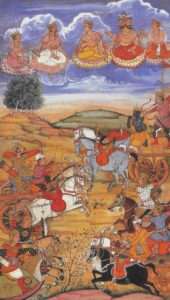
Arjuna, discerning that his son was encircled by the Kaurava host, hastened to his rescue. Sounding his conch Devadatta, he poured forth a storm of arrows upon Bhishma, Duryodhana, and the assembled warriors. His onslaught shook the field and shattered the Kaurava ranks, while celestial spectators applauded his precision and swiftness in battle. Dharmaraja inspired renewed ardor among his troops; they raised triumphant cries and pressed fiercely upon the foe.
The dust raised by countless hooves and wheels veiled the sky and obscured the sun, as though night had descended untimely. Soon the dust was laid low, mingled with the blood and flesh of fallen soldiers, elephants, and horses. The fiery torrent of Arjuna’s shafts rent bows, armor, spears, tridents, maces, axes, and many other weapons, which fell like mountains upon the lifeless forms beneath. Burnt banners, shattered standards, royal umbrellas, and white fans lay strewn in dreadful heaps across the field. Riderless horses ran wildly, and soldiers, seized with terror, fled in disarray, so that the scene resembled a flower garden laid waste by storm.
Krishna and Arjuna, blowing their conches Panchajanya and Devadatta, proclaimed victory and filled the Pandava ranks with exultation. Beholding the pitiable plight of the Kaurava forces, Bhishma spoke to Drona: “Under the guidance of Krishna as charioteer, Arjuna has routed our armies. None surpasses Krishna in mastery of the reins; by his direction Arjuna has cut down our warriors. Arjuna moves as though empowered by a divine captaincy, blazing like Lord Shiva when his third eye is opened. Our forces are no longer within our control. Restrain the fleeing men, for the hour is grave. The warriors are exhausted and disheartened, and the sun now declines toward the west. It is fitting that the combat cease for this day.”
Thereupon the commander-in-chief ordered the armies to withdraw. The forces of Matsya and Panchala roared in triumph, their cries reverberating through the heavens as they returned to their encampments. Thus, as Sanjaya faithfully reported to Dhritarashtra, ended the second day’s battle.

