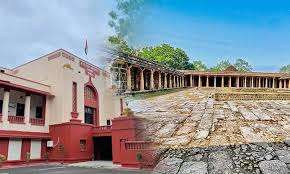
The verdict on the Bhojshala-Kamal Maula complex in Madhya Pradesh is not merely another property dispute settled by a court. It is yet another reminder that history, however inconvenient to political narratives, cannot be buried forever. When courts rely on archaeological surveys, historical records, inscriptions, and documentary evidence, the debate ceases to be about emotion and becomes one about civilizational truth. The May 15, 2026 judgment of the Madhya Pradesh High Court has done exactly that. The court, after examining the Archaeological Survey of India’s extensive scientific findings, declared that the disputed Bhojshala complex in Dhar was originally an 11th-century Saraswati temple and a major Sanskrit learning center established under Raja Bhoj. The court quashed the 2003 arrangement that had artificially divided worship rights between Hindus and Muslims, granted exclusive daily worship rights to Hindus, and even directed efforts for the return of the original Saraswati idol from the British Museum in London. Most importantly, the court also made a balanced observation: if the Muslim petitioners desired, they could approach the government for alternate land to build a mosque elsewhere in Dhar district. This is not majoritarianism. This is restitution based on evidence. For decades, sections of India’s political establishment tried to dismiss every such demand as “communal.” Yet the Ayodhya verdict and now the Bhojshala judgment demonstrate that courts are not operating on slogans but on records, archaeology, and historical continuity. The judiciary cannot be expected to ignore documented evidence merely to sustain post-independence political compromises designed for vote-bank calculations. The uncomfortable truth is that India’s civilizational wounds did not emerge out of imagination. Across centuries of invasions and imperial conquests, countless temples were destroyed, desecrated, or converted into structures meant to symbolize political domination. This is not propaganda; it is documented history recorded in inscriptions, Persian chronicles, colonial archives, and archaeological findings. Yet independent India, instead of addressing these historical grievances with honesty, chose selective silence. Successive governments from the Congress era onward built an ecosystem of appeasement where any discussion of Hindu civilizational destruction was branded “extremism,” while minority insecurities were politically amplified for electoral gains. From Jawaharlal Nehru’s era to later Congress governments, and even through regional parties such as the Samajwadi Party, RJD, TMC, DMK, TDP, and YSRCP, Muslim vote-bank politics became a convenient instrument of power.
This strategy may have delivered elections, but it also deepened social mistrust. The larger issue today is not whether Indian Muslims have the right to live with dignity and equality—they absolutely do, as guaranteed under the Constitution. The issue is whether sections among them, encouraged by political actors, are willing to acknowledge historical truths and coexist with the civilizational ethos of Bharat without perpetual confrontation over every correction of historical wrongs. Partition itself was the biggest civilizational compromise. India was divided explicitly on religious lines. Pakistan was created as an Islamic homeland. Yet India consciously remained a Hindu-majority civilization with a secular Constitution that protected all faiths. Hindus did not ask Indian Muslims to leave. They stayed back as equal citizens with equal rights. But coexistence cannot survive on denial. If courts, ASI surveys, inscriptions, and historical evidence repeatedly establish that certain disputed structures were originally temples, then a mature response would be reconciliation, not radical resistance. Unfortunately, sections of political Islam in India continue to react as though every historical correction is an existential attack. It is not. The Bhojshala verdict should therefore be viewed as a signal—not of triumphalism, but of reality. India’s judiciary has shown that evidence matters. Archaeology matters. Civilizational continuity matters. Historical truth matters. There are indeed thousands of ancient temples across India with disputed histories. No democratic nation can indefinitely suppress these questions merely to preserve artificial political harmony. The wiser path for all communities is restraint, dialogue, and acceptance of facts established through lawful constitutional processes. Indian Muslims must also recognize a changing political reality. The era when political parties could frighten Hindus into silence while mobilizing minorities as permanent vote banks is steadily eroding. The consolidation of Hindu political consciousness in states such as Assam and West Bengal reflects a larger national mood: the majority community no longer wishes to apologize for its own civilization. That sentiment should not be feared. It should be understood. India’s future cannot be built on endless historical denial. Nor can it be built on communal hostility. The only sustainable path is honest reconciliation rooted in truth, constitutionalism, and mutual respect. The Bhojshala judgment is ultimately not about revenge against the past. It is about acknowledging the past honestly so that the future does not remain trapped by it.