



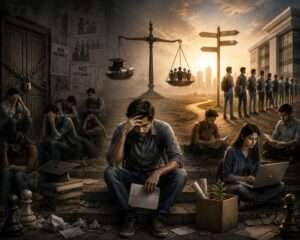
“In this race for marks, childhood became sad.
The cloak of hope weighed heavy on the shoulders.”
In a developing country like India, education has always been considered a means of respect and progress. Education not only provides knowledge but also provides understanding of life, social awareness, and direction for a better future. However, over time, the nature of education has changed, and today, the situation has become such that education is simply about scoring high marks and outdoing the competition. Children are evaluated not on their personality, behavior, creativity, or sensitivity, but on their marksheet percentage. As a result, childhood is groaning under the burden of pressure, stress, and expectations.
Today, every parent wants their child to top the class, score the highest marks, and achieve a prestigious position in society. This desire is natural, as every parent wants a bright future for their children. The problem begins when this desire becomes an expectation, and this expectation gradually turns into pressure. Little attention is paid to the child’s interests, abilities, and pursuits. The primary concern becomes marks and rank.
The current education system has made children’s lives highly competitive. In addition to schoolwork, coaching, tuition, online classes, and assignments have taken up most of their day. Earlier, children played in the fields in the evenings, climbed trees, and laughed and ran with friends, but today their childhood is confined between books and screens. The playground has been reduced to a mobile screen, and worry about results has replaced free-spirited laughter.
Every year, after exam results are announced, society’s behavior further impacts children’s mental health. Children who score high marks are often labeled “brilliant” by society, while those who score relatively low are often seen as inferior. This comparison creates a sense of inferiority in children. Many become overwhelmed with stress, depression, and fear. Sadly, some children even resort to suicide due to exam failure. This situation indicates a failure not only of the education system, but of society as a whole.
Today, the biggest impact on children is “comparison.” “Look how much Sharmaji’s son studies,” “He got 98 percent, why didn’t you?”—such statements deeply hurt children’s minds. Comparison never inspires; instead, it weakens self-confidence. Every child is unique in their abilities, thinking, and talents. Some may excel in music, some in sports, some in painting, and some in writing. But our education system and social thinking consider success to be limited to becoming a doctor, engineer, or administrative officer.
Another important question is whether simply scoring high marks guarantees success in life. Both history and the present bear witness to the extraordinary achievements of many great individuals despite mediocre educational attainments. Success comes not from mere bookish knowledge, but from courage, patience, creativity, sensitivity, and hard work. If education fails to transform a person into a good human being, it is incomplete.
Today’s children are technologically astute, but they are becoming increasingly isolated emotionally. With both parents working, the breakdown of joint families, and the rise of mobile phone culture, children are receiving less communication and emotional support. They are unable to openly share their problems. Consequently, the pressure of exams and the future breaks them from within. Instead of being a joyful environment, the educational environment is becoming one of fear.
The growing culture of coaching institutes has also exacerbated this problem. Big advertisements showcasing the faces of toppers create the impression in children and parents that success is only achieved through fierce competition and persistent study. Children are being trained like machines. Their creativity and independent thinking are gradually being eroded. Education is no longer a learning process, but rather a marks-making factory.
The most tragic situation is when children feel burdened by their parents’ dreams. They fear that if they get low marks, they will disappoint their family. This fear weakens them mentally. Sometimes, parents unwittingly make their children feel that their love depends on their marks. What children need most is unconditional acceptance and emotional security.
We must understand that the true purpose of education is not just to get a job. The goal of education should be to develop humanity, sensitivity, morality, and self-confidence. If a child learns to help others, respect their parents, become responsible towards society, and remain mentally healthy, that is true education.
Children should be allowed to pursue their interests. If a child enjoys music, they should be allowed to pursue it. If someone is interested in sports, acting, writing, art, or any other field, they should be respected. Every talent is important. Society must understand that the world isn’t just run by doctors and engineers, but also by artists, teachers, farmers, writers, scientists, musicians, and athletes.
Parents and teachers have a greater responsibility here. Instead of scolding and scaring children, it’s essential to understand and motivate them. If a child fails, they should be reassured that failure isn’t the end, but an opportunity to learn. Sometimes, life’s greatest successes are born from failures.
Schools should also move beyond exam-centric education and focus on personality development, creative activities, and moral education. Children should be encouraged to think and understand rather than simply memorize. Education should inspire curiosity and joy, not fear and stress.
The government and society must also be serious about children’s mental health. Schools should strengthen counseling systems. Parents also need to be periodically educated about the harmful effects of putting unnecessary pressure on children.
Today, we need to redefine education and success. We should see children not just as marks-making machines, but as sensitive and creative human beings. We should make them realize that their value is far greater than their marksheet.
If we truly want to raise the next generation to be happy, healthy, and confident, we must break away from the blind pursuit of grades. Let children play, dream, fail, and then get back up and move on. Because life isn’t just about test scores, it’s a beautiful amalgamation of experiences, struggles, emotions, and relationships.

