



Sanjaya said, “O monarch Dhritarashtra, listen with a mind unattached to hope or despair as I recount the events. Your son Duryodhana sent Durmukha, Kripacharya, Kritavarma, Shalya, and Vivimshati to stand in support of Bhishmacharya. They stood around him like five perpetual fires guarding the commander of the army, resembling the sacred agnis of ancient lore—Dakshina, Ahavaniya, Garhapatya, Sabhya, and Anasadhya—encouraging Bhishma with their skill and unwavering devotion, as he shone like the sun beneath a lofty banner.”
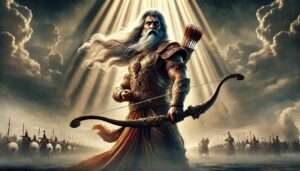
Bhishma, radiant with warrior grandeur and bursting vigor, fell upon the Pandava forces, shattering the strategic formations of the Kekaya kings and agitating the enemy ranks like a masterful player upon the field. Proficient in archery, he cut through herds and companies, breaking their unity. He moved swiftly in zigzag paths within the circles of battle, penetrating the enemy lines from every angle. He sliced armor and weapons alike, leaving his foes helpless and desperate.
The Pandava forces were deeply perturbed by Bhishma’s storm-like strikes and wave-like sweeps across their ranks. The battlefield grew terrible, strewn with fallen heads, bleeding bodies, severed limbs, broken banners, streams of blood, and mire formed of flesh and bone. Bhishma appeared like Lord Shiva dancing on the day of dissolution, manifesting both destructive and formative powers, resembling the forms described in ancient texts—Rudra, Bhairava, Tripura, Urdhava, Ananda, Sandhya, Kalika, Gauri, Samhara, Uma, and Tandava. His stride and ferocity reflected these forms, and Sanjaya reported this with a trembling voice at the smashing advance of the commander-in-chief of your armies.
Then Abhimanyu entered the dreadful field and dashed against Bhishma, shooting Shalya with five arrows as he guarded him. He sliced down the charioteer of Durmukha, smashed the bow of Vivimshati, pierced his body with three arrows, slashed the shield of Kripacharya, struck his horses, and slackened his movements. Abhimanyu attacked Bhishma himself, piercing him with nine arrows and roaring like a pouncing lion.
The celestial beings looked down in wonder at the chivalry and courage of Abhimanyu. Bhishma praised him as equal to Arjuna in swiftness and skill. The son of Ganga thought it best not to allow this warrior to devour his forces like fire, and he struck down Abhimanyu’s charioteer, smashed his banner, and unleashed a volley of arrows against him.
Meanwhile, the band of guards to the commander-in-chief—Shalya, Kritavarma, Durmukha, Vivimshati, and Kripa—together unleashed showers of arrows. The young warrior Abhimanyu stood like a mountain, fighting the elite of the Kaurava host. Restraining all strong opponents, he smashed Bhishma’s banner and struck the bold and valiant guarding force, offering them a fierce challenge. The commander-in-chief’s flag fell before this assault.
Seeing this turn of events, the Pandava forces shouted victory for Abhimanyu and surged forward. The fall of a chief’s banner is an insult to one side and applause to the other, as ordained by the codes of war. Bhima came to support of Abhimanyu and pushed back the enemy with his mighty mace and other methods. The son of Ganga grew angry at Bhima, struck down his banner with arrows, and unleashed many sanctified weapons against him.
Then Bhima shot Bhishma with three arrows, pierced Kripacharya with eight, and roared like an enraged lion. The son of Vayu struck Shalya, causing him to faint. The forces that rushed to support Shalya were shot, slashed, and pierced, their banners and chariots smashed, until the ground was submerged in blood and mud of flesh due to the ruthless and fierce fighting of the son of Vayu.
Then Satyaki, Dhrishtadyumna, the five Kekaya kings, King Virata, and his sons rushed in support of Bhima and Abhimanyu. They advanced like blazing fire, smashing everything in their path. The son of Ganga, Bhishma, with renewed power and zeal, unleashed volleys of arrows against his enemies and pierced their forms, causing blood to ooze forth.
The son of Virata, Uttara, attacked Shalya, shattered his elephant herds, leaped onto his chariot, crushed his horses and charioteer, and threw him to the ground. Shalya, angered at this once timid son of Virata who had now become a warrior capable of facing him, deployed a powerful weapon, the shakti, which lodged in Uttara’s chest and took his life. This weapon, skillfully fashioned by Shalya himself, had never failed in its purpose, and now it took the life of Virata’s son. After killing Uttara, Shalya drew his sword and slashed the trunk of his elephant.
The forces applauded, and this further roused him. He leapt like a hungry lion onto Kritavarma’s chariot. Uttara’s brother, Shankha, enraged at his brother’s fall, dashed against Shalya. The commander-in-chief Bhishma and his guarding warriors ran toward Shankha and surrounded him. Sanjaya described the scene thus: when the head of a herd is attacked, all the elephants rush to its peril; so too did all the elite Kauravas rush to the risk of Shalya.
Shankha’s chariot and supporting forces were shattered by Bhishma’s arrows, unable to withstand his aggression. Seeing this, Arjuna rushed to the spot and stood against Bhishma. The clash of titans and their respective forces broke out as though the universe itself were being torn apart. Terror, boldness, courage, dexterity, sanctified arrows, strength, power, and commitment on both sides resembled oceans crashing against one another and mountains colliding with speed and precision.
Shalya descended from Kritavarma’s chariot with a mace and went about smashing the horses, elephants, and chariots of Shankha. The son of Matsya, leaping from his chariot, wielded a sword, slashing soldiers along his path and sheltering behind Arjuna’s chariot. Bhishma unleashed another volley of arrows and shattered the Pandava forces, shining and reverberating with strength. He attacked Drupada and weakened him, moving with such swiftness and precision that none could resist. He strode like wildfire through a dry forest, destroying many enemy units.
The five Kekaya kings were perplexed by Bhishma’s arrow shots and remained stunned for a time. Bhishma slashed the forces of Virata like a wild tiger among a herd of goats. The Pandava forces were deeply disturbed by the dreadful death march of Bhishma, and they struck back in surprise at his ferocity. At that time, Bhishma shone like the sun, and as the sun set in the west, it seemed as though Bhishma had replaced him. At sunset, the lotus flowers closed, like the fear-stricken faces of the Pandava host, and darkness slowly spread.
According to the rules of war, the fighting ceased for the day. Sanjaya said, “O Dhritarashtra, foremost of the Bharata lineage, both armies halted and returned to their stations. Your son Duryodhana and his brothers were filled with joy at the valor and chivalry of Bhishma.” Dhritarashtra then asked Sanjaya what the Pandavas did after being so shaken by the first day’s battle, and Sanjaya’s report was yet to follow.

