



The Taj Mahal is a cultural heritage of India and one of the world’s most famous historical buildings. Built by the Mughal Emperor Shah Jahan in memory of his wife Mumtaz Mahal, this magnificent monument is considered a symbol of love, art, and architectural beauty. Built between 1632 and 1653, this marble mausoleum is now listed as one of the Seven Wonders of the World. However, controversies have periodically arisen regarding its origin and construction. Some claim it to be a Hindu temple or a palace, and others question its historicity based on the so-called “Tejo Mahalaya” theory. In recent years, the film “The Taj Story” has reignited this debate. Therefore, it is essential to understand this topic based on historical facts, archaeological evidence, and authenticated documents, rather than on emotions or rumors.
The Taj Mahal is located on the southern bank of the Yamuna River in Agra. Contemporary historian Abdul Hameed Lahori, in his famous work “Padshahnama,” detailed that after Mumtaz Mahal’s death, Shah Jahan commissioned the construction of this mausoleum in her memory. According to historians, approximately 20,000 artisans and craftsmen worked for 22 years to complete the building. Persian, Turkish, Indian, and Central Asian artisans played a role in the construction. The use of white marble from Makrana (Rajasthan) and precious stones from various regions makes its grandeur unparalleled.
The Taj Mahal’s architecture is considered a fine example of the Mughal style, showcasing a beautiful blend of Islamic arches, Persian domes, and Indian architectural elements. Its Charbagh-style garden, its surrounding minarets, its intricate marble carvings, and its artistic inscribing of Quranic verses make it a world-class heritage site. UNESCO declared it a World Heritage Site in 1983, calling it “the finest example of Mughal architecture.” The Archaeological Survey of India (ASI) also clearly considers it a Mughal-era mausoleum.
The modern controversy surrounding the Taj Mahal is believed to have begun in 1989 with Purushottam Nagesh Oak’s book, “Taj Mahal: The True Story.” Oak claimed that the Taj Mahal was actually a Shiva temple called “Tejo Mahalaya,” which Shah Jahan captured and converted into a mausoleum. He cited the Sanskrit etymology of the word “Taj,” certain architectural features, and enclosed chambers in his arguments. However, historians and archaeologists dismissed these claims as baseless.
Most importantly, no contemporary Hindu text, inscription, official document, or British-era survey mentions a temple named “Tejo Mahalaya.” If such a massive structure had existed as a temple in the past, references to it would surely be found in some historical record. Courts have also dismissed these claims from time to time. In petitions filed in 2000, 2005, and 2017, the courts stated that such claims were inconsistent with historical facts. The Supreme Court also rejected these claims due to the lack of concrete evidence.
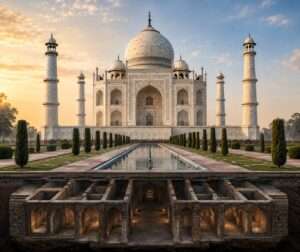
The so-called “22 Closed Rooms” of the Taj Mahal have long been a subject of curiosity and controversy. These rooms, located in the basement area of the Taj Mahal, have long been kept closed for security reasons. Some groups claim that Hindu idols, Shivalingas, or other religious relics are hidden in these rooms. However, the Archaeological Survey of India has clarified that these rooms are auxiliary chambers built for the structural strength of the building. They were kept closed to the public due to concerns about damage to the marble from high humidity, carbon dioxide, and tourist activity.
Several experts, including archaeologist K.K. Mohammed, have inspected these rooms. They say there’s nothing unusual inside, except for the typical walls, arches, and damaged plaster. Even the photographs released in 2022 showed no religious symbols or idols in these rooms. This makes it clear that most of the rumors about these rooms are based on imagination and sensationalism.
Recently, the film “The Taj Story” revived this controversy. The film attempts to portray the Taj Mahal as a Shiva temple and presents the mystery of the 22 locked rooms in a mysterious manner. However, historians believe this portrayal is driven more by imagination and political discourse than by historical facts. Art and cinema enjoy freedom of expression, but when presenting history, factual responsibility becomes equally important.
The Taj Mahal is not just a building, but a symbol of India’s shared cultural heritage. Its architecture reflects a remarkable blend of Indian and Persian artistic traditions. The use of Indian symbols such as the lotus indicates that Mughal architecture was influenced by local art and culture. Limiting it to a single religion or community would be a narrowing of the breadth of history.
Today, the Taj Mahal attracts millions of tourists every year and contributes significantly to India’s tourism economy. Challenges such as pollution, acid rain, the Yamuna’s declining water level, and environmental damage are already raising serious questions about its preservation. At this time, the need for conservation and promotion of this World Heritage Site is greater than baseless controversy.
Ultimately, the Taj Mahal is an immortal masterpiece of history, art, and human sensibility. History should be evaluated based on evidence and research, not rumors and political pressures. Rising above myths and controversies, we must view this monument as a symbol of India’s cultural unity and shared heritage. This approach is the hallmark of a society that is responsible for its history and aware of its future.

