Upadhyayula Lakshman Rao
In the sacred hymns of the Rigveda, the sage Praskanva, son of Kanva, raises a profound prayer to Agni through verses composed in the classical Anustup meter. His invocation is not merely devotional; it is an exposition of faith that connects the cosmic order with the fragile yet aspiring world of mortals. In his vision, Agni is not just the physical flame that burns upon the sacrificial altar, but the dynamic principle that sustains the rhythm of the universe. The sage approaches the divine fire gently and reverently, praising him from many dimensions—as the all-knowing witness of existence, the benefactor of health and happiness, and the luminous intelligence that permeates both nature and consciousness.
Praskanva recognizes Agni as the cause of rain and fertility, for the fire of sacrifice symbolically rises to the heavens and returns as life-giving water upon the earth. He remembers the primordial act of Manu, who first installed Agni in the sacred ritual of yajna, establishing the eternal bond between humans and the divine. In this sacred continuity, the sage prays that Agni brings forth the divine hosts—the Vasus, the Rudras, and the Adityas—along with all other gods who participate in the universal harmony. The offering patron performs the ritual with devotion, and Agni becomes the mediator who carries the oblations upward, transforming human effort into divine communion.
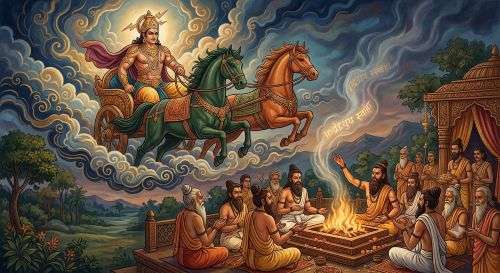
In the poetic imagination of the sage, Agni is envisioned with radiant red horses, symbols of energy and swift cosmic movement. He is the lover of praise sung in the ancient hymns of the Rigveda, for sacred speech itself is believed to nourish the divine flame. Through these praises, Praskanva prays that Agni may bring the extraordinary intelligence of the thirty-three gods into the sacrificial space. Agni’s activities, the sage declares, are immeasurable and unlimited; he knows everything, sees everything, and moves through all realms of existence. Just as he once heard and honoured the prayers of the venerable sages Medha, Atri, Virupa, and Angirasa, so may he graciously listen to the humble invocation of Praskanva, son of Kanva.
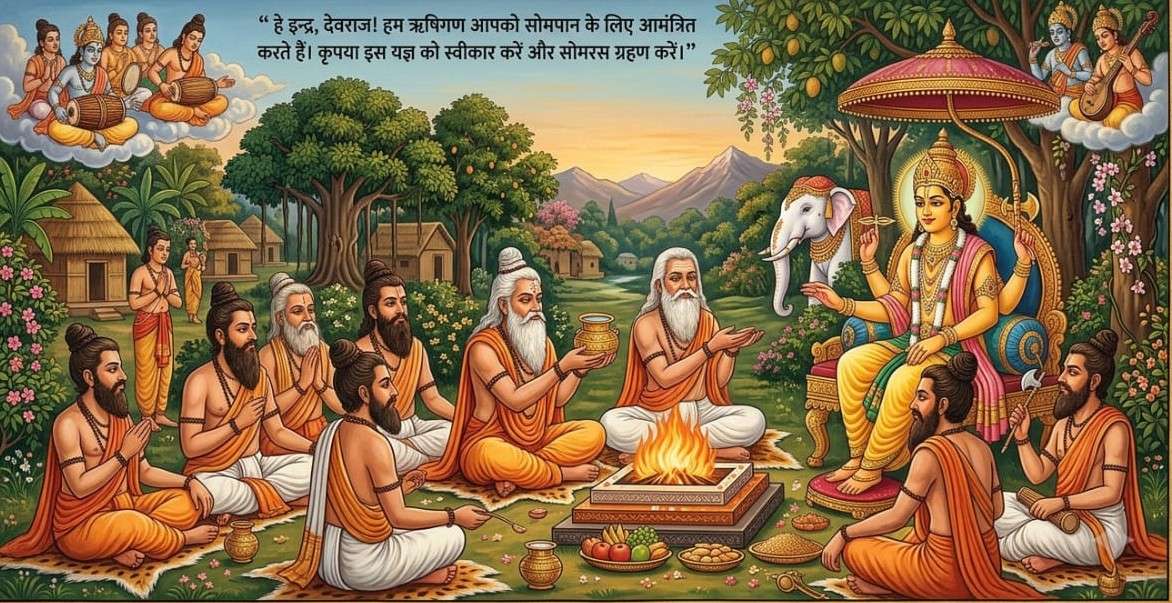
Around the sacrificial altar, the sages gather in disciplined devotion. They are performers of noble deeds, lovers of yajna, and seekers of cosmic harmony. In the centre of the sacred altar—the yajña-vedikā—the flame of Agni blazes brightly, symbolizing the axis between earth and heaven. Pure ghee is poured into the fire with reverence, each offering accompanied by mantra and intention. In this ritual science, Agni is regarded as the bestower of the fruits of sacrifice, for through him the subtle transformation of matter into energy becomes a sacred bridge between the human and the divine. The sons of Kanva praise and invite him with sincerity, asking him to honour their prayer and accept their offerings.
Agni is revered as the genuine nourisher of life, for fire is the source of warmth, cooking, and transformation. He carries the oblations to the gods and ensures that the ritual remains alive with divine presence. The patrons of the sacrifice call upon him with admiration for his shining hair-like flames and his radiant brilliance. In the Vedic vision, he is not merely a force of nature but also the priest of the gods—the Hota and the Ritvij—who presides over sacred order. As the bestower of wealth and prosperity, he listens attentively to the appeals of priests and patrons alike, welcoming every sincere invocation with receptive grace.
The intellectual sages of ancient times established Agni at the centre of sacrificial rituals, recognizing in him a symbol of illumination, vitality, and disciplined inquiry. His luminosity represents not only physical fire but also the light of knowledge that sustains stable and harmonious living. Thus, during the morning oblations of the yajna, Agni is invited to partake in the sacred drink of soma, the mystical elixir celebrated throughout the Rigveda. The fire itself is born through the churning of the Arani sticks—a process that reflects both ritual precision and empirical understanding of nature’s forces.
Standing humbly before the blazing altar, the priests offer a gentle prayer through Agni to the assembled gods: “O divine ones, the soma elixir is here. It was purified yesterday and is worshipped today. Accept it without hesitation.” In this moment, the ritual becomes more than a ceremonial act; it becomes a profound expression of humility and intellectual awakening. The Vedic sages demonstrate that the quest for divine connection is inseparable from disciplined observation of nature and the development of ritual science.
Thus, the hymn of Praskanva unfolds as a remarkable synthesis of spirituality and proto-scientific awareness. Fire, rain, energy, transformation, and cosmic order are woven into a single symbolic framework. The yajna becomes a laboratory of sacred knowledge where the human mind learns to cooperate with the forces of the universe. In honouring Agni, the sage reveals a deep insight: that the flame burning upon the altar is also the flame of consciousness within humanity. Through reverence, knowledge, and disciplined ritual, that inner fire connects the mortal world with the vast and harmonious cosmos.