Baneswar Shiva Temple is located in Baneswar village in the Cooch Behar district of West Bengal, around 10 kilometers from Cooch Behar town. The temple is considered one of the most important Shiva pilgrimage centers in North Bengal. Devotees from West Bengal, Assam, Bihar, and neighboring Bangladesh regularly visit the temple throughout the year.
The temple complex is especially famous for its sacred pond called Shiv Pukur, which houses rare black softshell turtles locally known as “Mohan.” These turtles are treated as sacred and are protected carefully by temple authorities and devotees.
Baneswar Shiva Temple is believed to be several centuries old and is regarded as one of the ancient Shiva temples of North Bengal. Historical traditions suggest that the temple existed before the Koch dynasty and later received royal patronage from the kings of Cooch Behar.
Many historians connect the temple with Maharaja Nara Narayan and Maharaja Pran Narayan of the Koch kingdom, who are believed to have renovated and expanded the temple structure. Though the present structure belongs mainly to the medieval and later periods, the worship traditions associated with Baneswar Mahadev are believed to be much older.
The presiding deity of the temple is Lord Shiva worshipped as Baneswar Mahadev. The Shiva Lingam inside the sanctum is considered highly sacred and is situated below the ground level, making the shrine unique among Shiva temples.
Devotees worship Baneswar Mahadev for protection, peace, prosperity, and fulfillment of wishes. Daily abhishekams and offerings of milk, water, flowers, and bilva leaves are performed with great devotion.
The temple reflects traditional Bengal temple architecture combined with Koch dynasty influences. The structure has curved cornices and a dome-like top commonly seen in old Bengal temples. The sanctum sanctorum lies below the main floor level, giving the temple a unique spiritual atmosphere.
The temple also has a large sacred pond beside it, which is an important part of the temple’s identity. The ancient structure reportedly developed a slight tilt after the great Assam earthquake of 1897.
The history of Baneswar Shiva Temple is closely connected with the royal and spiritual history of the Cooch Behar region. Over centuries, the temple became an important center of Shaiva worship under the patronage of local rulers and devotees.
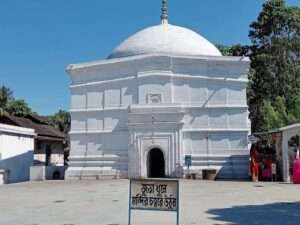
Different traditions attribute the temple’s construction or renovation to various Koch kings. The temple gradually gained fame as a sacred pilgrimage center because of its spiritual importance and miraculous legends associated with Baneswar Mahadev.
According to ancient legend, Banasura was a mighty ruler and an intense devotee of Lord Shiva. He performed severe penance for many years to obtain the blessings of the Lord. Pleased with his devotion, Lord Shiva appeared before him and granted him boons.
Banasura then requested Lord Shiva to permanently stay in his kingdom so that he could worship him every day. Lord Shiva agreed to accompany him in the form of a sacred Shiva Lingam, but imposed one strict condition — the Lingam should never be placed on the ground during the journey. If it touched the earth, it would remain fixed permanently at that spot.
Banasura accepted the condition and began carrying the Lingam with devotion. When he reached the present-day Baneswar region, he suddenly became unable to continue due to exhaustion and divine illusion created by Shiva’s maya. Left with no choice, he placed the Lingam on the ground for a moment.
The moment the Lingam touched the earth, it became permanently fixed there. Banasura tried repeatedly to lift it again, but failed despite all his strength. Lord Shiva then revealed his divine presence and declared that he wished to remain there for the welfare of devotees in future ages.
Since the deity became established through the devotion of Banasura, the place came to be known as “Baneswar,” meaning “Lord of Bana.”
Another local belief states that the Shiva Lingam here is Swayambhu, or self-manifested, and possesses immense spiritual power. Devotees believe sincere prayers offered at this temple are fulfilled quickly by Baneswar Mahadev.
The sacred turtles in Shiv Pukur are also closely associated with the temple’s spiritual traditions. Local devotees believe the turtles are protected by Lord Shiva and symbolize purity, longevity, and divine blessings. Feeding the turtles is considered auspicious, and harming them is strictly forbidden.
For centuries, devotees have believed that Baneswar Mahadev blesses worshippers with peace, protection, prosperity, and spiritual strength.
Maha Shivaratri is the most important festival celebrated with special poojas and a large fair.The Shravan month attracts thousands of Shiva devotees, especially on Mondays. Shiva Chaturdashi is observed with special rituals and devotional programs.
Regular Pradosham poojas and daily abhishekams are performed throughout the year.