The sudden warmth being projected between Donald Trump and Xi Jinping is neither a grand geopolitical reset nor a revival of trust between Washington and Beijing. It is far more tactical, temporary and transactional. The much-publicized visit of the US President to Beijing appears less like statesmanship and more like strategic damage control by an administration struggling to contain the fallout of multiple global confrontations. To portray this outreach as a genuine friendship revival would be politically naïve. For months, Trump’s second-term foreign policy has been marked by unpredictability. One day comes praise for rivals, the next day threats, tariff warnings or personal insults. Critics across the diplomatic spectrum — including several former diplomats — have repeatedly argued that this inconsistency has weakened America’s credibility. Diplomacy is built not merely on power, but on predictability. Nations negotiate seriously only when commitments are trusted. That trust deficit now shadows Washington’s global engagements. China understands this reality better than most. Beijing has not forgotten the tariff wars, semiconductor restrictions, aggressive rhetoric, and repeated attempts by Washington to economically isolate China. Nor has it ignored the language used against Chinese institutions and businesses over the years. Civilizations with long strategic memory do not suddenly change course because of one high-profile summit or ceremonial handshake. This is why the body language between Trump and Xi during official interactions mattered. The smiles appeared formal, not warm. The conversations were necessary, not transformational. Both leaders understand that they are engaging out of compulsion rather than confidence. At the heart of this diplomatic outreach lies the growing instability surrounding Iran and the wider energy crisis linked to the Strait of Hormuz. China remains one of Iran’s biggest energy partners and buyers of oil. Any prolonged disruption in West Asian shipping routes directly impacts Beijing’s energy security and manufacturing ecosystem. Simultaneously, the United States fears that an uncontrolled regional escalation could damage global markets, hurt American consumers, and deepen economic uncertainty back home. That is where Trump’s Beijing outreach acquires meaning.
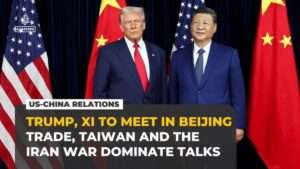
Washington appears to be seeking Chinese leverage over Tehran — not out of affection for China, but out of necessity. However, expecting Beijing to abandon Iran is unrealistic. Iran remains strategically important to China’s Belt and Road ambitions, energy access, and broader anti-Western geopolitical balancing. China may encourage restraint, but it is unlikely to “throw Iran under the bus” merely to accommodate Washington. Likewise, America cannot abandon Taiwan for the sake of any temporary understanding with Beijing. The Taiwan issue remains central to US strategic positioning in the Indo-Pacific. Any suggestion that Washington would sacrifice Taipei to secure Chinese cooperation on Iran is far-fetched. This is precisely why the so-called thaw between Washington and Beijing should be viewed cautiously. Both sides are trying to reduce immediate tensions without compromising their long-term strategic rivalries. The competition for technological dominance, economic supremacy, and military influence remains intact. In fact, Xi’s larger objective remains unchanged — to steadily challenge and eventually diminish American global primacy. China’s leadership thinks in decades, not election cycles. Beijing is focused on industrial growth, technological expansion, and building alternative power structures through forums like BRICS. That brings India into the broader picture. At a time when Washington and Beijing are cautiously engaging each other, New Delhi’s hosting of key BRICS-level engagements carries geopolitical significance. The presence of senior representatives from Russia and Iran alongside Indian leadership underlines the emergence of a more multipolar diplomatic order. External Affairs Minister S. Jaishankar has consistently argued that the world is no longer defined by a single power centre, and recent developments appear to support that assessment. China, too, increasingly realizes that stable relations with India and Russia offer more strategic reliability than dependence on the mood swings of Washington politics. Despite border tensions and unresolved distrust, Beijing understands India’s growing economic and geopolitical weight. Simultaneously, Moscow, Tehran, and Beijing all view BRICS as a platform to gradually dilute Western dominance in global institutions. Trump’s Beijing visit, therefore, is not a story of friendship. It is a story of compulsion. The United States wants crisis management. China wants a strategic advantage. Iran wants survival. Russia wants a multipolar order. And India is positioning itself carefully amid these shifting fault lines. In geopolitics, permanent friendships rarely exist. Permanent interests do.