



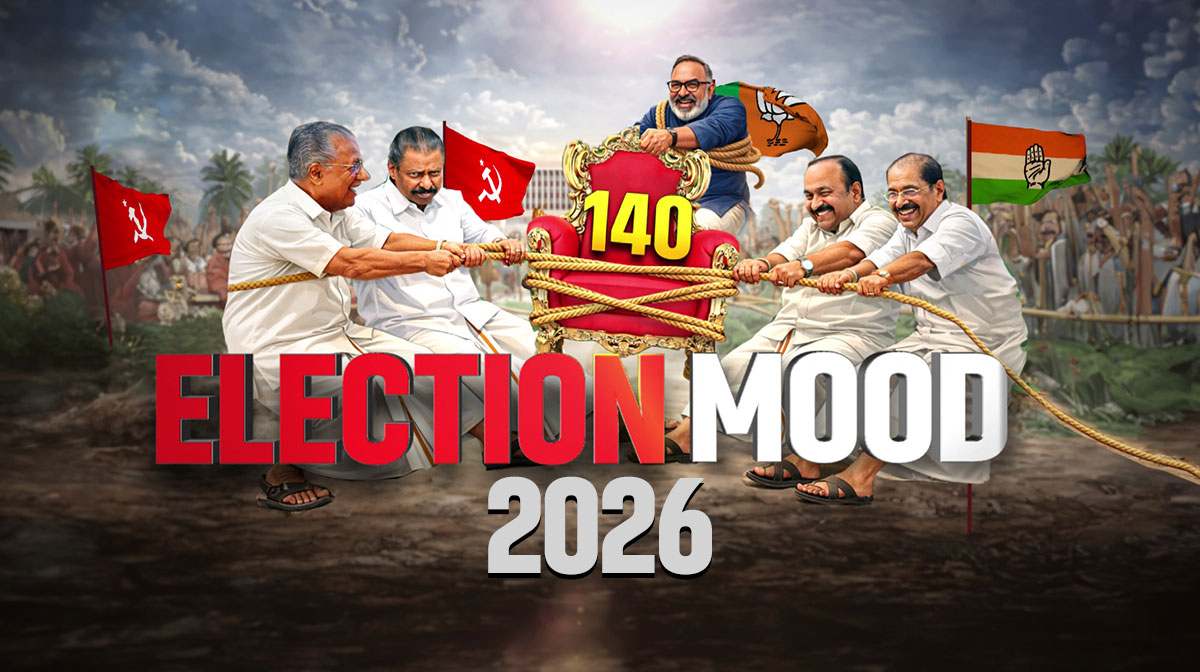
As Kerala heads toward its next Assembly election, expected in May with the Election Commission likely to announce the schedule by the end of this month, the state once again finds itself at the centre of national political calculations. For the Congress, struggling across much of India, Kerala remains perhaps the last major political lifeline. The stakes could hardly be higher — not just for the United Democratic Front (UDF), but for the future relevance of the grand old party itself.
The contest, as always in Kerala, is primarily between the ruling Left Democratic Front (LDF) led by the CPI(M) and the Congress-led UDF. The LDF created history in 2021 by returning to power with 99 seats in the 140-member Assembly — breaking Kerala’s decades-long tradition of alternating governments. Now Chief Minister Pinarayi Vijayan is attempting something even more unprecedented: a third consecutive term for the Left, something the state has never witnessed.
The Congress-led UDF, which was reduced to 41 seats in the last election, believes the political tide may be turning in its favour. Pollsters and early surveys suggest the opposition may have regained momentum. Some projections even indicate that the UDF could dramatically reverse the 2021 numbers and approach the 90–100 seat mark if anti-incumbency consolidates. Whether that prediction proves accurate will depend on how effectively Congress converts public dissatisfaction into votes.
Adding a new dimension to the traditional bipolar contest is the growing visibility of the BJP-led National Democratic Alliance (NDA). Historically marginal in Kerala’s electoral arithmetic, the BJP has nevertheless been steadily expanding its organisational footprint. Pollsters suggest that the NDA could finally open its account in the Assembly and possibly win half a dozen seats if favourable conditions emerge.
Much of this optimism stems from the BJP’s recent performance in Thiruvananthapuram’s civic elections, which many observers believe could serve as a barometer of broader political shifts. The capital city has long been considered a Left bastion. The BJP’s success there has encouraged its cadre to believe that the political landscape may be gradually changing.
However, even the most optimistic projections acknowledge that the BJP remains far from mounting a serious challenge for power in Kerala. The state’s complex social fabric — with significant Muslim and Christian populations and a politically aware electorate — has traditionally confined the contest to the LDF and UDF. For the BJP to make substantial gains, several political variables would have to align simultaneously.
One of the BJP’s strategic calculations revolves around possible vote fragmentation among minority communities between the LDF and UDF. If Muslim and Christian votes split, and if Hindu voters consolidate behind the NDA in response to issues such as the Sabarimala controversy or corruption scandals like the gold smuggling case, the party hopes it could make incremental gains. But even sympathetic analysts concede that such a scenario would require an extraordinary political shift.
A recent Vote Vibe survey offers a nuanced snapshot of voter sentiment. Around 44 percent of respondents say they are satisfied with welfare schemes implemented by the LDF government, including LIFE Mission housing projects, the Kerala Administrative Service (KAS) initiative, and Kudumbashree’s women-led self-help programmes. These schemes continue to provide the ruling coalition with a strong welfare narrative.
Yet satisfaction with welfare programmes does not necessarily translate into approval of governance. In fact, about 44.3 percent of voters rate the overall performance of the government negatively. Corruption allegations appear to have had some impact, with roughly 44.2 percent of respondents believing the charges are either true or somewhat credible.
Economic anxieties also loom large. Unemployment emerges as the single biggest concern for voters at 23.2 percent, followed by rising prices at 18.8 percent. These issues could become decisive if the opposition successfully frames the election around governance failures rather than welfare delivery.
Community voting patterns continue to play a crucial role in Kerala’s politics. Scheduled Caste voters remain a strong support base for the LDF, largely due to welfare benefits. However, unemployment concerns are particularly high among SC voters, with 38 percent identifying it as their top issue.
Muslim voters appear to strongly favour the UDF, with opposition leader V.D. Satheesan enjoying significant support within the community. Christian voters also lean towards the UDF, reflecting long-standing political alignments in central Kerala. Meanwhile, the OBC electorate — which accounts for roughly one-third of the state’s voters — remains politically divided and could emerge as the decisive swing bloc.
Leadership preferences reflect a competitive political environment. Satheesan currently leads in chief ministerial preference with about 25 percent support, slightly ahead of Vijayan’s 21.5 percent. However, when broader leadership figures from each alliance are considered collectively, the difference narrows significantly, indicating that the ruling front remains internally cohesive.
Former health minister K.K. Shailaja continues to enjoy strong popularity, particularly among women and younger voters, highlighting the LDF’s ability to retain influential secondary leadership.
Interestingly, voters appear largely unconvinced by the routine political accusations exchanged between alliances. Claims that the Indian Union Muslim League would dominate a UDF government, or that the CPI(M) and BJP share a tacit understanding, receive nearly equal levels of agreement and disagreement. Many voters seem to dismiss such allegations as standard campaign rhetoric.
What may ultimately determine the outcome is voter turnout and the behaviour of undecided voters. Surveys suggest that more than 30 percent of respondents remain neutral or undecided on several key questions. This floating electorate could prove decisive.
If younger voters aged 25–44 — who are particularly concerned about corruption and rising prices — turn out in large numbers, the opposition could benefit. Conversely, higher participation among women and welfare beneficiaries may strengthen the LDF’s prospects.
For the Congress, therefore, Kerala represents far more than just another state election. With the party’s national footprint shrinking and organisational struggles visible across many states, a victory here could restore some political credibility and momentum.
For now, Kerala remains the Congress party’s last major bastion of hope — but in a state known for its politically sophisticated electorate, nothing can be taken for granted.



Very well explained. Tacit understanding between BJP and Congress cannot be ruled out to keep Communists at bay is also very much in air. While BJP may improve, giving away a state or two to Congress cannot be ruled out under the premise that only national parties shall rule the roost, leaving all the regional parties in lurch. The new political system facilitates hugging of bitterest enemies to keep a common enemy away.