



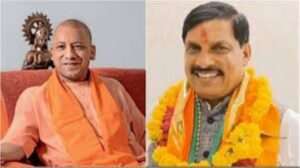
There is a reason why some leaders inspire confidence during uncertain times while others merely issue statements and vanish behind press conferences. Leadership is not tested in times of abundance. It is tested when global uncertainty threatens domestic stability. And in that context, the swift response of Uttar Pradesh Chief Minister Yogi Adityanath and Madhya Pradesh Chief Minister Mohan Yadav deserves appreciation.
Both chief ministers acted with speed and seriousness after Prime Minister Narendra Modi appealed to citizens to rationalise fuel consumption and avoid unnecessary spending on gold amid growing global economic uncertainty triggered by the continuing tensions in West Asia. Instead of treating the appeal as mere rhetoric, the two BJP-ruled states reportedly moved towards austerity measures within government departments, instructing ministries to cut avoidable expenditure and adopt disciplined consumption patterns.
That is how governance is supposed to work.
Contrast this with the predictable political circus from sections of the Opposition. The moment Modi speaks of sacrifice or restraint, the usual brigade emerges — mocking, sneering, and manufacturing outrage. Ironically, many of these critics have neither controlled inflation in their own states nor demonstrated any fiscal discipline in governance. For them, opposition to Modi is not political strategy anymore; it has become psychological compulsion.
Yet history exposes this hypocrisy.
During the 1971 war and subsequent economic stress, former Prime Minister Indira Gandhi appealed to citizens to reduce gold consumption and cooperate with national priorities. At that time, responsible political parties understood the gravity of the situation. They did not rush to television studios to score cheap points. National interest came before partisan warfare.
Today’s Opposition, unfortunately, seems incapable of such maturity.
The global situation is indeed serious. The continuing instability in West Asia directly impacts crude oil prices, shipping routes, insurance costs, and energy security. India imports nearly 85 percent of its crude oil requirements. Every spike of even one dollar per barrel affects India’s import bill significantly. Petroleum products remain deeply linked to inflation, transport costs, agriculture, and manufacturing. According to government estimates, India consumes over 5 million barrels of oil daily. Any disruption in supply chains can rapidly escalate economic pressure.
Against such a backdrop, Modi’s appeal was not alarmism. It was preventive statesmanship.
Fortunately, India today is far better prepared than it was a decade ago. Strategic petroleum reserves have improved. Diversification of suppliers has reduced excessive dependence on one region. Digital monitoring of supply chains has become stronger. The Modi government has repeatedly asserted that India possesses adequate fuel stocks to avoid panic situations.
But preparedness does not mean recklessness.
This is precisely why the austerity steps initiated by Yogi Adityanath and Mohan Yadav matter. Governments cannot preach restraint while indulging in extravagance themselves. Official convoys, lavish events, wasteful electricity usage, and unnecessary travel by departments must all come under scrutiny. If states begin leading by example, citizens are more likely to cooperate voluntarily.
In fact, India has already witnessed this phenomenon during the COVID-19 pandemic. When Modi called upon citizens to light lamps, clap for frontline workers, or participate in vaccination drives, crores responded. India administered over 220 crore vaccine doses — one of the world’s largest vaccination campaigns. Despite misinformation spread by several political leaders and conspiracy theorists, people ultimately trusted institutional guidance over political theatrics.
That public trust remains Modi’s biggest political capital.
However, this newspaper maintains a consistent position. Austerity cannot become a slogan meant only for ordinary citizens. It must begin from the top. If BJP chief ministers can move swiftly to implement spending discipline, then the Union government too must institutionalise visible austerity measures across ministries. Symbolism matters in democracy. Citizens sacrifice more willingly when leaders visibly share the burden.
The larger message here is simple. Responsible governance is not about distributing freebies endlessly while bankrupting future generations. It is about preparing society for difficult times with honesty and discipline. Even a modest reduction of 20 to 30 percent in avoidable fuel consumption across sectors could significantly ease pressure on India’s import bill and fiscal management.
India cannot control wars in West Asia. It cannot control global oil cartels or geopolitical adventurism. But it can control domestic discipline, administrative efficiency, and responsible consumption.
And for once, at least two chief ministers understood the assignment perfectly.


Purposeful Article.
PM Modi Ji’s clarion call to the citizens is very much similar to the advice. guidance given by elders to the other members in any family. This advice comes out of concern and affection the elders have towards their family members. They carry a lot of wisdom and experience and everyone in the family feel so very blessed.
Anticipating an economic turbulence and cautioning the citizens to be on an alert and to act more vigilantly is what Modi ji is advocating taking into account the global political scenario.