


The New York Times headlines screamed, Modi’s Hindu Nationalists Conquer a Bastion of India’s opposition after the historic win of Bharatiya Janata Party (BJP) in West Bengal last week, ending 15 years of political violence, tyranny, and fear under TMC (Trinamool Congress) rule. The western media like The New York Times, The Washington Post, The Guardian, BBC and the Qatari Al Jazeera often brand BJP with labels like “right wing” or “Hindu Nationalist” to project the party as anti-Muslims, anti-poor, pro-capitalist and conservative. This narrative is then lapped up by our copycat liberal Indian media to promote an international agenda against India. In reality, the BJP is just the opposite of this propaganda.
The Left-Right ideology: The left-right ideology is a concept that is alien to India. It originated during the French Revolution in 1789 and refers to a seating arrangement in the National Assembly gathered in Versailles, a suburb of Paris, to draft a constitution. Revolutionaries who were against the Monarchy wanted radical changes to limit its power, sat on the presiding officer’s left, and those in support of the King sat on the right. Since then, the right wing is seen as a supporter of nationalism, while the left wing opposes it. In short, “Left wing = system of change and Right wing = system of order”.
Since the leftists were identified with change, they are considered as torch bearers of social change and equality through a strong government role. The attributes of the left are communism, socialism, and liberalism. On the other side, rightists are identified with order but prioritize limited government intervention, economic freedom, and tradition. The other attributes are nationalism, conservatism, and capitalism.
Let me explain the left-right ideology using a line numbered from (0) at the centre to (-10) on the left and (+10) on the right. The end of the left (-10) is identified as Anarchy, with communism and Maoism at (-9), and the extreme right end (+10) as fascism. Other attributes of the left are socialism at (-8) and liberalism at (-7), and right attributes of nationalism at (+8), conservatism at (+7), and capitalism at (+6). Historically, the regimes that were identified with extreme left or the extreme right ends have produced dictators identified as anarchists, communists, Maoists, and fascists. These dictators were responsible for the deaths of millions of people during the 20th century. The deaths were due to a combination of systematic mass murder, forced labour, ethnic cleansing, and man-made famines. The most famous examples are Stalin and Mao on the extreme left and Hitler and Mussolini on the extreme right. The list is unending.
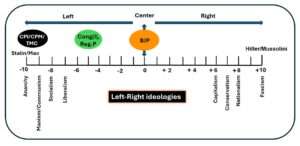
The 21st-century world is a global village where the leftist ideology of anarchists, communists, and Maoists has failed globally. Suppression of masses through authoritarian rule is not acceptable anymore; wherever it exists today, in some stray pockets in Cuba, Laos, and North Korea, people are poverty-stricken and are suffering. Russia and China, though communist and Maoist regimes, have realised the failure of their ideology and are slowly moving from extreme left (-10) towards the centre, practising tenets of left liberalism and right capitalism to survive in the interdependent world today.
Indian context: Fortunately, in India, we did not see extreme leftist or rightist political leadership after independence, though the Congress that ruled the country for most of the time was more inclined towards left socialism and liberalism, which was responsible for the slow growth of our country. India has maintained a democratic structure since 1947, except for a brief period of authoritarian rule of Indira Gandhi who declared an emergency, suspending fundamental rights of the citizens, and threw hundreds of political leaders behind bars in 1975. Other regional parties, including the Aam Aadmi Party, whose leader Arvind Kejriwal declared himself an anarchist, pursued leftist ideology.
The 15-year traumatic TMC rule in West Bengal that ended on 7 December 2026, is the only exception in independent India that resembled the Stalin and Mao regimes on the extreme left (-10) on the number line. This period was characterised by sharp polarisation with anti-Hindu sentiment and a systematic development of a vote bank of Bangladeshi Muslim infiltrators (ghuspatias) into Bengal, cut money (bribes) and tolabaazi (extortion) culture, rape of Hindu women, and silencing of opponents’ voices with violence. This period overshadowed the atrocities of the earlier rule of the communist (CPM/CPI) parties in West Bengal and the Emergency period of 1975-77 in India.
On the right side of the line is the BJP, which is a nationalist party because of its declared “Nation First” policy. By prefixing it with “Hindu”, a narrative is built by the international media to defame it as a communal and anti-Muslim party. This is purely agenda-driven, where prefixes like “Hindu fundamentalist”, “Rightist Hindu”, and “Conservative Hindu” party are often used interchangeably for the BJP.
But what is the reality? BJP does not adhere to a state-heavy socialist model of communism but practices “pragmatic socialism” and a “welfare-oriented capitalist” approach to help the poor. It does not believe in adopting a pure free-market approach but rather emphasizes market-friendly policies, reduced regulations, and increased Foreign Direct Investment (FDI) for the country’s growth. Some of the programmes that impacted a wide spectrum of Indian society, irrespective of caste or religion, are “JAM trinity (Jan-Dhan, Aadhaar and Mobile connectivity), rural housing, LPG connections, sanitation (Swachh Bharat), education (Samagra Shiksha), and healthcare (Ayushman Bharat).
Left Liberalism: Being a liberal myself, I believe that extreme liberalism is counterproductive and can lead to degradation in society. In rightist ideology, there are endpoints for liberalism, a point at which goals are achieved, and the next goal is only to preserve the status quo. Whereas, in Leftist ideology, there are no endpoints for liberalism, and there is always a scope to go further.
Let me explain this with an example of the most debated LGBT (Lesbian, Gay, Bisexual, and Transgender) issue. Rightists identify marriage with its millennia-old definition of being between a man and a woman to raise a family and live harmoniously in a society. But leftists find no fault with same-sex marriage in society in the name of liberalism and label rightists as conservative on this issue. Then they go further and seek to eliminate sex from the definition of gender. Still not satisfied, they encourage youth to explore gender identities other than those with which they were born. Continuing with liberal ideas, they want to treat minors with hormones from the opposite sex and further go ahead with “gender-changing” surgeries on minors. I am not sure where it will end.
The problem with leftist ideology, which is fashionable these days among the rich strata of society is to push liberalism to the point of ridiculousness. I think this is the greatest deficit in leftist thinking as there is no endgame. There is simply a desire for more change once a goal is achieved.
BJP’s win in West Bengal, defeating the communist ideology, shows the acceptance of the Centrist approach being pursued by the party. This centrist approach is typical of a liberal Hindu philosophy where ancient scriptures show high levels of tolerance and acceptance of everyone in the society. Both theists and atheists are parts of Hinduism, so the narrative of Hindus being anti any other religion falls flat. Even in the case of LGBT, Hindu tradition and texts promote inclusivity rather than condemnation as in other religions. The best example could be the respect for Shikhandi, a pivotal figure whose unique identity (born female, became male) was recognized, accepted, and crucial to the unfolding of dharma as discussed in the Mahabharata.
To conclude, I would say, kudos to the team BJP under Prime Minister Narendra Modi for ending the traumatic TMC rule. Keep working as Lord Krishna told Arjuna to perform his duty (war) without thinking of the consequences, Chapter 2, verse 47 in the Bhagwat Gita, कर्मण्येवाधिकारस्ते मा फलेषु कदाचन।मा कर्मफलहेतुर्भूर्मा ते सङ्गोऽस्त्वकर्मणि॥ (Karmanye vadhikaraste ma phaleshu kadachana / Ma karma-phala-hetur bhur ma te sangostvakarmani//).


Chadda Saab, as usual ur articles are most informative & educative. A well researched article, u have brought out the nuances of Left – Right lucidly. My congratulations to you. Warm Regards NN Rao
Dr. Chadha as claimed by himself that he is a liberal himself is true during his service as a scientist in NGRI. In this article he has brought out the difference in left n right through a simple diagram.
we hope BJP retains power n expands it to other non bjp states through its liberal policy. There is a proverb in hindi while a giant elephant walks in a street a thousand darks bark at it.
As usual the western and american media never appreciate India adopting an independent foreign policy and will neveraccept that India is not toeing the line of so called super powers/the called democratic developed nations. Every country is well within its right to develop programmes that facilitate faster development of its own country. The same wester world/western media had not expressed even lip sympathy to Pahalgam victims. They have not even criticized the nation that had sponsored this barbaric act. No hesitation to accept such a country as a mediator to negotiate the deal between America, israel and Iran. May be big brother had forgotten the role played by this country, in sheltering Osama-bin-Laden or the support extended to Afgan. talibans during american-afgan conflict. When many terrorist acts r taking place, no nation however peace loving it may be, will not keep quiet. Why other countries shoudl have problem about ruling dispensation in India. Nations should undersatand democracy is not giving cermons to other nations. Pl. put into practice before what u preach.
Kudos to Dr Chadha for a beautiful elaborative knowledgeable weekend editorial on the current affairs, listing historical political facts and events in India and abroad and distinction between leftists and rightists. A great article.
Some of the western media is owned/controlled by big bussiness houses and they may not wish to see/report success stories of a ‘developing country’ in the right perspective. They could be envious of our progress!
I feel we should have democracy like that is in Singapore.
As long as our leaders/govt keep ‘Nation First’ policy, our progress is a surity.
An excellent contribution insofaras the end of Mamta regime. I saw myself what was happening on my way to IITK. But it should have happened much before. That was the Governance failure.
0-10 is a good attempt in the quantitative mapping of isms. However, one may not agree to the way it has been coneptialized.
Nice. A well-documented and self-explanatory article that grades the ideologies towards left and right. The News papers and agencies you listed in your article are also labeled as leftist /Socialist/Communist leaning agencies in US. These agencies hate Modi and BJP and compare them with Trump. Day by day all of them are losing their viewership /readers and many of them are running in losses as the latest ideological war shapes how the news is covered. Over the past few months in US Tech Titans are taking over these ideologue news organizations and trying to balance the 95 % left leaning news agencies to be more realistic. India was able to implement SIR and clean voters list but, US laws are different and Trump with his highhanded approach could not get work done and of course, the legal course will take centuries to act. It is the same problem with illegal migration. Votes and power. While trying to clean up such large problem there always will be some incidents that will result in damage to lawful citizen and are highlighted by press. This is the simple truth and and it is same everywhere and people thought process temporarily influenced by the news they read often which will change very quickly when they experience similar situations.
congratulations to Dr. Chadha for bringing out the position and thought process of different ideologies and putting it to a pragmatic application. when the development is meant for all and inclusive I don’t mind whatever name you call it.