



The trembling man of indecision in Arjuna had now developed an incomparable equipoise. This inward peace arose from intelligent surrender to Krishna, who was delighted by what he had heard from the Lord. Krishna then addressed Arjuna as mighty-armed, reminding the Pandava prince that he must be a hero in his inner life, carving out of his present a kingdom of divine joy, which is the true heritage of man. The Lord’s encouragement was a call to rediscover within oneself the greater possibilities of being. Arjuna was urged to listen to the supreme word, which Krishna, wishing his welfare, was now to declare. When the Infinite is seemingly identified with total or cosmic intellect, it develops thereby an ego-centric personality of its own and projects itself, for its own joy and transactions, as a world of sense objects. Together these are symbolized as the seven sages, personified in ancient texts under different names, representing the intellectual and mental life of man, the efficient and material causes for all creation. Gods do not literally mean a host in heaven; they signify the sense organs that illuminate the world of objects for us and enable our innumerable experiences. It is therefore pure consciousness that is the source of all gods and great sages, and this conscious principle is the substratum of both physical and mental-intellectual life in each one of us. Though they sustain all, they cannot know its origin.
Consciousness, being the very subjective truth in us, can never become an object of perception for the senses, an object of feeling for the mind, or an object of knowing for the intellect. He who knows this not merely through emotional sweep or intellectual comprehension, but through true and full spiritual apprehension, attains such knowledge during moments of intimate identification with the Self. The Self is to be realized as unborn, without beginning, the great Lord of all worlds. Being eternal, it is birthless; everything else is born in it, exists in it, and returns to it. Waves are born in the ocean, but the ocean itself is birthless. Every wave, every manifestation, has a beginning, a duration, and an end, but the essence cannot have a beginning. The entire universe is the total of the world of experience of each individual, and the ruler that governs the universe is the absolute Self. Arjuna confessed that he had already been taught of the Infinite and the Eternal by gods and sages, and yet, looking at Krishna as his contemporary, he found himself repeating the Vedic proclamation.
Arjuna was seeing Krishna with physical eyes, while Krishna was declaring himself as the pure Self. Preoccupied as he was, Arjuna could not comprehend Krishna the Spirit, for his mind was filled with Krishna the friend and kinsman, Krishna the beloved, Krishna the dependable man of intellect and diplomacy. Hence, the Pandava prince stood confused. Yet Arjuna exposed himself fully and expressed his unfaltering faith in his teacher, declaring, “I regard all that you say to me as truth.” Kesava, the remover of the sorrows of those who surrender to him, had satisfied Arjuna’s heart, which overflowed with faith and belief, yet his intellect remained starved and thirsty. Naturally, Arjuna asked Krishna to reveal his cosmic glory, by which he fills all worlds, and his cosmic stature. He inquired in what forms the Lord was to be thought of, even while living life and meeting its problems, for if one is to remember constantly the divine presence everywhere, one must know precisely where to see it among individual objects, among the combinations of things, and among the communities of beings.
Krishna replied, “I am the Self that exists in every being. Among the Adityas, I am Vishnu, among the luminaries, I am the sun, among the winds I am Marichi; among the asterisms, I am the moon. Of all the Vedas, I am the Sama Veda, of the Devas I am Vasava, of the sense organs I am the mind. Of all things created in the world, the most magnificent and wondrous is the mysterious power called intelligence, which has not yet been fully brought within the understanding of science, beyond certain vague and unreliable theories.” Continuing his declaration of truth, Krishna said, “Among the Rudras I am Sankara, among the Yakshas and Rakshasas I am Kubera, the treasurer of wealth, among the Vasus I am Pavaka, and of all the seasons I am autumn. Of all peaks, I am Meru. Of household priests, I am Brihaspati, of waters, I am the ocean, of the great rishis, I am Bhrigu, the chief of the seven rishis. Of words, I am the syllable Om, for words are symbols of sound that express one’s thoughts. Of sacrifices, I am japa, the universal spiritual exercise. Of things, I am the motionless.”
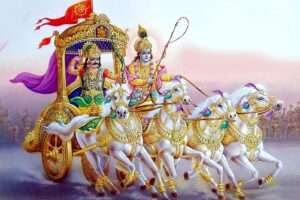
“I am the Himalayas,” the Lord declared. The motionless is often conceived as inert and insentient, as mud and rocks, trees and plants, birds and animals, intermixed with the splendor of phenomenal might, such as whistling storms, tearing thunder, roaring rivers cascading through silent valleys, and still pools of central lakes faithfully reflecting the blue sky and duplicating mountain peaks in their love-lorn hearts. All these together constitute the picture of mountains, yet the Lord says, “I am the Himalayas.” He grants them a more glorious and divine status because of their special significance, for unlike elsewhere, the Himalayas possess secret peaks where man has sat to rocket his thoughts beyond the frontiers of his intellect and has done so successfully, as was never before achieved by any living being from the beginningless history of the world.
Not yet satisfied, the Lord vigorously sought through fine examples and words to convey his infinite glory to Arjuna. “Of all trees I am the Aswattha tree,” he said, which in both magnitude and lifespan may be considered all-pervading and immortal, for it generally lives for centuries. “Of the Devarishis I am Narada; of the heavenly seers I am Narada, of the Gandharvas I am Chitraratha, and of the Siddhas I am the sage Kapila.” Feeling that his words had delivered the required impact, the Lord continued, “Know me as Uchchaihsravas among horses, as Airavata among elephants, as the thunderbolt among weapons, as Kamadhenu among cows, and as Cupid, the god of love, among the causes of offspring. Of snakes, I am Vasuki,” who, though small enough to become a ring on the finger of Lord Eswara, volunteered to serve as the rope in the churning of the milky ocean in ancient times. “Of the Nagas, I am Ananta,” the many-hooded serpent, the thousand-hooded one who forms the bed of Lord Vishnu. “Of water deities, I am Varuna, of the Pitris, the ancestors, I am Aryaman, and of the controllers I am Yama, the lord of death.”
In a spell of pleasant enthusiasm, the Lord continued, “Among the Daityas I am Prahlada, among reckoners I am time, among beasts I am the lord of beasts, the lion, and among birds I am the son of Vinata, Garuda. The majesty and grandeur, the dignity and manliness of the lion among animals make him royal, while the flight, powers of perception, and the altitude to which it can climb make Garuda the king of birds. Of cleansing agents, I am the wind, of arguments I am the technique of discussion directed toward truth, and of the alphabet, I am the letter A. Of all compound words, I am the pair, and I alone am infinite time. I am the sustainer. I am all-consuming death, and I am the source of all that is to be. The Supreme is not merely the destroyer who reduces all into lifeless commonality, but also the source of all new creations that are to come in the future.”
“Of feminine qualities, I am fame, speech, memory, intelligence, steadfastness, and patience.” The Lord then gave further indications of the Samans, saying, “I am the Brihat Saman, for the songs of the Sama Veda are called Samans. Of all meters I am Gayatri. Of the months I am Margasirsha, corresponding to parts of December and January in the English calendar, and of the seasons I am the flower-bearing spring. Not only am I to be recognized among the majestic and the divine, among the beautiful and the charming, but also among the lowest of the low. Of all deceptive games I am the dice play. I am splendor in the splendid. I am victory. I am effort. I am the goodness in the good.” Still, if elaboration was needed, the Lord invited Arjuna to listen further, as Sri Krishna continued his spiritual exposition.

