



Yoga has evolved from an ancient Indian discipline to a powerful tool of India’s “soft power.” This statement not only underscores yoga’s historical journey but also highlights the role of cultural diplomacy in the contemporary global landscape, especially in an increasingly fragmented world where the lack of global trust and social cohesion has become a serious challenge. Yoga’s origins date back to the archaeological remains of the Indus Valley Civilization, to the Upanishads and Patanjali’s Yoga Sutras, where it was considered the science of unifying mind, body, and spirit. In ancient times, yoga was a means of spiritual practice, but in the modern era, it has become an integral part of physical health, mental peace, and lifestyle. Swami Vivekananda introduced yoga to the Western world at the 1893 Chicago Parliament of Religions, laying the foundation for its global acceptance. However, the real change came when the United Nations declared June 21st as International Yoga Day, a proposal by Indian Prime Minister Narendra Modi. This decision transformed yoga from a mere exercise to a cultural ambassador. Today, yoga is celebrated in over 190 countries, a testament to India’s soft power. Soft power, as defined by Joseph Nye, is the ability to influence through charm and persuasion, rather than force. In India’s context, yoga is its perfect expression, as it has been adopted globally without controversy. For example, the yoga industry in the United States is worth $16 billion, while in Europe and Australia it has become a part of health policies. This not only provides economic benefits but also establishes India’s image as peaceful, inclusive, and a repository of ancient wisdom.
Cultural diplomacy is fundamental to soft power, serving as a bridge between the state and society. This diplomacy goes beyond traditional diplomatic negotiations and deepens relationships through culture, art, music, dance, and philosophy. In an increasingly divided world, where geopolitical tensions such as the Russia-Ukraine conflict, the US-China trade war, instability in the Middle East, and domestic polarization are growing, cultural diplomacy is the only medium that can transcend ideological boundaries. The global crisis of trust is at its peak today. Pew Research Center surveys show that trust in international institutions has declined in a majority of countries, while social media-generated fake news has further deepened divisions. In such a context, cultural diplomacy restores shared human values. Yoga is a prime example. International Yoga Day events bring together people from diverse cultures in asanas, symbolizing social solidarity. From events held at the United Nations Headquarters to the streets of Times Square, yoga has connected divided societies. India has established yoga centers through the Indian Council for Cultural Relations (ICCR), which not only provide training but also encourage cultural exchange. In neighboring countries like Nepal, Bhutan, and Sri Lanka, yoga has strengthened historical bonds, while in European Union countries it has become popular as a solution to stressful lifestyles.
Yoga’s success is based on three key principles of cultural diplomacy: inclusivity, universality, and long-term impact. Inclusivity is because yoga is not bound by any religion or caste; it is for everyone, Hindus, Muslims, and Christians. African-American communities in the United States have integrated yoga into social justice movements, while in Muslim countries in the Middle East, it has been combined with Islamic meditation practices. Universality is inherent in yoga’s philosophy of “Vasudhaiva Kutumbakam.” This message proved particularly relevant during the COVID-19 pandemic, when India launched the “Yoga for Wellness” campaign, connecting countries grappling with the global health crisis. Online yoga sessions brought millions of people home, providing a digital form of cultural diplomacy. Yoga has a long-term impact on the younger generation. Yoga courses in universities, curricula in schools, and corporate wellness programs have made it a part of life. The UNESCO-recognized Yoga Institute in France and the Yoga Festival in Germany are testaments to this. These efforts not only build trust but also enhance social cohesion. In a divided world, where economic nationalism and cultural isolation are on the rise, elements like yoga teach tolerance. For example, yoga sessions held in Tel Aviv amid Israeli-Palestinian tensions conveyed a message of peace. Similarly, in African countries, yoga has helped combat poverty and health disparities.
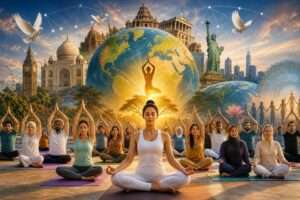
Yoga is central to India’s soft power strategy. Over the past decade, India has improved its ranking in the Soft Power Index, where yoga, Ayurveda, and Bollywood are key components. Yoga sessions at G-20 summits have impressed host countries. Yoga, along with the African Union’s membership in the 2023 Delhi G-20, united the global South. Cultural diplomacy has repositioned India as a “Vishwa Guru.” Unlike Western models like the British Council and the Goethe Institute, India’s model is more holistic. Programs like Mission Suryodaya have promoted Surya Namaskar in 100 countries, linking it to environmental awareness. These efforts demonstrate solidarity on global issues like climate change. While there are challenges—commercialization is diluting the spiritual essence of yoga, and Western adaptations are losing its original elements. Nevertheless, Indian government policies, such as the joint efforts of the Ministry of AYUSH and the Ministry of External Affairs, are addressing these challenges.
Cultural diplomacy has become increasingly relevant in an increasingly divided world. Polarization following the US presidential election, internal fissures within the European Union, and border disputes in Asia have fractured the world. In such a context, cultural diplomacy complements hard power. According to UNESCO, cultural exchange accounts for 70% of peacebuilding. Yoga has made this a reality. Abu Dhabi’s yoga center in the United Arab Emirates has connected Indian expatriates and local Arabs. In China, where there is Hindu-China tension, yoga therapy centers are popular. It restores global trust. Yoga focuses on mental health for social cohesion. World Health Organization data show that depression and anxiety are a global epidemic; yoga is a scientifically proven solution. Studies show that regular yoga maintains hormonal balance, bringing cohesion to stressed societies. India has made it a diplomatic tool – joint yoga programs in Quad countries have provided a soft edge to strategic partnerships.
Ultimately, yoga symbolizes cultural diplomacy that connects a divided world. It not only strengthens India’s soft power but also binds humanity together through a common thread. In the future, yoga’s reach will expand further through digital platforms and virtual reality. India must lead global solidarity while preserving it in its original form. This journey, starting from ancient sages and reaching global citizens, is a triumph of cultural diplomacy.


