



Heatwave threatens agriculture and farmers’ incomes in Haryana and Punjab
In this crucial era of climate change, extreme heat is no longer just a seasonal aberration; it is emerging as a deep structural crisis, shaking the foundations of global food systems. Rising temperatures and increasingly intense heatwaves have put agriculture, livestock, fisheries, and food supply chains under such pressure that every link seems to be weakening. Scientists and policymakers are now recognizing it as a “risk multiplier”—a factor that not only causes harm itself but also multiplies other risks. If decisive action is not taken now, extreme heat will become the single greatest systemic threat to global food security in the coming decades.
The most direct and obvious impact of extreme temperatures is on crops. It’s a well-established fact that temperatures above 30°C are unfavorable for major crops like wheat, rice, and maize. High temperatures disrupt plant photosynthesis, affect pollination, and leave grain development incomplete. This results in yield declines, which in many cases can reach 10 to 50 percent. It’s not just a quantity issue—heat also reduces the nutritional value of grains, impacting food quality. Thus, this crisis simultaneously impacts both production and nutrition.
The livestock sector is no exception to this heat stress. High temperatures increase heat stress in animals, directly impacting their productivity. Decreased milk production in dairy animals, reduced egg production in chickens, and slowed growth rates in pigs are prime examples. In extreme conditions, animals can even die, severely impacting farmers’ incomes. The situation in fisheries is even more complex—ocean heat waves reduce dissolved oxygen levels, stressing fish and making their survival difficult. Thus, extreme heat is simultaneously affecting all major sources of food production.
But the real challenge arises when these effects begin to amplify each other. Extreme heat leads to drought, putting unprecedented pressure on water resources. Water shortages for irrigation further reduce crop productivity, while water scarcity worsens for animals and humans. Furthermore, higher temperatures create favorable conditions for the spread of pests and diseases. Events like locust swarms are becoming more frequent and intense, capable of destroying vast croplands in a matter of days. Thus, temperature rise is not just an isolated problem, but part of a cycle that continually reinforces itself.
Forest areas are also experiencing profound impacts. Increasing heat and drought are leading to increased forest fires, which damage biodiversity and disrupt the carbon cycle. This creates a dangerous vicious cycle—forest fires increase carbon emissions, which further accelerate temperature rise, and this increase in carbon emissions fuels new fires. This cycle ultimately impacts agriculture and food systems.
An important but often overlooked aspect of extreme heat is its impact on labor productivity. Agricultural workers, especially in developing countries, are often unable to work due to extreme temperatures. When the “wet bulb temperature” reaches above a certain threshold, prolonged work can be fatal to the human body. This situation creates a kind of “heat-economy trap,” where heat directly limits labor, production, and income. It is estimated that in regions like South Asia, there may be hundreds of days a year when it will be impossible for workers to work. This directly impacts the incomes of farmers and laborers, increasing economic insecurity.
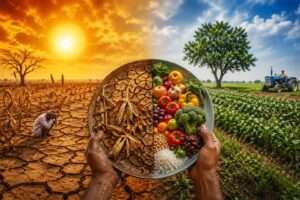
The combined result of all these effects results in a “cascading failure.” When crops fail, livestock suffers, and workers are unable to work, the food supply chain breaks down. This has a direct impact on markets—food prices rise, making it more difficult for the poor and vulnerable to access food. This situation leads to malnutrition, poverty, and social instability. In many areas, it also promotes migration, where people are forced to leave their homes in search of livelihoods. Thus, extreme heat becomes more than just an environmental problem—a widespread socio-economic crisis.
This challenge is even more serious for an agricultural country like India. In Haryana, Punjab, and other parts of North India, the adverse impact of heatwaves on wheat and rice yields has been clearly evident in recent years. Late-sown crops are particularly affected, resulting in production declines of 10 to 15 percent. These regions, once the epicenter of India’s Green Revolution, are now becoming the biggest laboratories of climate instability. Furthermore, overexploitation of groundwater and rising temperatures are exacerbating the water crisis, posing a serious threat to agricultural sustainability.
The impact of this crisis is not evenly distributed. Small and marginal farmers, women, and youth are most affected. They have limited resources, less technical knowledge, and lower risk-taking capacity. As a result, they are more vulnerable to the increasing pressures of climate change. Thus, extreme heat is becoming not only an environmental challenge but also a factor deepening social and economic inequalities.
Therefore, concrete and multifaceted strategies are needed to address this. First, adaptation must be addressed. Climate-smart agricultural practices—such as the use of heat-tolerant seeds, crop diversification, drip and sprinkler irrigation, and shade cultivation—can play a crucial role in this direction. Furthermore, strengthening weather forecasting and early warning systems is essential so that farmers can adapt their decisions in time and minimize losses.
Improvements are also needed in animal husbandry. Technologies such as better ventilated sheds, adequate water availability, and selective breeding can protect animals from the effects of heat. Furthermore, it is essential to provide economic security to farmers through insurance schemes and financial assistance to help them cope with climate risks.
At the policy level, governments must adopt a holistic and long-term approach. Water conservation, biodiversity protection, and promoting sustainable agricultural practices should be prioritized. The National Food Security Mission and other agricultural schemes in India need to be restructured to reflect climate change. Furthermore, it is essential to increase international cooperation and reduce greenhouse gas emissions, as long-term solutions are only possible through mitigation.
Ultimately, it’s essential to understand that this extreme heat crisis is a warning—a signal that our development system is colliding with the limits of nature. Securing food systems requires not just technological and policy changes, but also a shift in our approach. Only by placing sustainability, resilience, and inclusivity at the center of our resilience can we meet this challenge.
The time is clear—either we act now, or pay the heavy price of food insecurity in the future.


