Upadhyayula Lakshman Rao
The sage Kutsa, born of the illustrious lineage of Angirasa, invokes Agni in the solemn cadence of the Trishtubh metre of the Rigveda. His hymn unfolds a profound vision of the cosmos, where night and day stand as complementary opposites, ceaselessly revolving in ordained succession. From the womb of night arises Surya, nourished by the subtle essence of his mother, while from the womb of day emerges Agni, likewise sustained by maternal energy. Thus, creation is revealed as a continuous cycle of birth, nourishment, and renewal, governed by an unseen harmony.
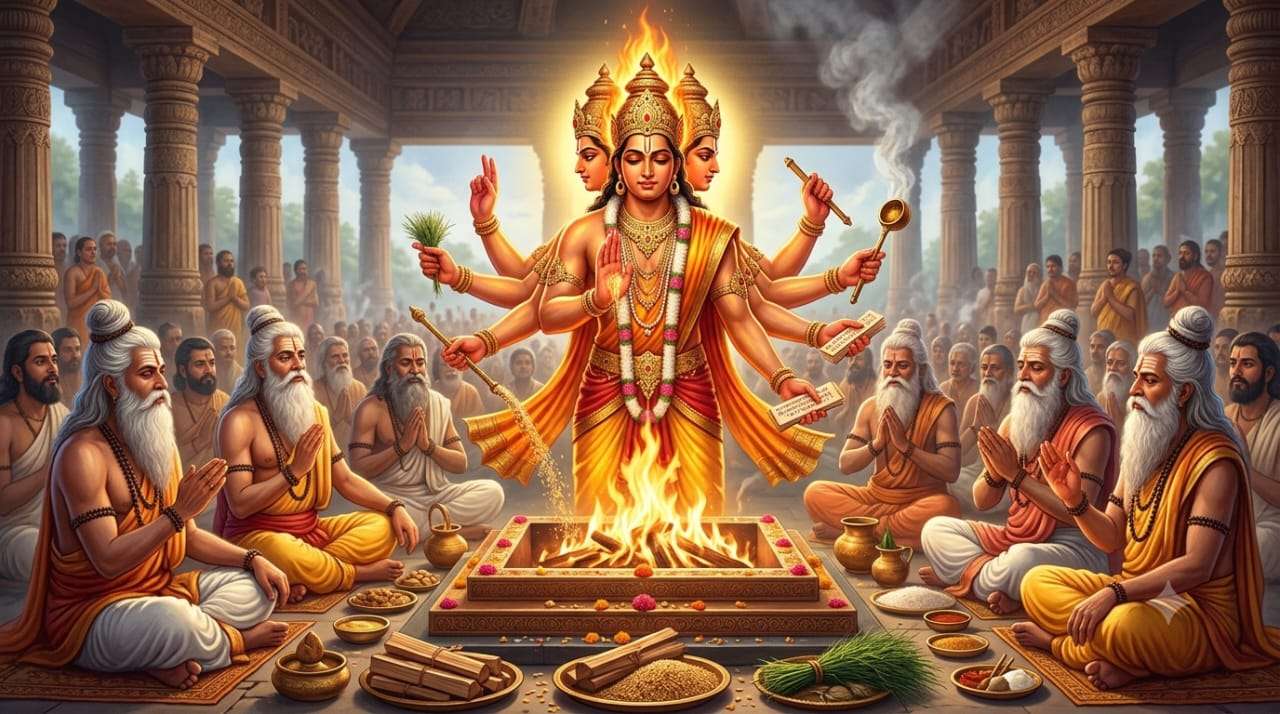
Agni is further conceived as the incarnate son of Vayu, the vital breath that pervades all existence. His presence resides within every living being as the inner fire, the source of vitality and consciousness. Radiant and resplendent, he shines in manifold forms across all realms. His earthly birth is symbolized through the sacred friction of the Arani sticks, the ritual instruments pressed by human hands, from which the divine flame is brought forth. The priests, custodians of sacred knowledge, carry this living fire from place to place, preserving the continuity of divine presence among men.
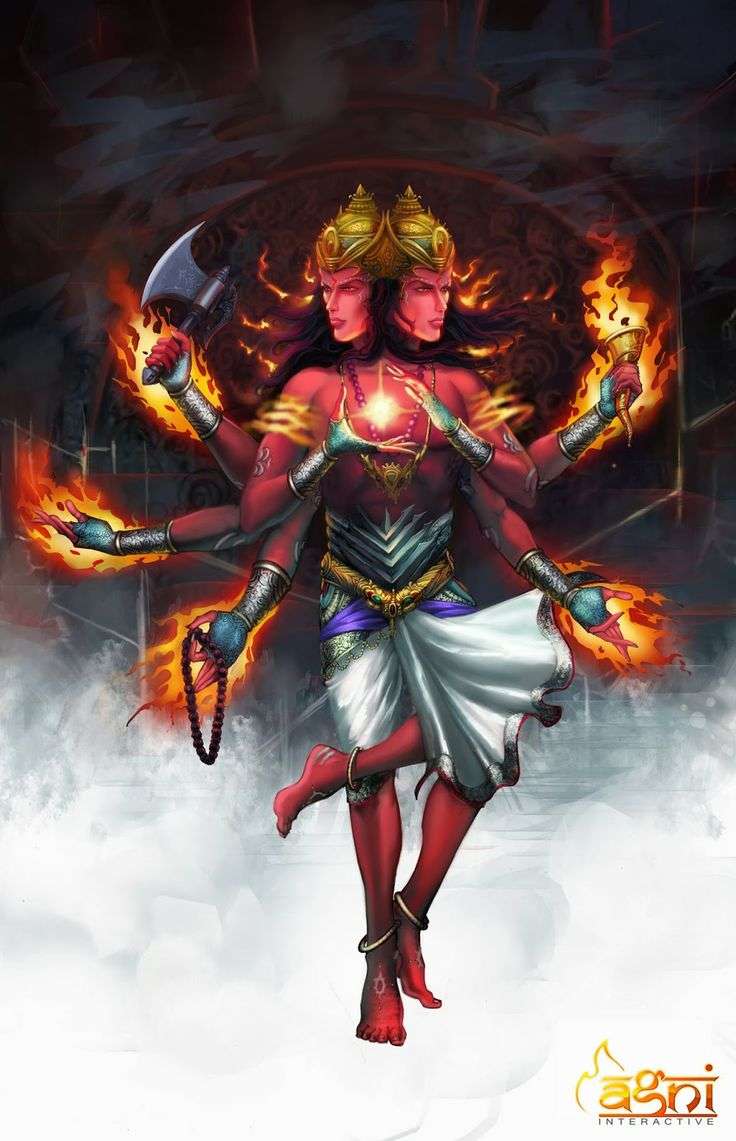
The hymn reveals the threefold manifestation of Agni: as the hidden submarine fire within the depths of the ocean, as the blazing sun in the heavens, and as the विद्युत् अग्नि, the lightning that flashes within the waters and clouds. These forms signify not merely physical phenomena but cosmic principles that govern time and transformation. Through them arise the seasons, the rhythms of nature, and the cycles of fertility and decay. Among these, the eastern radiance, where the sun rises, is held to be the most auspicious, symbolizing illumination and awakening. Yet, the sages ask: who truly knows the inner fire that dwells within all beings, subtle and unseen?
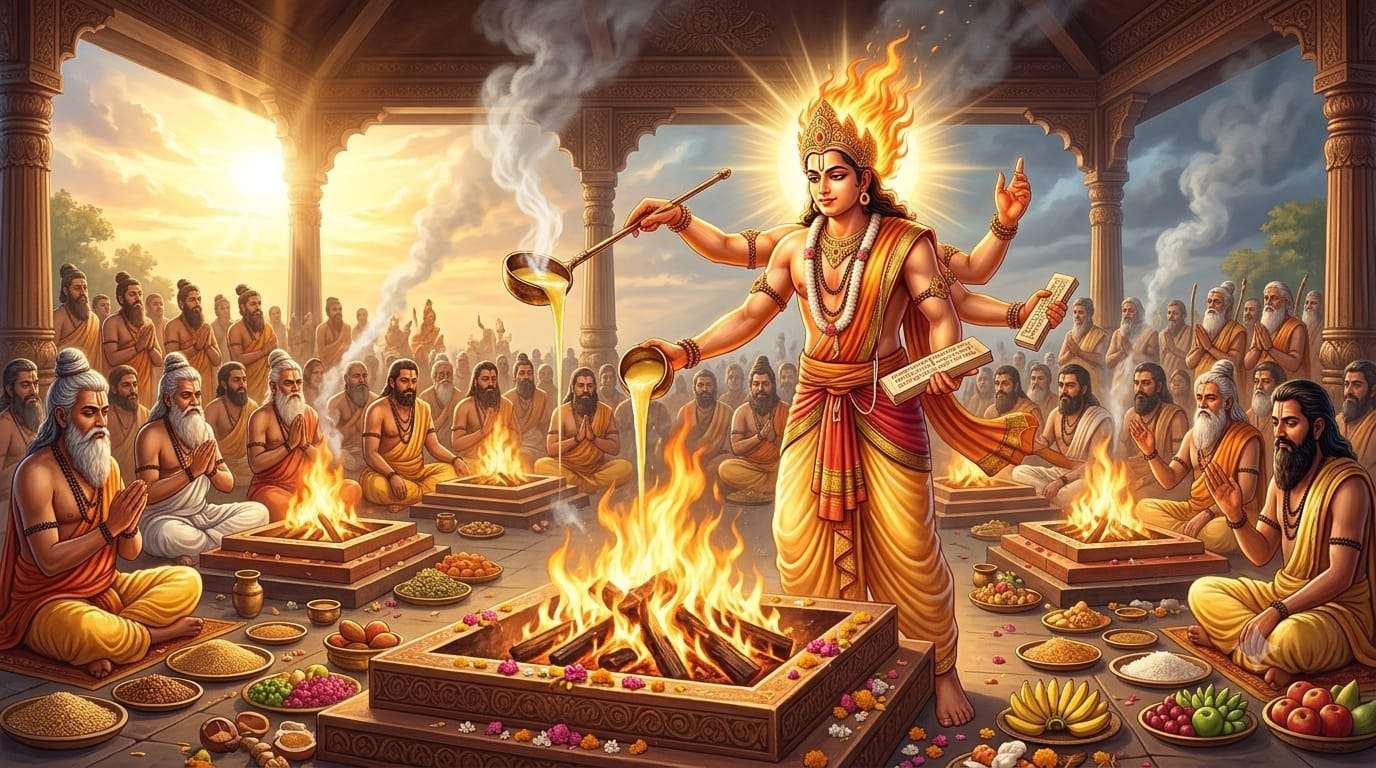
The cloud is poetically described as the mother of Agni, for within its womb the electric fire is concealed. From this union emerges rain, the life-giving essence. Agni, in turn, prepares nourishment in the form of oblations, sustaining the cosmic cycle of giving and receiving. He is the radiant, wise, and nurturing force who accompanies Ushas, the dawn, and rises from the depths of existence, resplendent and majestic. In the flowing waters he dwells, glowing with intensity, embodying both motion and brilliance.
The vast expanse of heaven and earth themselves stand in reverence before Agni. They serve him like devoted maidens, tending to his presence with care and humility. Like cows nurturing their calves, the earth and sky sustain and cherish this divine fire. The priests, through offerings and hymns, continually nourish Agni, who in turn becomes the mightiest among the mighty. His flames rise upward like the sun’s rays, illuminating both earth and sky, adorning creation with brilliance and power.
Agni, fierce and radiant like the sun, draws the essence of all offerings upward, transforming them into subtle energies. Through clouds and rain, he redistributes this essence across the world, sustaining life in all its forms. The lightning that flashes in the sky, brilliant and untouchable, reveals the hidden power of Agni within the waters. Even from afar, fire becomes the sustainer of life, and the heavens themselves are filled with his radiance.
Thus, the seer offers his prayer to this महान् तेजस्, the great luminous Agni—noble, victorious over adversaries, and the inexhaustible treasure of light. His brilliance spreads across the heavens, protecting and guiding all beings. By his law, the waters that gather in the sky are transformed into rain, descending to nourish the earth. Within this process lies the mystery of ripening, growth, and sustenance, governed by the purifying power of fire.
The sacred grass, offered in ritual, strengthens Agni and invites his blessings. Through him, the devotee seeks abundant nourishment and prosperity. This nourishment, once granted, is safeguarded by the divine forces—Indra, Varuna, Mitra, and Aditi—as well as by the cosmic realms of ocean, earth, and sky. In this grand vision, Agni stands not merely as fire, but as the unifying principle of transformation, linking the physical and the spiritual, the visible and the invisible, in an eternal dance of energy and life.