


If political reinvention were as easy as changing a party’s nameplate, every fallen outfit would be reborn overnight. Kalvakuntla Kavitha seems to believe precisely that. Her reported attempt to float a “Telangana Rashtra Sena” — a cosmetic rehash of the old Telangana Rashtra Samiti — is not political innovation. It is desperation dressed up as rebellion.
Let’s be blunt. The TRS was not just another party. It was a movement — built by K. Chandrashekar Rao — with a singular purpose: achieving separate statehood for Telangana. That goal was accomplished in 2014. The emotional capital of that struggle carried the party to power for nearly a decade. But movements don’t age well when they turn into family enterprises. Once statehood was achieved, TRS had to evolve into a governance-driven political force. Instead, it calcified into a tightly held Kalvakuntla enterprise.
Power stayed within the family — K. T. Rama Rao, T. Harish Rao and Kavitha herself — leaving little room for organic leadership. Governance took a backseat to control. The inevitable happened in 2023: the electorate delivered a verdict. The defeat was not accidental; it was due to accumulated fatigue.
Now comes Kavitha’s “rebellion,” which raises more questions than it answers. She accuses “outsiders” of hijacking the party. Outsiders? In a structure where power rarely strayed beyond bloodlines, this claim borders on absurdity. If anything, the problem was the opposite — suffocation by insiders.
What we are witnessing is not ideological dissent but a family feud triggered by political irrelevance. When power slips, fault lines appear. When resources dry up, loyalty evaporates. Let’s not pretend otherwise — the loss of power also meant the loss of access. Telangana politics is not naïve enough to ignore that the gravy train has halted.
Rebranding TRS as “Sena” is a particularly hollow exercise. The original identity was rooted in a cause. What is the cause now? What new ideological plank does Kavitha offer? None. A name change without a narrative is like repainting a crumbling house.
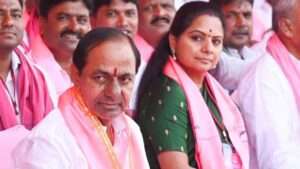
Meanwhile, the political landscape has moved on. The Congress under A. Revanth Reddy has seized power, while the Bharatiya Janata Party has firmly positioned itself as the principal opposition force in Telangana. The space for a splinter outfit — especially one carrying the baggage of the same family — is virtually non-existent.
And then there is the credibility question. Kavitha’s political journey is not unfolding in isolation. The shadow of the Delhi excise policy controversy continues to linger. Her legal reprieves may offer temporary relief, but they do not erase public perception. With proceedings linked to figures like Arvind Kejriwal still under judicial scrutiny, the issue is far from closed. Courts may decide legality; voters decide legitimacy.
Equally telling is Kavitha’s selective activism. On issues like the Women’s Reservation Bill — a historic moment in Indian politics — her voice has been conspicuously muted. For someone attempting to carve out an independent political identity, the silence is deafening. Leadership demands clarity, not convenience.
Ultimately, this is less about ideology and more about survival. The Kalvakuntla brand, once synonymous with Telangana pride, now struggles under the weight of its own contradictions. Internal cracks, corruption allegations, and electoral rejection have converged into a perfect storm.
Kavitha’s “Telangana Rashtra Sena” is unlikely to alter that trajectory. Political legitimacy cannot be inherited, nor can it be manufactured through rebranding. It must be earned — through credibility, vision, and public trust.
Right now, she offers none of the three.
What remains is a spectacle: a dynasty arguing with itself, trying to repackage yesterday’s politics for a state that has already moved on.



The irony is under the umbrella of family and clan such women compete for power and the most substantive women silently contribute to growth of the society and state ! Hoping that a time will come for the most knowledgeable women to be in power and the most ignorant to be out of it !