Upadhyayula Lakshman Rao
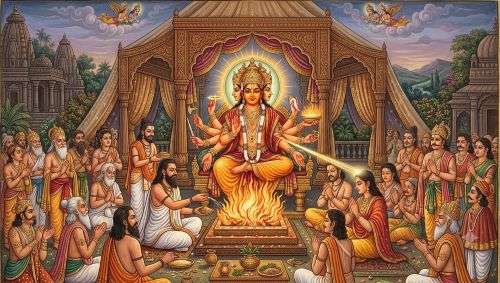
The sage Kutsa, born of the illustrious lineage of Angirasa, raises his voice in solemn invocation to Indra through the majestic metres of Jagati and Tristubh, as preserved in the sacred hymns of the Rigveda. In the serene stillness of penance, where the seers pursue excellence with unwavering discipline, the atmosphere becomes charged with a transcendental calm that rises above the turbulence of emotional entanglement. Their minds, purified by austerity and illuminated by wisdom, find profound delight in dedicating themselves to the spiritual upliftment of humanity and the harmonious functioning of the cosmos.
In this elevated state of consciousness, the sages perceive the subtle intricacies of nature and the intricate web of the universe not as fragmented phenomena, but as a unified expression of cosmic order. The interplay between the elements, the rhythm of existence, and the unseen forces that bind creation together are brought into alignment with the human spirit. Thus, the chanting of hymns begins—not merely as ritualistic recitation, but as a melodious convergence of focus, devotion, and clarity of intent. Indra, the wielder of power and sustainer of vitality, is invoked as worthy of all glory, and the priests are urged to raise their voices in resonant praise, for these hymns themselves become nourishment for both the material and spiritual realms.
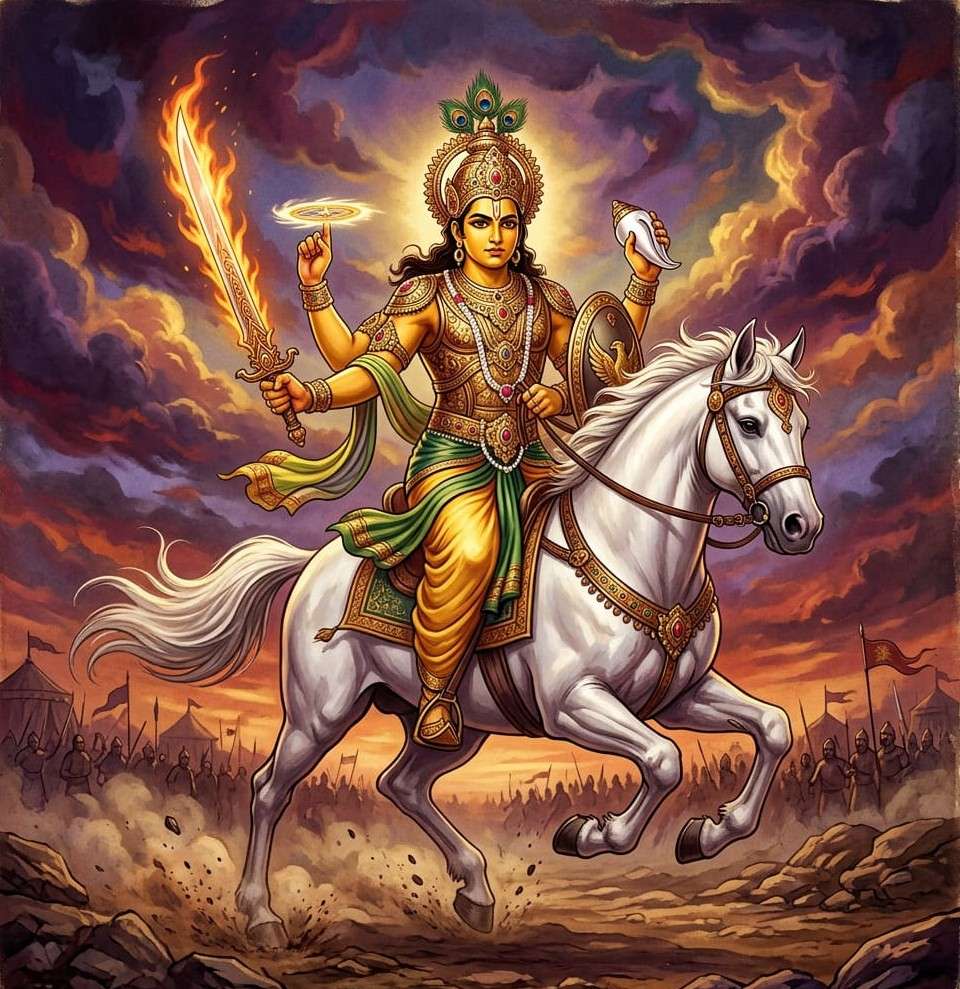
Indra, accompanied by the valiant Rujaswa, is celebrated as the destroyer of the demon Krushna and the liberator of the life-sustaining rains. With the Vajra firmly held in his right hand, he stands as the embodiment of divine strength, responding to the outstretched hands of seekers who yearn for friendship and protection. In his righteous fury, he uproots Vritra, severs the might of adversaries such as Sambara, Pipru, and Sushna, and restores the balance disrupted by forces hostile to sacred order. Under his command, the forces of nature—Varuna, Surya, and the flowing rivers—align themselves in obedience, affirming his sovereignty over both the terrestrial and celestial domains.
Indra is revered as the lord of cows and horses, symbols of prosperity and vitality, and as an independent force capable of all actions. From every direction, voices arise—some bold, some trembling, some fleeing in fear—all calling upon Indra for refuge. In these cries, one perceives the universal dependence of existence upon a central sustaining force. The Maruts, the fierce sons of Rudra, accompany Indra with roaring vigor, their presence reverberating through space, amplifying the grandeur of his movement across the cosmos. Thus, Indra is not merely a deity of myth but a representation of dynamic energy permeating all activity.
Invited with devotion, Indra is entreated to descend from his supreme abode into the sacred space of ritual. The soma, carefully extracted and purified, awaits his presence. The hymns themselves become his chariot, carrying him across realms to partake in the offerings. He is urged to sit in comfort, to drink deeply of the soma, and to find satisfaction in the devotion of his worshippers. This act symbolizes the reciprocal relationship between the divine and the human—the offering of effort and sincerity by mortals, and the bestowal of strength and abundance by the divine.
The prayers further exalt Indra as the provider of nourishment, protection, and victory. His wisdom and intellect are reflected in the very structure of the hymns, elevating them to greatness. The priests, empowered by the purity and potency of their chants, seek his blessings for prosperity and the flourishing of future generations. The imagery of Indra adorned by the seven rivers, the three worlds, and the radiant sun signifies his integration with the fundamental forces of existence, portraying him as the axis around which life revolves.
In a deeper sense, the hymns reveal an early scientific temperament embedded within spiritual expression. The sages, through contemplation and observation, grasp the interconnectedness of cosmic phenomena and human existence. The cycles of nature, the movement of celestial bodies, and the flow of energies are not seen as isolated events but as manifestations of an underlying order that can be understood through disciplined inquiry and inner awareness. This synthesis of spirituality and rational perception reflects a profound understanding of the universe, where knowledge is not derived from experiment alone but from intuitive insight aligned with observation.
The human spirit, in this vision, is not separate from the cosmos but an active participant within it. The collective aspiration of humanity, expressed through prayer and action, resonates with the larger rhythm of existence. The invocation of Indra, therefore, symbolizes the awakening of inner strength, the alignment of will with universal law, and the pursuit of harmony between the individual and the infinite. The narrative thus unfolds not merely as a devotional hymn but as a philosophical exposition on the unity of existence.
In conclusion, the hymn of Kutsa stands as a testament to the depth of Vedic thought, where spirituality and proto-scientific reasoning converge seamlessly. It presents a vision in which the cosmos is an ordered, interconnected system, and the human spirit, through discipline and insight, can comprehend and harmonize with it. Indra, as the central figure, embodies the शक्ति (power) that sustains this balance, reminding humanity of its potential to rise above fear, ignorance, and disorder, and to participate consciously in the grand design of the universe.