Perhaps state BJP president N. Ramchander Rao was right when he described Prime Minister Narendra Modi’s visit on May 10 as a “festival” moment for Telangana. He may well have a point. With the Prime Minister set to unveil infrastructure projects worth several thousand crores, along with the inauguration of AIIMS at Bhongir, the visit carries both scale and significance. Notably, this will be Modi’s first visit to the state after assuming office for a third consecutive term.
For the BJP in Telangana, this is far more than a ceremonial occasion. It is a political moment loaded with purpose — a signal, a strategy, and above all, a call to action.
For too long, Telangana’s political narrative has been dominated by regional rhetoric and personality-driven politics. Yet beneath that noise lies a silent churn — an aspirational electorate increasingly drawn to governance, development, and national integration. Modi’s visit offers the BJP an opportunity to tap into that sentiment and convert it into tangible political capital.
The projects being unveiled are not mere symbolic gestures. They represent concrete interventions in infrastructure — highways, rail connectivity, urban expansion, and critical investments in energy and logistics. Over the past decade, the Modi government has dramatically scaled up capital expenditure, from around ₹2 lakh crore in 2014–15 to over ₹11 lakh crore in recent budgets. Telangana, given its strategic location and expanding urban footprint, stands to gain significantly from this push.
But let’s be clear: development announcements do not automatically translate into votes. The bridge between the two is built by the party cadre — booth workers, local leaders, and ground-level organisers who carry the message to the last mile. And that is where this visit assumes real importance.
The BJP in Telangana has shown flashes of promise — whether in the 2020 GHMC elections, where it emerged as a formidable force in Hyderabad, or in subsequent bypoll performances. Yet, it has struggled with consistency, organisational cohesion, and narrative clarity. Modi’s presence offers a rare moment to reset all three.
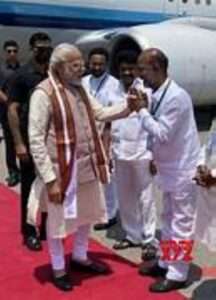
The immediate political priority is clear: the Greater Hyderabad Municipal Corporation (GHMC) elections. Winning GHMC is not just about controlling an urban local body; it is about capturing the political nerve centre of the state. Hyderabad is not merely a city — it is Telangana’s economic engine, its media hub, and its ideological battleground.
A strong showing in GHMC would serve as a psychological breakthrough for the BJP. It would send a message that the party is not just an emerging challenger but a credible alternative to the ruling establishment. More importantly, it would energise the cadre, attract fence-sitters, and build momentum heading into the Assembly elections.
And that is where the long game lies.
The road to the 2023 Assembly polls — or any future electoral battle — cannot be paved overnight. It requires sustained engagement, micro-level planning, and relentless messaging. The BJP’s central leadership has repeatedly emphasised booth-level strength as the cornerstone of electoral success. Telangana must internalise that lesson.
Every infrastructure project inaugurated on May 10 must be translated into a local narrative. A new highway is not just a road; it is faster connectivity for traders, better access for farmers, and new opportunities for youth. A railway upgrade is not just steel and concrete; it is economic mobility and regional integration. These are stories that need to be told — repeatedly, convincingly, and in the language of the people.
At the same time, the party must avoid the trap of over-reliance on central leadership. Modi’s charisma can ignite enthusiasm, but it cannot substitute for local credibility. The BJP in Telangana needs a strong second line of leadership that can sustain the momentum long after the Prime Minister’s convoy leaves.
There is also a broader political context to consider. Across India, the BJP’s electoral success has been built on a combination of welfare delivery, infrastructure development, and ideological clarity. Telangana offers a fertile ground for replicating that model, but only if the party aligns its organisational machinery with its political messaging.
May 10, therefore, should not end with applause and headlines. It should begin a campaign.
A campaign that starts with GHMC, builds through sustained grassroots work, and culminates in a serious bid for power in the state. A campaign that converts development into trust, and trust into votes.
For the BJP cadre in Telangana, this is not just another event on the calendar. It is a test of intent.
The Prime Minister will lay the foundation stones. It is now up to the party to build on them.