



Sanjaya reports that Krishna, who had remained silent, now deliberately lashes out at the extreme anxiety of Arjuna. His silence had carried deep meaning, and when he finally spoke, his eloquence poured forth in carefully chosen words, each like a sharpened arrow. He declared that Arjuna’s mental state was neither sufficiently masculine to inspire passionate courage nor sufficiently gentle to allow softer emotions of hesitation and despair. Emotionally, Arjuna stood as a contradiction, torn between resolve and retreat.
Overwhelmed by compassion, Arjuna had decided not to fight and began presenting arguments to justify his choice. Krishna, as a discerning thinker, knew that it was futile to directly oppose one who was inspired to argue in favor of a mistaken understanding. He perceived that only divine grace could reorient the heart and burn away negativity. His words gleamed and struck like lightning upon Arjuna’s wavering mind as he commanded him to rise and act. Yet cowardice still seized Arjuna, who framed arguments that would appear convincing to an ordinary mind, for he had missed the deeper essence of the war as explained by Krishna.
This imminent war was not between individuals driven by rivalry. Arjuna had no identity apart from the Pandavas force, and Drona and Bhishma were not merely personal figures but embodied the Kauravas cause. Two great forces stood arrayed, each contending for principles. The Kauravas fought for unrighteousness, while the Pandavas upheld virtue. With such a noble cause at stake, and both armies representing the will of the people, Arjuna, though a hero, possessed no personal right to accept honor or disgrace based on individual relationships. By viewing the conflict through the narrow lens of his ego, he erred in arrogating the situation to himself alone.
He recognized himself as the disciple of Drona and the grandson of Bhishma, yet these very men regarded Arjuna only as an adversary in the opposing camp and did not hesitate, for they were free from ego-driven misconceptions. They had dissolved their personalities into the cause they championed. Thus, Arjuna’s egoism became the root of his moral confusion and distorted understanding. Vedavyasa sought to resolve this confusion for all humanity, teaching that the more one identifies with the narrow “I,” the more one loses connection with a greater cause, principle, or nation. When one expands into larger identification, personal morality fades into insignificance, while true morality arises from unity with righteous cause and principle.
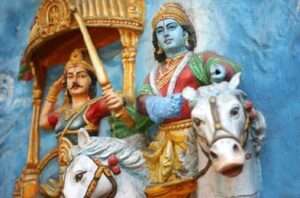
Still, Arjuna advanced shallow arguments, portraying himself as a martyr to his own morality and ethical excellence. He proclaimed that Drona and Bhishma were great men, ideals of their age, symbols of the highest culture, courage, and conviction, who had made many sacrifices to uphold ancient virtue. Such noble figures, he argued, did not deserve to be slain for mere hunger for power and status. He further asserted that not only the present age but future generations would suffer the loss of such precious lives. He declared that it would be nobler for the Pandavas brothers to live by begging than to gain kingship by destroying the rare flowers of their cultural garden. After the mass killing of elders, teachers, and kin, he believed that no Aryan heart could delight in kingdom or wealth, for all would be stained by the bitter memory of blood spilled on the battlefield.
Sanjaya’s narration is precise, explaining that when one misreads a situation, sentiments cloud judgment. This, Vyasa revealed in this heart-throbbing moment. Arjuna’s hysterical perplexity had attacked his intellect, and the stimuli from the opposing armies overwhelmed him. He needed guidance to free himself from anxiety over the fruits of the war, for his senses no longer functioned with harmony of purpose. Krishna therefore resolved to re-educate and reorient Arjuna’s inner world.
The great warrior realized his helplessness and confessed that his intellect had fallen into confusion regarding righteousness and virtue, rendering him incapable of proper judgment. Sanjaya then conveyed the meaning of Dharma to Dhritarashtra, explaining that that which preserves its true nature is Dharma. Arjuna placed his faith in the Lord and sought his guidance, for earlier he had interrupted Krishna’s message with doubts, whereas Krishna responded with renewed enthusiasm for the righteous cause. Arjuna indicated the urgency of direction, as he was suffering silently with inward agony.
It is natural for any thoughtful person to feel intellectual impatience to resolve inner conflict and restore peace of mind. Arjuna sought consolation, declaring that his sorrow did not arise from the desire for possessions or worldly pleasures, for even sovereignty over three worlds could not dispel his grief. Sanjaya emphasized that Arjuna surrendered himself to Krishna, seeking divine guidance and becoming a conqueror of the self. The slayer of enemies declared that he would not fight and would follow the Lord’s direction.
Sanjaya hopefully reports that the mortal Arjuna, under perfect harmony and guidance of the divine Krishna, attains invincibility, and that the blind king must realize the devastating power of this divine and mortal union. Sanjaya knows that only the blind monarch might comprehend the futility of opposing Arjuna and thus halt at the final moment, yet the king, blind by birth, has also grown deaf to righteous counsel through his boundless attachment to his erring sons. Thus, the Lord of the universe has initiated what shall benefit the intellectual world for ages to come.

