



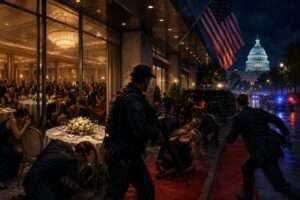
The shooting at the prestigious Washington Hilton in Washington on Saturday night shocked the entire world. It wasn’t just a security incident, but a moment that brought history, politics, and democracy together. When gunfire suddenly rang out during the White House Correspondents’ Dinner, it was nothing short of a nightmare for the thousands of people present. Top leaders like Donald Trump, Melania Trump, and J.D. Vance were present. Within moments, the festive atmosphere turned into fear and chaos. The promptness of the US Secret Service brought the situation under control, but the incident raised many deep questions that face no easy answers.
The most shocking and terrifying thing about this incident is that it’s not the first time this has happened. This same hotel, sometimes known as the “Hinckley Hilton,” has previously witnessed one of the most violent incidents in American history. In 1981, then-President Ronald Reagan was shot outside this very location by John Hinckley Jr. In that attack, Reagan was seriously injured and his press secretary, James Brady, suffered permanent disabilities. The same questions arose then—how did the security lapse occur? And today, nearly 45 years later, the same questions confront us again. The only difference is that the world is much more complex and the nature of threats has changed.
According to those present, everything was proceeding normally. A mix of laughter, speeches, media, and politics—this dinner has always been a unique tradition of American democracy. But the sudden gunfire shook this tradition. People began hiding under tables for safety, panic ensued, and within moments, the entire situation seemed to spiral out of control. While it’s a relief that there was no major loss of life or property, the mental and psychological impact cannot be ignored.
This incident is not just a security lapse, but also reflects growing political tensions in American society. Ideological polarization has increased sharply in the US over the past few years. Events like the January 6th Capitol riot have demonstrated that political differences are no longer confined to debate and discussion. They are being openly expressed on the streets, in institutions, and now even at high-level events. In this context, the Washington Hilton incident does not appear to be an isolated incident, but rather part of a broader trend.
Donald Trump ‘s politics also plays a significant role in this entire scenario. While his policies like “America First” and “Make America Great Again” appealed to a large segment of society, they also generated discontent and opposition among a segment of society. His confrontations with the media, his use of terms like “fake news,” and his harsh language against political opponents—all of this has further heightened the social climate. Therefore, when a violent incident occurs, it appears not to be the act of a single individual, but rather the result of a broader social and political environment in which dissent is often perceived as hostility.
It’s natural to raise questions about security. The U.S. Secret Service is considered one of the most capable security agencies in the world. Since the 1981 incident, significant improvements have been made—the use of cutting-edge technology, more trained security personnel, and advanced surveillance systems. However, the occurrence of such incidents demonstrates that the risks at crowded public events cannot be completely eliminated. Today, threats stem not only from conventional weapons, but also from factors such as mental instability, online radicalization, and personal frustration.
Another important aspect of this phenomenon is the digital age and the role of social media. Today, ideas spread at an extremely fast pace. Misinformation, conspiracy theories, and radical ideologies reach millions of people in a short time. While the influence of movies on John Hinckley Jr. was discussed in 1981, today the digital world and social media are seen as a greater influence on attackers. This shift presents new challenges for security agencies, as it has become more difficult than ever to identify and prevent threats in a timely manner.
The impact of this incident cannot be ignored globally. The United States is considered the world’s most powerful democracy, and events there serve as a signal to other countries. For countries like India, where large-scale political and social events are held, this is a warning. Strengthening security systems solely technically is not enough; it is also essential to promote social harmony, dialogue, and mutual trust.
This incident also raises a profound question—is democracy truly secure? Democracy is not just about elections and institutions, but rather an ideology that embraces dissent and prioritizes dialogue. When conflict replaces dialogue in society, the foundations of democracy begin to weaken. The Washington Hilton incident points to this potential weakness.
Its social implications are profound. The media, which is central to this event, itself became a part of the incident. Journalists, who were there to question the authorities and strengthen democracy, suddenly found themselves facing a crisis. This situation forces us to wonder whether growing intolerance in society regarding the freedom of the press and its role is also giving rise to such incidents.
Ultimately, this incident is a warning not just for America, but for the entire world. History repeats itself, but each time it also offers a new message. Security improvements were made after the 1981 incident; this 2026 incident will likely require even more extensive changes. But the most important change should not be in technology or security, but in our thinking. Unless tolerance, dialogue, and mutual respect are promoted in society, it will be difficult to completely prevent such incidents.
This night at the Washington Hilton is not just an event, but a mirror—one in which we can clearly see both the strengths and weaknesses of democracy. It reminds us that democracy cannot be protected solely by law and security agencies, but also by the thinking, behaviour, and values of its citizens. If we understand this message, perhaps history will not need to repeat itself in the future.


Very well written. Tolerance, dialogue and mutual respect seem to be better keys for strong security than the ultra modern gadgets and surveillance technology. All aspects have been so well covered that they become common to not only the US but to the rest of the world also.