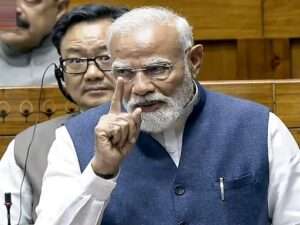
When Narendra Modi rose to address the special session of Parliament, he did more than outline a legislative agenda—he threw down a political gauntlet. The message was unmistakable: history is knocking, and those who choose obstruction over opportunity will have to answer not just to Parliament, but to the people—especially India’s women. At the heart of the current churn lies the long-pending demand for 33% reservation for women in legislatures, now strategically linked with the delimitation exercise. The Opposition, predictably, has chosen to retreat into a familiar refuge—technicalities, procedural quibbles, and speculative fears about regional imbalance. But let’s be clear: this is not a constitutional crisis; it is a crisis of political will. For decades, political parties across the spectrum have paid lip service to women’s empowerment. The numbers tell a stark story. Women currently constitute barely 14–15% of the Lok Sabha, despite forming nearly 50% of India’s population. India ranks embarrassingly low globally in women’s parliamentary representation—hovering outside the top 100 nations. This, in a country that prides itself on democratic depth. So, when the government moves to structurally correct this imbalance, the question is not whether the Opposition agrees with every procedural detail—it is whether they have the moral courage to support a transformational reform. The Opposition’s latest line of resistance hinges on delimitation. Parties, particularly from southern states like Tamil Nadu and political players such as Dravida Munnetra Kazhagam, argue that a population-based redraw of constituencies could tilt representation in favour of northern states. It’s a familiar argument—but one that conveniently ignores both facts and assurances. The Prime Minister has categorically stated that no state—big or small—will suffer injustice. The delimitation process, when undertaken, will be guided by a commission designed precisely to balance demographic realities with federal equity. More importantly, projections suggest that even if the Lok Sabha expands to around 850 seats, the relative share of southern states—currently about 28%—will broadly remain intact.
This is not a zero-sum game. Every state stands to gain from an expanded House. The idea that one region’s gain must come at another’s loss is not just flawed—it is politically motivated fear-mongering. More crucially, the Opposition is deliberately conflating two issues to stall one. Delimitation is a constitutional necessity, pending since 1971 due to a freeze that cannot continue indefinitely. Women’s reservation, on the other hand, is a moral imperative whose time has long come. Linking them is not a trick—it is a structural alignment to ensure representation keeps pace with demographic and social realities. Let’s also address the legislative argument being floated. Critics claim that such sweeping reforms demand a two-thirds majority and are therefore being rushed. Yet, as both Arjun Ram Meghwal and Amit Shah have pointed out, several constitutional amendments in the past—particularly those relating to delimitation and seat adjustments—have passed with varying thresholds depending on their scope. The attempt to weaponize procedure is nothing more than a delaying tactic. The real question is political accountability. If the Opposition truly believes in women’s empowerment, this is their moment to prove it—not through speeches, but through votes. Supporting the bill does not strengthen the government alone; it strengthens every political party by ensuring one-third of their candidates and representatives are women. It broadens their base, deepens their outreach, and aligns them with a generational shift in voter expectations. Opposing it, however, carries a cost. Not just electorally, but morally. Indian women are no longer silent stakeholders—they are decisive voters. From rural self-help groups to urban professionals, women have emerged as a formidable political constituency. Any party seen as obstructing their rightful representation risks being permanently out of step with the electorate. Modi’s assurance is not merely administrative—it is political insurance for the Opposition. He has offered them a way to stand on the right side of history without losing face. The question is: will they take it? Because if they don’t, the narrative will write itself. That when India finally stood at the cusp of a historic correction, the Opposition chose hesitation over leadership, and cynicism over courage. This is not about North versus South. Nor is it about government versus Opposition. It is about whether India’s democracy is mature enough to reflect its own social reality. The clock is ticking as voting set at 4 pm on Friday. The vote is imminent. And history, as always, will remember who stood where.