Upadhyayula Lakshman Rao
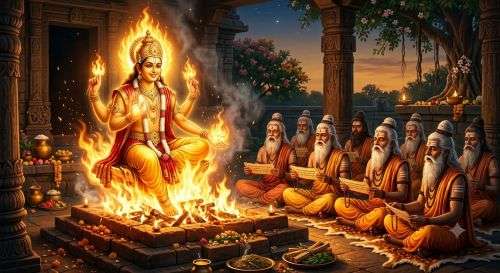
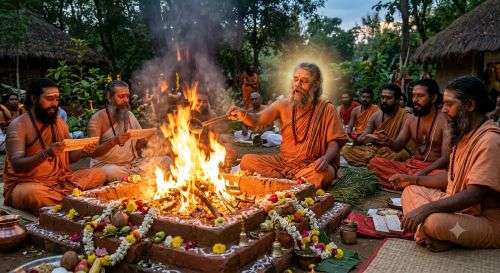
The seer-sons of Vṛṣa—Rujasva, Ambarīṣa, Sahadeva, Bhayamana, and Suradhānu—raise their voices in solemn invocation, composing their hymns in the stately cadence of Triṣṭubh metre. Their praise is not merely poetic adoration, but a profound contemplation of cosmic order, where divinity and natural law converge. In their vision, Indra stands as the sovereign force who governs the rhythms of rain, the unfolding of space, and the sustenance of life. Through their sacred utterances, they seek not only protection in battle but alignment with the universal principles that uphold existence.
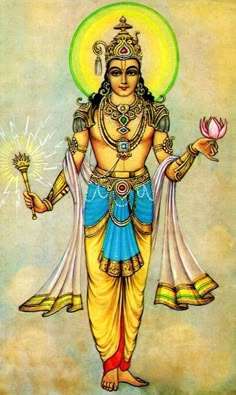
Indra, as revealed in these hymns, is the wielder of immense and dynamic power. It is he who releases the life-giving rains, working in harmony with the subtle veil of Avaraṇa-śakti, through which the unseen becomes manifest. The rains that descend are not random gifts but expressions of a regulated cosmic process, wherein Indra shapes both heaven and earth, carving out realms and setting waters into motion. Thus, rain becomes both a spiritual blessing and a scientific phenomenon—an ordered transformation within the natural world, governed by divine intelligence.
Accompanied by the swift and radiant Maruts, Indra strides across the firmament with a गति likened to that of the sun itself—unstoppable, luminous, and far-reaching. The Maruts, embodiments of storm and wind, act as his companions and collaborators, amplifying his शक्ति in both battle and creation. Together, they stir the atmosphere, gather clouds, and unleash rain, demonstrating an early perception of atmospheric dynamics. In war, this same force transforms into a destructive might, drying up enemies and scattering hostile forces, revealing the dual nature of energy—nurturing and annihilating.
Indra’s brilliance is compared to the rays of the sun, emanating from the heavens with irresistible force. His speed surpasses all known motion, making him the swiftest among the swift. Yet, beyond physical prowess, he is exalted as the most generous of benefactors—more giving than rain itself, more steadfast than the closest friend. He is worthy of reverence by the reverent, and praiseworthy even among those who are themselves praisers, for he embodies the highest ideal of divine excellence.
In his association with the Maruts, who are also described as the sons of Rudra, Indra’s role expands into that of a unifier of cosmic forces. He stands alongside Vāyu, the wind, not as a subordinate but as an equal, indicating a profound understanding of interdependent natural elements. Together, they generate rain and sustain life, while in battle they become forces of irresistible momentum. Vāyu himself is said to inspire Indra, urging him forward like the wind that drives the storm—an allegory for the energizing principles that activate latent शक्ति.
Indra is invoked as the guardian of wealth and the protector of rightful possessions. He bestows the fruits of rituals upon those who approach him with sincerity and without deceit. His acceptance of oblations—taken with the right hand while wielding destruction with the left—symbolizes the balance between grace and शक्ति. He rewards devotion with prosperity, grants progeny to those who seek refuge in him, whether kin or stranger, and ensures victory even in the darkest of battles. His impartiality reflects a universal justice, untouched by bias, rooted in the moral integrity of the devotee.
The imagery of Indra’s chariot, drawn by powerful horses of black and red hue, reflects both physical grandeur and symbolic depth. These steeds, adorned and vigorous, represent the energies harnessed by the divine will—visible in warriors and men alike. They carry Indra across realms, enabling him to distribute wealth and uphold order. His weapon, the Vajra, signifies concentrated शक्ति—capable of shattering ignorance and defeating the Dasyus, the forces of chaos and obstruction.
Indra’s dominion extends over the rivers, the skies, and the earth itself. He governs the fivefold streams of existence, ensuring their continuity and balance. His strength is unmatched, even among the gods, and without his intervention, the world would be deprived of water and vitality. His enthusiasm, described as pervading both heaven and earth, reflects a dynamic ऊर्जा that sustains the cosmos. In rituals, he is invoked with joy, for his presence dispels sin and restores harmony.
The sages conclude with a declaration of purity and सत्य. Their offerings are earned through righteous means, devoid of cunning or deceit. They entrust these oblations to the संरक्षण of Mitra, Varuṇa, Aditi, the Ocean, the Earth, and the vast expanse of space. This final invocation reflects a comprehensive vision of cosmic guardianship, where every element of existence participates in preserving dharma. Thus, the hymn becomes not only a praise of Indra but a testament to the intricate interplay between spiritual devotion and the scientific order of the universe.