



Sri Krishna continues his discourse to Arjuna, explaining the causes by which the dark age comes into being. A community is formed by individuals, and however greatly the achievements of the whole may be praised, the contributions of its units cannot be ignored. When individuals are noble and rightly ordered, the community moves in harmony; but when its units are distorted, the structure loses its strength and healthy growth collapses.
The decline of the individual begins in the senses. Limited by the belief that they are nothing more than the body, people become absorbed in its nourishment and indulgence. Confined to bodily identity, they cannot perceive higher aims of life, nor can they cherish any purpose beyond the satisfaction of animal impulses. In such an age, none step forward to act in the redeeming spirit of sacred duty, without which favorable conditions for the flowering of human potential cannot arise. Seekers of sense pleasures compete with one another in lust and greed for selfish happiness, and thus, often unknowingly, disturb the rhythm of righteous action. Such people are said to live in sin.
Action performed in the spirit of sacred duty integrates the personality and prepares one for the highest calling of life, meditation. Through selfless work, an individual attains increasing inner poise, and when such a concentrated mind is directed toward meditation, one transcends the limited ego. To such a perfected being, work is no longer a discipline for purification but the fulfillment of divine realization itself.
Satisfaction and contentment are the two wheels of life’s chariot. For ordinary people, action in the world is necessary: to earn and save, to gather and spend. But the person of perfection, transcending identification with material coverings, enters the inner realm and is ushered into the all-perfect domain of the spirit. There, one feels such fullness of selfhood that complete contentment in divine nature arises, leading to perpetual satisfaction. When this state is reached, no desire enters the heart; in the absence of desire, action ceases, and thus the effects of ignorance, craving, thought, and compulsion no longer bind. In such a being there remains no obligatory duty, for all work has been fulfilled. Thereafter, one is free to act and lives as a divine person upon the earth.
The ordinary person is driven to action either by anxiety for gain or by fear of loss. But one who has realized the spiritual stature within, who has discovered perpetual satisfaction in the Self and reached perfect contentment, has nothing further to achieve through activity and nothing to lose by inaction. Rooted in the Self and dependent on nothing—neither being nor object—for joy and bliss, such a person realizes that the objects of the world are nothing but the subject itself, tossed upon the waves of mental agitation.
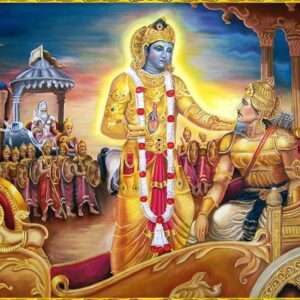
Thus far, Krishna has been explaining the wheel of action and crystallizing his conclusions, urging Arjuna to act. Therefore, one must always perform the duties appropriate to one’s present station, domestic condition, and membership in the community and nation. Sanjaya tells Dhritarashtra that Krishna repeats to Arjuna the need to be vigilant in all activities, keeping the mind free from dangerous attachments that form tendencies and deepen impressions within.
The wise kings of old, such as Janaka and Aswapati, attained perfection through the path of action. They were men of right understanding and liberated themselves through deeds performed in a spirit of detachment and self-dedication. By their immaculate lives of service, they set an enduring example for the world.
Arjuna, a prince by birth and one who has undertaken the responsibility of mobilizing and fighting the war, must honor his destiny and act diligently without fleeing the battlefield. This alone is the means by which he can exhaust his accumulated impressions. Born a king, he bears a greater responsibility than others; therefore, it is his duty to hold his post and work steadfastly.
In truth, he has manifested as the son of his father in a royal lineage because nature judged that the most suitable circumstances for his life were those of a prince—facing dangers, fighting enemies, and establishing peace and progress in society. The moral renewal of any age arises only from the example set by its leaders; minor officials cannot be kind and honest when rulers themselves are corrupt tyrants.
Krishna therefore affirms that Arjuna must act diligently; otherwise, the entire community may follow the low standard of retreat from action that he would set, leading to general cultural decay. To impress this teaching indelibly upon Arjuna, the Lord presents Himself as the supreme example. Though already liberated, He acts tirelessly and without attachment, so that His generation may rise above the lethargy of the age into vigorous endeavor. The very life of Krishna is active resistance to evil; His nonviolence is not the helplessness of a dreaming coward who cannot oppose injustice, but the strength of one who stands firmly for righteous principles and national culture. Thus, no doubt can remain in Arjuna’s mind regarding the efficacy of the path of action taught by the Lord.

