



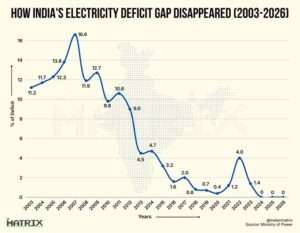
India’s power story has undergone a quiet but extraordinary transformation over the past decade—one that has fundamentally altered the narrative from chronic shortages to surplus capacity, from blackouts to resilience. The disappearance of India’s electricity deficit is not the result of a single reform or policy, but a combination of scientific innovation, strategic infrastructure, and demand-side efficiency measures that together rewired the nation’s energy landscape.
For decades, India’s electricity sector was synonymous with outages, load shedding, and unmet demand. As late as 2012, the country witnessed one of the largest blackouts in history, affecting over 600 million people. Fast forward to today, and India has not only bridged the deficit but, at times, operates with a power surplus—capable of exporting electricity to neighboring countries. This shift is rooted in three key pillars: material innovation, transmission revolution, and energy efficiency.
Aluminium over Copper: A Strategic Material Shift
Unlike many Western nations that built their grids using copper, India faced a structural constraint—limited domestic copper reserves. However, what could have been a disadvantage was turned into an opportunity. Indian scientists and engineers developed advanced aluminium-based conductors, most notably the AL-59 alloy.
This innovation is not merely a substitute; it is, in many ways, superior. AL-59 aluminium alloy conductors can carry up to 30% more current than traditional copper-based lines, while exhibiting significantly lower sag even under high temperatures and heavy loads. Reduced sag translates to higher safety margins and the ability to transmit more power without increasing tower heights or right-of-way requirements. In a tropical country like India, where extreme heat is a constant challenge, this technological leap has proven invaluable.
The use of aluminium, which is more abundant and cost-effective in India, has also reduced dependence on imports and brought down infrastructure costs, enabling faster and wider grid expansion.
The UHVDC Revolution: Moving Power Across a Continent
Equally transformative has been India’s aggressive push into Ultra High Voltage Direct Current (UHVDC) transmission. While much of the Western world continues to rely heavily on aging alternating current (AC) infrastructure, India leapfrogged into building some of the most advanced HVDC corridors in the world.
Projects like the Raigarh–Pugalur HVDC System and the North-East Agra HVDC link represent engineering feats that allow bulk transfer of electricity over distances exceeding 1,000 kilometers with minimal losses. These systems operate at voltages as high as 800 kV, dramatically improving efficiency compared to conventional AC lines.
Why does this matter? India’s energy resources are geographically uneven—coal reserves are concentrated in the east, solar potential is highest in the west, and hydropower is abundant in the north. UHVDC corridors act as high-speed energy highways, seamlessly moving power from surplus regions to deficit areas. This has effectively nationalized the grid, reducing regional imbalances and ensuring that electricity is available where and when it is needed.
UJALA: The Power of Saving Power
Perhaps the most underappreciated yet impactful intervention has been on the demand side. The UJALA Scheme (Unnat Jyoti by Affordable LEDs for All) stands as a global benchmark in energy efficiency.
Under this scheme, India distributed over 36.8 crore (368 million) LED bulbs to households across the country. The impact has been staggering. By replacing energy-guzzling incandescent and CFL bulbs with efficient LEDs, the program reduced peak electricity demand by approximately 9,500 MW.
To put that into perspective, 9,500 MW is equivalent to the output of roughly 20–25 large coal-fired power plants or the entire installed capacity of several smaller Indian states. And this reduction was achieved without generating a single additional unit of electricity—simply by consuming less.
Moreover, the scheme has resulted in annual energy savings of around 48 billion units (kWh), significantly lowering both electricity bills for consumers and carbon emissions for the country. It is a textbook example of how demand-side management can be as powerful as supply-side expansion.
From Deficit to Discipline
India’s journey from power deficit to surplus is also underpinned by better grid management, real-time monitoring, and policy reforms such as the UDAY scheme for discom restructuring and the push for renewable energy integration. Today, India boasts one of the largest synchronized grids in the world, operating at a frequency of 50 Hz with remarkable stability.
The country’s installed power generation capacity has crossed 400 GW, with renewables contributing a rapidly growing share. Solar and wind energy, once considered supplementary, are now central to India’s energy mix, further easing pressure on conventional sources.
A Model for the World?
What sets India apart is not just the scale of its achievements, but the approach. Instead of being locked into legacy systems, India embraced context-specific solutions—leveraging its material strengths, investing in cutting-edge transmission, and aggressively promoting efficiency.
While many developed nations grapple with aging infrastructure and the high cost of retrofitting, India has effectively leapfrogged into a modern, flexible, and resilient power system.
The disappearance of India’s electricity deficit is not an accident. It is the result of deliberate choices, scientific ingenuity, and policy execution at scale. In an era where energy security is becoming a defining geopolitical issue, India’s model offers a compelling lesson: sometimes, the smartest way to generate power is not to produce more—but to transmit better, waste less, and innovate relentlessly.


