

Call it a play on words, but after a recent, rather harrowing drive, this writer is convinced the answer is a resounding yes.
What began as a neatly planned road trip from Hyderabad to Bengaluru on April 29 nearly spiralled into a roadside nightmare—saved, quite literally, by a blinking dashboard sensor most of us barely notice until it’s too late.
We set out at 5:30 a.m., fully prepared for the punishing summer stretch. The highway did not disappoint—temperatures soared past 40°C, baking the tarmac and testing both machine and man. The expectation was simple: endure the heat, reach Bengaluru, and enjoy cooler weather. But nature, as it often does, had other plans.
Instead of relief, Bengaluru greeted us with a violent hailstorm. Ice pellets lashed the city, followed by a torrential downpour that brought life to a standstill. Inside the car, insulated from the chaos, the scale of the disaster was not immediately apparent. Only later did we learn that the storm had claimed nine lives, injured several others, uprooted trees, toppled hoardings, and crippled the city’s power and traffic systems.
The roads were no longer moving in kilometres per hour—but in reluctant centimetres, if at all.
In such conditions, our automatic car initially felt like a blessing. No clutch, no constant gear changes—just ease. But that comfort, as it turned out, concealed a critical oversight. With the gear locked in “Drive” mode during an endless crawl, the transmission was under constant stress—something that would soon come back to haunt us.
Barely 2.5 kilometres from our hotel, the real ordeal began.
Traffic had frozen. Time dragged. And then, without warning, a yellow circular symbol—resembling a serrated gear—began blinking insistently on the dashboard. Almost simultaneously, a faint but unmistakable burning smell crept into the cabin.
Panic is never far in such moments. Was the car overheating? Could it catch fire? Should we abandon the vehicle in the middle of a gridlocked road?
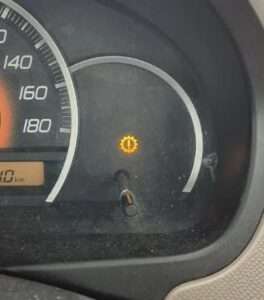
Age, experience, and a measure of restraint helped us avoid rash decisions. We slowly manoeuvred the car to a marginally safer spot and switched it off. The sensor, however, continued its relentless warning—like a child refusing to be ignored.
Complicating matters, our GPS lost its bearings in the chaos of diverted routes and disrupted traffic patterns. Just when the situation seemed to be slipping beyond control, help arrived—twice, and from the most unexpected quarters.
The first was a kind-hearted Rajasthani passerby who took it upon himself to guide us through the maze of blocked roads. Technology had not failed us entirely, but the pace at which city traffic diversions change would test even the best of digital maps.
The second saviour was a young mechanic we spotted about 150 metres away. One look at the warning signal, and he diagnosed the issue with clinical precision: the gearbox had overheated due to prolonged stress in Drive mode. He fetched a sachet of gear oil, topped it up, and advised us to let the car cool down.
The lesson was as clear as it was humbling. Keeping the car in “Drive” while stationary for extended periods had strained the transmission unnecessarily. A simple shift to “Neutral” could have prevented the overheating.
After about an hour’s wait, reassured by the mechanic’s calm confidence, we restarted the car and cautiously resumed our journey. The sensor continued to blink for a while—almost as if reminding us of our mistake—but we eventually made it to the hotel.
By the next morning, the car behaved as though nothing had happened.
But the thought lingered: what if that sensor hadn’t been there? What if the warning had gone unnoticed until smoke turned to flames?
Modern vehicles are packed with such silent sentinels—seat belt alerts, engine temperature warnings, locking indicators—all designed to compensate for human oversight. They may lack emotion, but they possess something far more valuable: consistency.
Which brings us back to the wordplay.
A sensor—electronic, precise, and impartial—alerts you to danger without bias. A censor, on the other hand, is human—subject to interpretation, inconsistency, and, at times, selective judgment. Anyone who has dealt with film certification boards or regulatory scrutiny will appreciate the difference.
In a world increasingly driven by technology, perhaps it’s worth acknowledging that non-biological systems, for all their limitations, often deliver a level of reliability humans struggle to match.
Sensors, in their quiet, blinking way, save lives.
Censors, depending on who they are, may only test your patience.
Sometimes, it pays to listen to the machine.


Civic Disaster Management is learned through these live experiences. A superb article responding to the most current climate and environmental stresses of the present times 👌🏼👌🏼