


We are proud to introduce this special page, “Unsung Heroes,” dedicated to India’s “unsung heroes” — individuals whose brilliance elevated the nation, yet whose stories were quietly pushed to the margins. These are minds that shaped India’s intellectual and scientific foundations but were denied their rightful place in popular memory. For decades after Independence in 1947, public discourse often circled around a narrow set of personalities, leaving countless contributors obscured by political narratives and selective historiography. The result is a generation that knows too little about the depth and diversity of India’s true legacy. This initiative is a small but determined step to correct that imbalance. By revisiting these lives, we hope to reconnect the present and future generations with the intellectual giants who helped build India — not for recognition, but out of conviction. We hope this page informs, provokes thought, and most importantly, restores memory where it rightfully belongs. – Editor
MS Sparsha
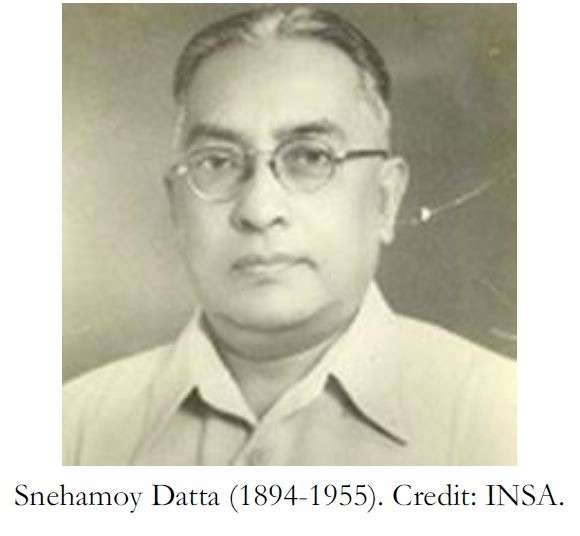
The Vanishing Signature of Dr. Snehamoy Datta
He decoded the language of light, yet history erased his own. Dr. Snehamoy Datta (1894–1955) remains one of the most enigmatic figures in Indian science — a man whose work illuminated the secrets of atoms, even as his own legacy faded into near invisibility.
Born in Bengal in 1894, Datta belonged to what can only be described as the golden generation of Indian physicists — a cohort that emerged during a time when India, still under colonial rule, was quietly producing minds capable of standing shoulder-to-shoulder with the best in the world. His journey took him to London in 1919, where he entered the elite circles of scientific research and went on to become one of the earliest Indians to earn a Doctor of Science (DSc) degree from the University of London.
Working under Alfred Fowler — a pioneer who helped lay the foundations of modern astrophysics — Datta immersed himself in one of the most complex scientific puzzles of his time: understanding how light interacts with matter. This was the era when quantum mechanics was still in its infancy, when scientists were only beginning to grasp how electrons behaved within atoms.
Datta’s work focused on spectroscopy — the study of light emitted or absorbed by substances. In simple terms, he was decoding the “signature” of elements, the unique patterns of light that reveal what stars and materials are made of. What set him apart was his precision and originality.
He tackled the problem of spectral regularities — the mathematical patterns hidden within the light spectra of elements. Through meticulous experimentation, Datta identified consistent patterns in elements such as magnesium, calcium, and strontium. These were not just incremental findings; they were foundational clues that helped scientists understand how electrons transition between energy levels.
At a time when theory often raced ahead of proof, Datta provided the crucial experimental backbone. His findings became reference points for some of the greatest theoretical physicists of the era, including Arnold Sommerfeld, who used such data to refine emerging atomic models. In essence, Datta was the bridge between observation and theory — the experimentalist whose work allowed abstract ideas to take concrete shape.
And then, at the peak of what could have been an illustrious global career, he made a choice that would define — and perhaps diminish — his place in history.
He returned to India. Not for recognition, not for awards, but to build.
Datta took on academic leadership roles, serving as Principal of Rajshahi College and later at the prestigious Presidency College. In doing so, he transitioned from being a world-class researcher to an institution builder — a decision that, while invaluable for India, came at a personal cost.
In Europe, he could have continued publishing, collaborating, and perhaps even entering the race for the highest scientific honours. In India, he chose instead to nurture talent, to create systems, and to lay the groundwork for future generations of scientists.
It is here that the paradox of his life becomes evident. By choosing to become the infrastructure of Indian science, he became invisible within it.
Unlike many of his contemporaries, whose names are etched into textbooks, commemorated through statues, or preserved in institutional memory, Snehamoy Datta quietly receded from public consciousness. Today, he is so little remembered that even within his own extended family, the scale of his contributions is not fully known.
This is not merely an oversight — it is a reflection of how history often rewards visibility over substance.
In the 1920s, Datta’s work was cited by leading physicists across Europe. His name carried weight in the laboratories of London and Germany, where spectroscopy was unlocking the secrets of the universe. Yet, in modern India, he remains largely absent from mainstream narratives of scientific achievement.
There are no widespread commemorations, no detailed popular accounts, not even a widely accessible record that does justice to his contributions. He exists, at best, as a faint trace in academic archives — a “ghost” in the history of Indian physics.
Dr. Snehamoy Datta passed away in 1955, just as India was stepping into its era of big science — atomic research, space exploration, and institutional expansion. He left behind generations of students, a strengthened academic framework, and a body of work that had already influenced the global understanding of atomic structure.
What he did not leave behind was recognition.
Perhaps because he never sought it.
And perhaps because history, too often, overlooks those who choose nation-building over self-promotion.
In remembering Snehamoy Datta, we are not merely revisiting a forgotten scientist. We are confronting a larger question: how many such architects of India’s intellectual heritage have been left out of the story? This page begins that search.



Marvellous and noble gesture of reviving the noteworthy contributions of Nation builders. I have heard about Dr Datta from physicist professor Puranik who happened to be the principal of Nizam college and the principal of my college where I first joined . His anguish that India neglects the substantial scientific thinkers finds some compensation through such tributes. Bringing back to people’s consciousness, the endeavours of noble intellectuals is a great cause . 👏🏻👏🏻👍🏼