

There was a time when a marriage in India could survive bad cooking, burnt rotis, and even unsolicited advice from both sets of in-laws. Today, it appears, it cannot survive the absence of chicken curry.
Two recent reports – one from Kamareddy in Telangana, another from Vadodara in Gujarat – read less like crime briefs and more like culinary reviews gone catastrophically wrong. In one, a husband objects to the lack of chicken at dinner. In the other, a husband declines to eat what is served. In both, the menu ends not with dessert, but with death.
It is tempting to treat these as aberrations – the sort of grim, isolated incidents that fill the inside pages and are forgotten by the next news cycle. But there is an uncomfortable pattern lurking beneath the absurdity. Domestic disagreements, once the staple of everyday married life, now seem to come with a hair-trigger escalation.
From pati dev to defendant
Indian marriages have traditionally been wrapped in reverence. The husband was ‘pati dev’ – an exalted figure, at least in theory – and the wife ‘gruha lakshmi’, the keeper of the home’s harmony and hearth. It was not always an equal arrangement, but it was a stable one, held together by duty, tolerance, and a shared understanding that walking out – or worse – was not the first option.
Arguments happened, certainly. Over salt in the dal, over money, over whose relatives were more unbearable. But these skirmishes rarely threatened the institution itself. The pressure to endure was immense – sometimes unfairly so – but it ensured that tempers cooled faster than they flared.
Today, the vocabulary has changed. Respect has given way to assertion, patience to instant reaction. The old endurance model has been replaced by a far more combustible mix of ego, stress, and zero tolerance for inconvenience.
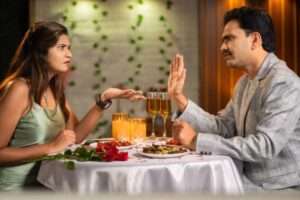
The tyranny of taste buds
Food, in these cases, is not the cause – it is merely the trigger. A refusal to cook chicken or to eat a meal is hardly grounds for existential crisis. Yet it becomes one, because the argument is no longer about dinner. It is about control, expectation, and the inability to accommodate even minor discomfort.
Somewhere along the way, the domestic table has become a negotiating table – and every meal a referendum on respect. A dish declined is seen not as a preference but as a provocation. A request unmet is treated not as a circumstance but as defiance.
It is a fragile arrangement, where the tolerance for disappointment is lower than the spice level in the curry.
The vanishing middle ground
What has disappeared is the middle ground, the quiet space where disagreements could exist without turning terminal. Earlier, families intervened, neighbours mediated, and even the participants themselves understood when to retreat. Now, escalation is swift and often irreversible.
Part of this is the erosion of community buffers. Nuclear families mean fewer witnesses and fewer peacemakers. Part of it is the pace of modern life, where stress travels home and settles at the dining table. And part of it is a shift in expectations – marriage is no longer seen as a compromise, but as a contract of continuous satisfaction.
When that satisfaction is not delivered, the reaction is no longer resignation. It is a confrontation.
Holy matrimony, hollow patience
None of this is to romanticise the past. The old system had its own injustices, often borne silently. But it did possess one quality that seems in short supply today – restraint.
The idea that a marriage could absorb friction without collapsing now feels outdated. Instead, we have relationships that are intensely expressive but structurally brittle. They react quickly, but they do not recover.
And so, a missing chicken curry becomes a provocation. A refused meal becomes an insult. And a moment of anger becomes a point of no return.
A modest proposal
Perhaps the solution is neither a return to blind endurance nor an embrace of explosive assertion. It lies somewhere in between – in the unfashionable virtues of patience, perspective, and the ability to let small things remain small.
After all, a marriage that cannot survive a bad meal is unlikely to survive much else. And if dinner continues to double up as a duel, it may be time to reconsider not the menu, but the mindset.