



In the modern era, the nature of warfare has completely transcended traditional boundaries. It is no longer limited to tanks, aircraft, or soldiers, but has become a multifaceted, complex, and technology-intensive process, in which drones, cyberattacks, space-based surveillance systems, artificial intelligence, and hypersonic missiles operate in unison. In this changing landscape, warfare is no longer confined to a single geographical region, but rather operates in a continuous coordination between sea, air, land, and cyberspace. In such an environment, it has become imperative for an emerging regional and global power like India to redefine its security strategy. Developing nuclear deterrence, especially in the maritime domain, is no longer an option but a strategic necessity, as it not only strengthens India’s defense capabilities but also bolsters its global strategic position.
The changing geopolitical situation in the Indian Ocean region further highlights this need. This region is not only strategically important but also a major route for global trade and energy supplies. Most of the world’s oil and commercial vessels pass through this route, and India’s energy security depends significantly on it. Consequently, any instability or external interference in the region could impact India’s economic and strategic stability. China’s growing maritime presence, its port development policy, and its military activities in the region pose long-term challenges for India. Pakistan’s nuclear capabilities and growing naval power are also a cause for concern. Under these circumstances, it becomes imperative for India to not limit its maritime security to conventional means alone but also to strengthen it with nuclear deterrence.
The fundamental objective of maritime nuclear deterrence is to ensure that any potential adversary receives a clear message that if it launches a nuclear attack, it will face an equally or more effective response. This principle gives rise to the concept of “credible minimum deterrence,” under which a country develops only as much nuclear capability as is necessary to deter a potential threat. India’s “no first use” policy is also based on this principle, which states that India will not use nuclear weapons first, but will respond with full force if attacked. The credibility of this policy is possible only if India possesses a capability that remains secure even after a first strike and can deliver an effective response. This is where maritime nuclear deterrence, especially nuclear-powered ballistic missile submarines, plays a crucial role.
Submarines are considered the most effective means in this regard, as they can remain hidden in the depths of the ocean for long periods of time and are extremely difficult to detect. This strengthens their “second strike capability.” That is, even if a country’s land or air bases are destroyed, submarines at sea remain capable of launching a counter-attack. This capability provides a strong deterrent for any adversary, as it knows it is not completely safe. Thus, maritime nuclear deterrence plays a vital role not only in the event of war but also in maintaining peace.
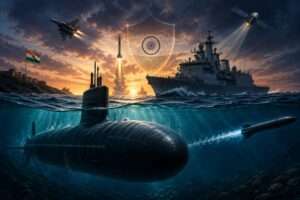
India has made significant progress in this direction in recent years. The development of nuclear-powered submarines based on indigenous technology indicates that India is now moving towards becoming self-reliant rather than relying on external sources for its defense needs. These submarines possess the capability to launch long-range ballistic missiles, making them extremely strategically important. Furthermore, the use of modern technologies such as Multiple Independently Targetable Re-entry Vehicles (MIRVs) makes them even more effective, allowing a single missile to engage multiple targets. This capability is not only militarily significant but also poses a strategic challenge to adversaries.
However, simply building submarines is not enough; a robust system is also required for their operation, maintenance, and security. Nuclear submarines rely on highly complex technical systems, and their operation requires a high level of expertise and training. Furthermore, cybersecurity has become a crucial aspect, as cyberattacks can disable any military system in modern warfare. Hacking a submarine’s communication or control system could pose a serious threat. Similarly, space-based surveillance systems could challenge the secrecy of submarines, impacting their strategic utility.
Future strategies will need to take all these aspects into account. The use of artificial intelligence, quantum communications, and advanced sensor technology could further enhance submarine capabilities. Quantum communications, in particular, could provide a new means of secure communication, making it virtually impossible for an enemy to intercept or interfere. Additionally, advanced sensor and surveillance systems could make submarines more accurate, effective, and secure.
International cooperation can also play an important role in this direction, but ultimately, a country’s security depends on its own capabilities. India is active on various global platforms and encourages cooperation for maritime security, but it must equally strengthen its indigenous capabilities. This requires increasing investment in research and development, strengthening scientific institutions, and promoting innovation in the defense sector.
The development of maritime nuclear deterrence is not merely a display of military power, but part of a balanced and responsible strategy aimed at maintaining peace and stability. A strong deterrence capability helps deter potential conflicts and ensures that any country seriously considers the consequences before taking aggressive action. Thus, this capability becomes an effective means of preventing war.
Ultimately, it can be said that in the modern era, India’s maritime nuclear deterrence capability has become a central element of its national security strategy. It not only protects India from external threats but also establishes it as a responsible and capable power on the global stage. Amidst changing global circumstances and emerging challenges, it is essential for India to continuously update its strategy and further strengthen its security by adopting new technologies and ideas. Steps taken in this direction will ensure a safe and stable environment not only for the present but also for future generations.


