



Dharmaraja, having sought the blessings of the elders, returned to his ranks with a mind absorbed in the coded exchange he had held with Bhishma and Drona. Their counsel demanded subtlety to decipher, and their intricate, suggestive words swirled ceaselessly in his thoughts. The most difficult task before him was to understand Dharma. In the present context, it meant righteous action and sacred duty, the foremost principle and essential mark of human life. Where righteousness abides, victory follows; duty is ever active, changing with time, place, and role. Perhaps Dronacharya had implied that Dharma, Krishna, and victory are but one divine mould. Krishna is my teacher, my guide, and my sustainer. In matters of discerning what ought and ought not to be done, let Krishna decide, lest the mind wander elsewhere and miss the living presence. Gathering himself fully, his gait turned like that of a lion leaping upon its prey. This change was noticed by Krishna and his brothers, and they felt relieved.
Karna, out of curiosity to learn the events unfolding, was politely greeted by Sri Krishna, who then struck him with a soft yet sharp word. “Karna,” he said, “I hear you are not taking part in the battle because of your anger toward Bhishma. Why not join the Pandavas and fight until Bhishma falls? This is the right moment to seek vengeance against him.” In this, Krishna hinted at Karna’s love of conflict and battle, employing a divisive tactic that forms an important part of political strategy. Karna replied, “I am indeed angered by his humiliating attitude toward me and have taken an oath not to fight beside him. Long ago I gave my life to Duryodhana; I do not join other forces. There is no question here, and I shall abide by my truthful commitment.” This clearly showed that Karna bore immense respect for Bhishma and that his anger was only temporary. The grandsire, too, had restrained him, for any small error might lead to disaster and uproot all efforts, considering Karna’s rash and impetuous nature. From both sides, it was a matter of principle, not personal vendetta. Both strove for Duryodhana’s victory, though their paths were not in harmony; hence Bhishma had suspended him for a time. Had he not done so, he would have been guilty of neglecting duty. Krishna, reflecting on this, appreciated Karna’s loyalty and moved toward the ranks.
After reaching his place, Dharmaraja went a step further in upholding the code of war and proclaimed aloud, gazing upon the Kaurava forces, “If anyone wishes to join our ranks, I welcome them wholeheartedly and shall treat them as my own brothers. This is my promise.” From the enemy camp came the reply that Yuyutsu, your son, wished earnestly to join him. Born to a maid in the palace of Dhritarashtra, he was thus a half-brother to Duryodhana. He declared his opposition to their views and wicked deeds and sought to join the righteous Pandavas. He was welcomed with drums, trumpets, and conches, garlanded, and joined the Pandavas with a band of soldiers, all praising the timeliness of his choice.
Dharmaraja mounted his chariot, donned armour, bore weapons, and placed upon his head a protective helm, becoming a fierce warrior in form. His brothers and commanders took their appointed positions. Soldiers on both sides recalled the hardships endured by the Pandavas and their sincere efforts for reconciliation, and in their hearts, they acknowledged their worth. Sanjaya, with his divine vision that could read minds, conveyed these sentiments to King Dhritarashtra. He also spoke with pleasure of the noble and refined character of Dharmaraja in having approached the elders of the opposing camp.
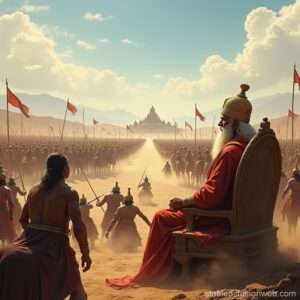
The blind king was acutely aware of the palpable injustice he had done to the sons of his brother Pandu and of the viciousness of his past conduct; the consciousness of crimes committed weighed heavily upon him. He doubted the outcome of the war and asked Sanjaya what was occurring on the field of Kurukshetra. Sanjaya reported that Duryodhana, seeing the Pandava forces arrayed for battle, though fewer in number than his own, felt his confidence ebbing away. He went to Dronacharya with a troubled mind, haunted by impure motives and an unjust cause, pointing out to his teacher the formations on the Pandava side. His speech revealed what he truly needed, for it betrayed his inward fears.
He listed the names of renowned warriors in the Pandava army, reviewing their ranks and highlighting those who functioned as maharathis, a division in ancient warfare. He spoke of Arjuna and Bhima as acknowledged men of war, famed for archery and strength, implying that though the Pandava forces were fewer, their effectiveness far exceeded that of the larger and better-equipped Kaurava host. He addressed his master as the best among the twice-born, then repeated the distinguished names within his own army, like a weak man seeking escape from his own fears. The guilty conscience of your son, a tyrant prince, undermined his mental strength. The more he realized the combined might of the great personalities arrayed in the Pandava camp, the more abjectly nervous he became, despite the competence of his own heroes.
Dronacharya remained silent, and your son, helpless to find new encouragement, sought to revive his sagging spirits by doubting his teacher’s loyalty. He reasoned that since the enemy ranks were filled with Drona’s own students, the teacher might harbor softness toward them. The tyranny within your son was shrewd and shameless, entertaining doubts about the integrity of his guru and projecting his own impure motives and foul thoughts upon him. Disturbed by his own brutal deeds and past crimes, his insulting arrogance returned upon him, while Dronacharya remained calm and silent. Duryodhana failed to understand this and instead boasted of the stupendous honor that so vast an array of heroes had come to lay down their lives for him.
After assessing the strengths and weaknesses of both armies, he rose above his mental clouds and issued imperial commands. He ordered each commander to hold his position, fight in disciplined ranks, conserve energy and strength, and above all protect the revered Bhishma. Perhaps he suspected that the vast force mobilized on his side was an ill-assorted, heterogeneous host of various tribal chieftains that required careful maneuvering toward a united cause. He knew that synchronized action was the root of his army’s success. Thus Duryodhana, now acting as a true strategist, instructed the commanders of the different wings toward the single aim of safeguarding Bhishma.
Your son’s unease and the stoic silence of Dronacharya were noticed by Bhishma. He realized that the situation could be saved only if those assembled were shaken out of their mental preoccupations, for delay would render them ineffective. Knowing the psychological dynamics of commanders, the grand marshal Bhishma lifted his war conch and blew it, sending forth a roaring wave of lion-like confidence into the hearts of those manning the ranks. This act of Bhishma was tantamount to the first arrow of warfare, and with that long roar, the great war began.
Sanjaya then said to Dhritarashtra that, for all practical purposes, the war had been initiated by the Kauravas. Yet he still nourished hope that by a critical description of Duryodhana’s state of mind, the monarch might possess the power to halt the destruction. Thus opened a grand page of ancient history, for generations to read, learn, grasp, and understand the dynamics of fratricidal war and its long-term impact upon society.

