


A pivotal moment on 6 April 2026, when Prototype Fast Breeder Reactor (PFBR) at Kalpakkam achieved criticality, was drowned in the cacophony of threats and counter-threats between the US and Iran in the ongoing Middle East war. With this milestone, India moved a step closer to achieving its goal of energy self-sufficiency, akin to the green revolution of the 1960s.
Bhabha’s vision: Dr. Homi Bhabha realised very early that India, with its meagre 1-2% of global Uranium reserves, will be dependent forever on other countries, exposing it to blackmail and hegemony of the Western countries, especially the US. The ongoing US-Iran war and the recent Trump tariff drama have proved Dr. Bhabha’s words prophetic. To overcome this predicament, Bhabha proposed a Three-stage closed nuclear fuel cycle in the 1950s to utilise enormous Thorium deposits in the country. India has 25% of the proven global Thorium reserves that can provide an almost unending nuclear energy for thousands of years, if the Three-stage program succeeds. It looks 70 long years for Indian scientists to overcome technology and fuel denial, but they never gave up and continued to live Bhabha’s dream.
With the success of PFBR, India demonstrated its technological prowess in Fast Breeder Technology. This aligns with the second stage of Bhabha’s vison of a closed fuel cycle and is a vital bridge between the current fleet of pressurized heavy water reactors and the future deployment of thorium-based reactors, leveraging the country’s abundant Thorium resources for long-term clean energy generation. A brief explanation on this topic is provided that would be of some interest to general readers.
Nuclear energy: Nuclear energy is produced from a naturally occurring element called Uranium. When an atom of Uranium is split through a process called fission, it produces an enormous amount of energy that is more than 10 million times that of the combustion of one atom of carbon from coal in a thermal power plant. A rough calculation shows that ~27 kg of Uranium is required to produce 1 million units of electricity against ~700 tonnes of coal! Unfortunately, only 0.7% of natural Uranium found in the Earth is fissile U-235 that can undergo fission, and the remaining 99.3% U-238 goes as waste. The numbers 235 and 238 mentioned indicate the number of protons and neutrons present in each of the Uranium atoms constituting its mass, and are called isotopes. Isotopes are like twin brothers of different weights and temperaments in a family.
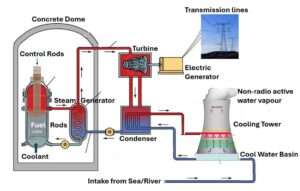
Nuclear Reactor: The core of a nuclear reactor is a pressure vessel made of thick, high-strength carbon steel, often with stainless steel cladding to prevent corrosion. It contains Uranium fuel (UO2) pellets assembled into fuel rods made of zirconium alloy, which is non-corrosive. In addition, there are movable control rods made of boron or cadmium that absorb neutrons to stop, start, or regulate the fission chain reaction. The core is housed inside a dome-shaped containment building made of thick steel-reinforced concrete, often 3 to 5 feet thick, to provide both structural strength to withstand internal pressure and radiological shielding to protect the environment.
Power generation: To start a nuclear reactor, movable control rods are raised so that the number of neutrons being absorbed by it drops. So, when a neutron strikes a U-235 nucleus, it splits by fission into smaller nuclei, releasing 2-3 additional neutrons, which in turn strike other U-235 atoms, creating a controlled, self-sustaining chain reaction. Sometimes, to boost the reaction in the initial stage, additional neutron sources like Californium-252 or alpha-beryllium mixtures are introduced into the reactor. During this process, an enormous amount of thermal energy is generated. A coolant, usually water, is pumped through the core, which absorbs the heat from the fission process, reaching temperatures up to 320 degrees centigrade, while remaining liquid due to extremely high pressure in the vessel. This hot water is then pumped into a steam generator (heat exchanger) where it passes through several small tubes. The high-pressure steam is used to move turbines that are connected to an electric generator and the power grid. The cooled water from turbines is looped back into the reactor chamber through cooling towers.
India’s unique closed-loop fuel cycle: A closed-loop fuel cycle is the very foundation of India’s three-stage nuclear power programme, designed to maximize India’s limited uranium resources while leveraging its vast thorium reserves.
The Three-Stage Strategy that was designed in the 1950s was to move from first-generation pressurised heavy water reactors (PHWRs) that India indigenised in Stage-1 to Generation IV fast breeder reactors (FBRs) in Stage-2 and finally to Thorium-based reactors in Stage-3. First-generation Indian PHWRs use natural Uranium as a fuel in the form of UO2 pellets. The spent fuel U-238 is reprocessed to extract fissile Plutonium-239 which becomes the fuel for the second stage FBRs.
Unlike PHWRs the second stage 500 Mwe Prototype Fast Breeder Reactor (PFBR) at Kalpakkam in Tamil Nadu is totally indigenous and is developed by Indira Gandhi Centre for Atomic Research (IGCAR) and built by Bharatiya Nabhikiya Vidyut Nigam Limited (BHAVINI) with the participation of over 200 Indian industries, including many MSMEs, contributing to its development, aligning with the Aatmanirbhar Bharat initiative. This Fast Breeder Reactor uses Uranium-Plutonium Mixed Oxide (MOX) fuel. The core of the reactor is surrounded by a blanket of fertile Uranium-238. Fast neutrons convert fertile Uranium-238 into fissile Plutonium-239, enabling the reactor to produce more fuel than it consumes. Because liquid sodium is used as a coolant, it absorbs fewer neutrons compared to heavy water, allowing more neutrons to remain within the reactor. An increased number of neutrons causes a higher proportion of Uranium 238 getting converted into plutonium -239, yielding more plutonium than the original nuclear fuel.
In the final stage-3, fertile Thorium-232 will be used along with fissile Plutonium-239 to convert Th-232 to fissile Uranium-233 that will be used as a fuel in a loop. This will provide long-term, sustainable energy using enormous Thorium deposits in the country.
Additionally, India is actively developing Generation IV reactors with a major focus on SMRs (Small Modular Reactors) and AMRs (Advance Modular Reactors) for different functions under a dedicated “Nuclear Energy Mission” for which Rs.20,000 crore have been allocated for 2025-26 for research, design, and development.
India shows the way: The quantity of nuclear waste in the form of spent fuel from worldwide nuclear reactors is increasing every day. Approximately 70% of spent fuel discharged from reactors goes through this “once-through” pathway, where it is stored in pools or dry casks, rather than being reprocessed. The disposal of this highly toxic nuclear waste has been a topic of discussion.
With the success of PFBR, India has shown the way. The quantity of waste from nuclear power plants in India is much smaller compared to any other country in the world, due to our adoption of the closed fuel cycle. The Indian three-stage nuclear power programme follows the philosophy of “reprocess to reuse”, where the spent fuel of one stage becomes the feeder fuel for the next stage. India treats the spent fuel not as waste, but as wealth. Let us Nurture Nature by reducing nuclear waste.


Nice article. Hopefully India will be self reliant in power sector. As much as we want to get out of fossil fuel it seems to take forever. But the world made big progress towards getting rid of fossil fuels.
Comparitively Production management is easier than the waste disposal or in a way waste management. The author has highlighted the most importance of nuclear waste where Indian scientists made it possible ie., reprocess to reuse. This is really a blessing in disguise.
Thanks to the author for presenting a comprehensive article on PFBR….
The author, Dr. R.K. Chadha, does an excellent job of demystifying “nuclear jargon” for a general audience.
Very timely initiative by GOI. Congratulations to the entire nation. Jai Bharat🙏
thank you sir for valuable article
Excellent, state-of-the-art article on the country’s power sector for general readers. Hope the country achieves self reliance in the near future.