



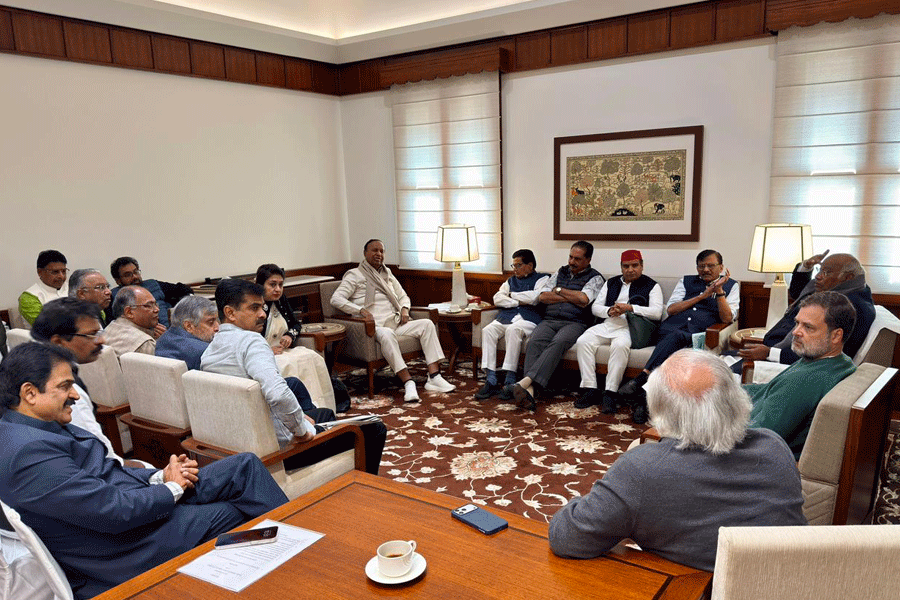
If reports are to be believed, India’s discredited Opposition is now preparing yet another dramatic move — a motion seeking the removal of Chief Election Commissioner Gyanesh Kumar. The alleged draft, reportedly prepared by the Trinamool Congress led by Mamata Banerjee, is being circulated among Opposition parties.
The question, however, is simple: what exactly is the purpose of these motions if the very parties moving them refuse to debate them seriously?
In recent months, the Opposition has developed a peculiar parliamentary habit — move dramatic motions, disrupt proceedings, and then refuse to engage in meaningful debate. The same spectacle was witnessed when Opposition parties attempted to move a motion against Om Birla. Instead of presenting evidence or arguments, they chose disruption over discussion.
Now the target appears to be the Election Commission.
The immediate trigger seems to be the ongoing scrutiny of electoral rolls through the Special Intensive Revision (SIR) exercise, which reportedly placed around 60 lakh suspicious voter entries under verification. Such scrutiny is neither new nor extraordinary; it is part of the Election Commission’s routine mandate to maintain the integrity of the electoral process.
Yet for the Opposition, verification itself has become a crime.
If the electoral rolls are not cleaned up, they complain about voter fraud. When the Election Commission attempts to verify questionable entries, they cry “democracy in danger.” This selective outrage reveals less about institutional misconduct and more about political anxiety.
The loudest voice behind the proposed motion appears to be the Trinamool Congress, which has long been uncomfortable with scrutiny of voter lists in West Bengal. The SIR process, by flagging millions of questionable entries, has clearly rattled those who thrive on the opacity of electoral rolls.
Instead of answering the Election Commission’s queries or encouraging transparency, the instinct is to attack the referee.
This strategy is not new. The Opposition had earlier attempted to disrupt Parliament during a statement by External Affairs Minister S. Jaishankar in the Rajya Sabha. Rather than engage with India’s foreign policy arguments, the preferred tactic was to shout slogans and stall proceedings.
In other words, debate is avoided, disruption is celebrated, and institutions are targeted.
But the deeper reason behind these theatrics may lie elsewhere — electoral desperation.
India is heading into six crucial state assembly elections this year, and the Opposition appears acutely aware of the difficult terrain ahead. Their earlier “vote-chori” narrative during the 2024 general elections failed to gain lasting traction. If anything, voters seemed unimpressed by the attempt to undermine the credibility of India’s democratic institutions.
The evidence was visible in subsequent state elections.
Instead of weakening the ruling alliance, the campaign backfired. Voters in states such as Haryana and Maharashtra returned the Bharatiya Janata Party to power, suggesting that the electorate was quick to see through the manufactured narrative.
History shows that Indians take their democracy seriously. Attempts to delegitimise institutions without proof rarely succeed.
The nervousness is even more visible in West Bengal. The ruling Trinamool Congress recently tried to manufacture another political scare — suggesting that the Centre might impose President’s Rule in the state after the replacement of Governor C. V. Ananda Bose by Kailash Nath Murmu (reports around administrative changes were quickly politicised).
The narrative did not last long. Like many previous allegations, it faded once facts caught up.
The anxiety is not limited to Bengal. In Kerala, some pollsters predict an edge for the Congress-led United Democratic Front. Yet many analysts believe the ruling Left Democratic Front could return for a third consecutive term, a result that would be politically devastating for the Congress.
Meanwhile in Bihar, political equations have shifted again. Veteran leader Nitish Kumar recently chose to move to the Rajya Sabha, effectively handing over greater operational space to the BJP in a state where it has already emerged as the single largest political force.
Ironically, it was the BJP that had earlier shown repeated magnanimity by backing Nitish Kumar as Chief Minister multiple times despite its own numerical strength. His latest move is widely interpreted as a gesture acknowledging that political reality.
All of this explains the Opposition’s growing resort to dramatic gestures.
When electoral prospects look uncertain, institutions become convenient targets.
But such tactics carry risks. Repeated attempts to undermine Parliament, question the Election Commission, and manufacture crises may energise political cadres, but they rarely convince voters. In fact, they often produce the opposite effect — strengthening the perception that the Opposition has run out of constructive ideas.
If the proposed motion against the Chief Election Commissioner indeed materialises, it may generate headlines for a day or two. But unless it is backed by credible evidence and serious debate, it is likely to meet the same fate as many previous Opposition theatrics.
In politics, credibility matters.
And motions without credibility often end up exposing those who move them more than those they target.


