
Television news loves a good set-piece. Election days, in particular, are treated less as exercises in democratic accounting and more as theatrical productions. Studios are redesigned, wardrobes coordinated, and correspondents deployed like battalions.
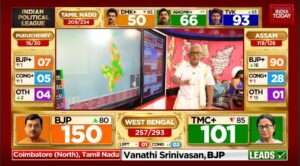
On this occasion, the spectacle was complete. Regional attire, cultural motifs, a sprawling digital dashboard – everything carefully assembled to convey immersion and authority. At the centre of it all sat Rajdeep Sardesai, presenting poll trends with the same breathless enthusiasm seen across major networks. The problem was, the numbers were not cooperating.
When data becomes inconvenient
Exit polls are a curious species. They are embraced when they flatter expectation and interrogated when they disrupt it.
What unfolded a couple of days ago was not merely scepticism. It was agitation. Projections suggesting a particular direction for the BJP were met with sharp questions about credibility, funding, and intent. The tone was unmistakably uneasy.
Yet today, as the broadcast progressed, that unease gave way to something else.
From doubt to declaration
The same anchor who had questioned the reliability of exit polls on Straight Bat was now presenting incoming trends with visible energy – treating them, effectively, as results emerged. It was a striking contrast.
The shift from doubt to near-certainty was not gradual; it was abrupt. One moment, the exit polls were suspect. Next, the emerging numbers were being relayed with confidence, urgency, and a sense of unfolding inevitability. One could be forgiven for wondering if it was the same Rajdeep.
The elastic standard
This is where the elasticity of standards becomes hard to miss. Opinion polls and exit polls are unreliable – until they begin to align with reality. Funding is questionable – until the numbers appear to hold. Methodology is flawed – until it produces a trend that cannot be ignored. Scepticism, in such a setting, begins to look less like a principle and more like a position.
Suspicion without specifics
Earlier insinuations about pollsters being backed by shadowy interests added drama but little clarity. If the ecosystem is compromised, it deserves exposure with evidence, not broad suggestion.
The narrative strain
At the heart of it lies a familiar tension. Political commentary often builds a narrative over time. When data begins to challenge that narrative, the instinct is to resist before recalibrating. That resistance was visible in Rajdeep’s initial reaction to exit polls. What followed, however, was recalibration in real time.
As trends firmed up, the resistance softened. The presentation was adapted. The tone aligned itself with the emerging numbers.
The inevitable landing
After the oscillation between doubt and acceptance, the conversation settled into the safest possible conclusion.
When the referee steps in
Journalism demands distance. It asks the observer to remain separate from the outcome. In this instance, that distance seemed to fluctuate.
There was a moment when the referee appeared to join the game, questioning the scoreboard when it looked inconvenient. And then, just as quickly, stepping back to read it out with authority when it began to stabilise. The numbers did not change in character. The response to them did.
And that is what made the coverage revealing – not the exit polls, not even the results, but the visible shift in tone when reality proved harder to argue with.