


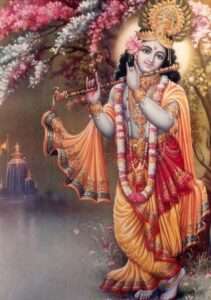
Śrī Krishna, with firm resolve to awaken Arjuna through the highest dimension of knowledge and experience, spoke thus: “Among the Vṛiṣṇis, I am Vasudeva. Among the Yādavas, the ancestor Yadu had a son named Vṛiṣṇi, and all his descendants together formed the tribe called the Vṛiṣṇis. In that lineage, Vasudeva was born as the great-grandson of Vṛiṣṇi, and to Devakī, the sister of the tyrant of Mathurā, Kaṁsa, Krishna was born. As the son of Vasudeva, the Lord is therefore called Vāsudeva.”
“Among the Pāṇḍavas, I am Dhananjaya. Just as Krishna was the mighty one who gave pride and glory to both the Yādava and Vṛiṣṇi clans, through whom they have attained a glorious and lasting memory among men, so too among the Pāṇḍavas he again was the animating soul, without whom the five brothers would perhaps have achieved nothing. The term Dhananjaya means the winner of wealth, and it is generally regarded as a title of Arjuna; hence it is understood as, ‘Among the Pāṇḍavas, I am Arjuna.’”
“Among the sages, I am Vyāsa. Vyāsa was a pen name that came to symbolize a new style of literature introduced into the realm of philosophical and religious works of that age. Until then, sacred literature had been cast in mantra form for chanting, with thoughts woven into short and compact linguistic threads. With the introduction of the Purāṇas, a new style was initiated and developed, where elaboration became the motive and repeated emphasis on fundamentals the chief technique. This was innovated by Kṛiṣṇa Dvaipāyana under a suggestive pen name—Vyāsa—explaining in itself his literary art of expansion. Thus, ‘Among all munis, I am Vyāsa’ suggests that among all men of reflection, the Lord is he who stands behind the stupendous work known today as the Purāṇas.”
“Among the seers, I am Uśanā. This seer is identified with Śukra, the planet Venus, who was the son of Bhṛigu and the preceptor of the Daityas. Śukra was called Kavi in the Ṛigveda, and the term Uśanā applies to one inspired through mantras.”
“I am the sceptre among chastisers. For both the ruler and the ruled to flourish, the state must prevail, if they desire progress and an improved standard of living within the community. The lawgiver must govern by enforcing law. In the function of government, the governor becomes the punisher of wrongdoers, while the ruled, in loyalty and reverence to the law, obey the ruler. The power vested in the king is the sceptre, the badge of authority to punish.”
“Among conquerors, I am statecraft. Mere physical conquest is no victory at all. No nation, community, society, or individual can be considered conquered merely because force stands guard over them. Conquest is complete only when, through intelligent administrative policies, the conqueror brings the conquered to identify with their culture and thought patterns. If the conqueror cannot transform the conquered, the conquest remains incomplete. Only this can bring the conquered permanently under the will of the conqueror. I am that statecraft by which conquerors truly fulfill their aim.”
“Of things secret, I am silence. Secrecy is maintained and nourished by silence; when a secret is exposed in open discussion, its very purpose is sabotaged. Its essence is silence. The knowledge of the Self is described in ancient texts as the secret of secrets. This great secret is experienced, sustained, nourished, and enjoyed only in deep inner silence.”
“I am the knowledge in the knower. The wisdom of the wise is not the wise themselves, and yet it is not different from them. The Self is not the body, yet we cannot say the body is anything apart from the Self, which is all-pervading. The coverings of matter and their worlds of experience are but the aura of glory that shines around the Self. The knowledge in the knower, the wisdom in the wise, is the expression of the divine glory.”
Summing up all that has been said, the Lord declares in a beautiful peroration: “I am that which is the seed of all.” It is constantly suggested that the Self is the source of all creation. The seed-condition of the universe is comparable to the dormant state of a tree before its manifestation: within the two lobes of the dicotyledonous seed, under favorable conditions, the primary shoot and the root system emerge, one ascending upward to become the tree, the other descending into the soil to form the roots.
In the state of sleep, our individual temperament, character, culture, decency, and etiquette lie dormant. After an interval of restful poise, impressions grow impatient to express themselves; when conditions become favorable, each manifests accordingly. The total mind-intellect, with all its impressions, lies in us in a dormant state. This pregnant condition of potential energy expresses itself under stable conditions. The Lord identifies himself with the total causal bodies of the world. The meaning of “I am the seed of the universe” is that nothing can exist without him, neither the moving nor the unmoving.
The cosmos arises from the culmination of ignorance that seemingly veils the truth. Ignorance is the seed from which all the experienced worlds of the universe have arisen. If the awareness within us, absolute and eternal, were not to illuminate that ignorance, it would produce only sigh and sorrow.
Drawing together these various lines of argument, Krishna now concludes with the ultimate statement: “There is no end to my glories. By brief examples alone have I declared my divine splendor.” The indication was given to Arjuna to facilitate the recognition of the Lord’s immanent glory in the things of the world. In an inspired surge of friendliness and love, Krishna beautifully summarized: “With a portion of myself, I support this whole universe,” meaning all fields of experience available to man as a physical body, a psychological being, and an intellectual entity—the sum total of the world perceived by the senses, mind, and intellect. The entire field of objects is supported, tended, and nourished by a portion of the Subject, the Self. Krishna, as the Self, supports the world with a portion of his glory, while vast portions of uncontaminated transcendence remain preserved for higher realization.
Thus, Śrī Krishna ends his discourse to Arjuna, revealing the sustaining portion of his glory as the ultimate instrument of poise, preparing Arjuna for war.

