



Sri Krishna instructs Arjuna to remain steady in his conviction, for when the mind is guided by discriminative intellect it becomes self-governed, mastering both the inner and outer worlds. Instead of accumulating fresh liabilities through new bondages, the seeker gains release from the mental congestion caused by existing attachments. When the ego is completely surrendered, the mind comes under the perfect direction of intellect. Those who engage in desire-driven actions live in wretchedness, veiled by ignorance and inviting new chains of inferior qualities, whereas one who maintains evenness of temper through withdrawal from sentiment and emotion, and who abides in resolute intellect, transcends both merit and demerit, good and bad.
The notions of good and bad belong to the mind alone, and their reactions are stored as impressions forming past bonds. He who identifies with the stormy sea of the mind is not shaken by the great waves of earlier impressions. It is therefore emphasized that one should not live on the outskirts of personality, formed of objects, body, and mind, but should enter the realm of intellect and assert from there one’s true manliness. Man stands as the highest center in the kingdom of life because of the rational power of discriminative intellect. Until this special faculty is consciously employed, one cannot claim the true heritage of humanity.
Krishna urges Arjuna not to be vain, but to become master of his external situations. The great hero had grown frail and weak because he lived in delusive identification with physical security and emotional attachments. He who constantly asserts his full evolutionary status as man is freed from the chains of all past impressions gathered through many embodiments. Therefore, Krishna advises him to apply himself to the devotion of action, wherein the art of working with perfect mental balance under all conditions is revealed. This art of desireless action, when practiced, loosens existing impressions and makes every deed a means of realizing the Self through meditation with a purified mind.
Being a man of action and keen intelligence, yet not having developed unwavering faith in Krishna, Arjuna’s state was foreseen by the Lord, who therefore explains the nature of true devotion. The wise, who understand the art of living, undertake all work while maintaining evenness of mind and abandoning anxiety for the fruits of action. These two conditions reveal the complete personality, one that discards ego and ego-driven activity. When the ego identifies with the agitations of the mind, it is born, becomes riddled with desires, and directs action accordingly; but when work is done in the absence of ego and desire, impressions are dissolved, and this is possible only when one holds a higher goal of life.
When intellect is purified, it loses its former fascination for sense experience. When intellect pierces the veil of ignorance, it lives its true nature of infinite bliss. Each fleeting joy of the sense world sharpens the appetite for this infinite bliss, which is the soul’s real nature. As ignorance dissolves in an integrated intellect, wandering in the sense world is restrained. The sense world is known through what is seen and unseen, smelt and unsmelt, tasted and untasted, touched and untouched; but when the seeker’s mind is purified, these no longer disturb him, and he becomes established in inward purity.
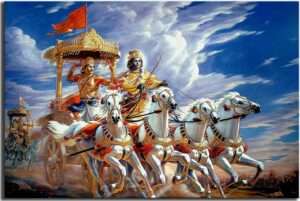
Now Krishna perceives that Arjuna is no longer hysterical. He has forgotten sorrow and dejection and listens with active interest to Krishna’s exposition. His intellect begins to appreciate the teaching, though he is not yet ready to accept it fully. As a practical man, he fears that after attaining the great goal in intellect, he may not be able to live vigorously in the outer world. His anxiety leads him to seek the complete truth about the state of mind of one established in Self-realization, and how such realization influences outward action when one emerges from the transcendental realm.
Every action does not bring bondage; only unintelligent action thickens impressions, building walls that obstruct the divine, making it inaccessible to ego-centered activity. The Creator, the total mind, projects the universe of the five elements and brings forth living beings, including man, upon this stage of life to work, strive, and achieve through self-dedicated activity. Living creatures are born of food and sustained by food; Krishna presents familiar Vedic terms infused with renewed meaning. The principle of right action, and even the power to act, arises from the Creator himself, who is none other than the imperishable Supreme.
Action is thus a gift from the Creator, and the all-pervading Supreme stands centered in all undertakings pursued in a spirit of self-dedication for the welfare of all. Among living beings, man alone has been granted freedom of action to contribute to cosmic harmony, and through this harmony he grows from strength to power within the universal mechanism. As long as the majority of a generation lives in obedience to this law of harmony, fields of happiness open before them, and such periods are known as golden ages of social and cultural life.
Yet this faithful obedience is not always maintained. At certain times in history, man as a social being revolts against this eternal law, and life slips from the peaceful domain of constructive growth into fearful ruin, marked by despair, restlessness, war, pestilence, flood, and famine. The question arises why the bright day of the world gradually sets to usher in the dark night of chaos. Krishna casts a wide net of explanation, illuminating for Arjuna both the analytical causes of such decline and the action required to restore harmony.
Thus Sanjaya reports that Arjuna is becoming an enlightened soul, equal in spiritual understanding to his physical prowess and divine wealth of sacred knowledge and celestial weapons.

