


In his second term in office, President Donald Trump’s name has become synonymous with “U-turns”. His instant U-turn, calling India a great country within an hour of reposting a racist remark, India – a hellhole, shows the desperation and the frustration of the most powerful man in the world, who is consistently inconsistent in his words and deeds. He is oblivious to the ways how a government works and behaves like a toddler.
Look at his tariff drama fooling his own citizens, threatening to annex Canada, Greenland and Cuba, kidnapping the Venezuelan President from his bedroom and starting a war with Iran, where he is caught up in a cobweb with no respectable exit routes in sight. Everything is transactional and temporary to him. The world is no more awestruck by the constant stream of lies coming from his mouth. Politicians are well known to lie, but no US President or any other head of state even comes close to Trump in the sheer volume and audacity of his lies.
I recollect when Trump was re-elected for a second term in 2024, the majority of Indians rejoiced because of his stand against global terrorism and his friendship and bonhomie with Indian Prime Minister Narendra Modi, with events like Namaste Trump and Howdy Modi in his first term. But he shocked the world in his second term, when he hosted the Syrian President Ahmed al-Sharaa at the Oval Office in White House, fawning praise on him while he was still a US-designated terrorist affiliated to Al-Qaeda. This he did in all the media glare in the presence of all his foreign aides in attendance to convey, I AM THE BOSS. His newfound love for Mullah Munir and Shehbaz Sharif, the Pakistani duo who run a jihad farm to breed terrorists, especially against India, was another shocker revealing his nervousness, frustration and an unreliable character.
What prompted Trump to change and become so desperate in his second term? An idiom that originated with medieval farmers, “Make hay while the Sun shines,” meaning take advantage of one’s position, seize opportunities, and act while the chance lasts, conclusively explain the compulsions of a US President in the second term. A two-term limit was imposed on the US Presidency in the 22nd Amendment in 1951 after the marathon run of President Franklin D. Roosevelt, who was elected for four consecutive terms in 1932, 1936, 1940 and 1944.
Due to a two-term limit, the US Presidents in their second term are no longer bound by the need to be re-elected, leading to a lack of restraint in their behaviour and therefore become more reckless and desperate to fulfil their own unfinished agenda (read “making hay”). Also, in their second term, many of their key advisors from the first term are either gone or resigned, leaving the Presidents with a B-team comprising sycophants, cronies, and yes men as advisors who are least interested in restraining the President’s behaviour, actions or managing the fallout from scandals. More so, Presidents become vulnerable and have to struggle in their second terms to enact key elements of their agenda, partly because Congress is freer to obstruct a President who will never be on the ballot again.
Here are a few examples that illustrate the point. Lyndon Johnson, who succeeded John F Kennedy after his assassination in 1963, authorised sustained bombing campaigns under Operation Rolling Thunder against North Vietnam in his second term, followed by the deployment of the first US ground combat troops. He became a very unpopular President because of the Vietnam War, where America lost its face, and Johnson lost his presidency to republican Richard Nixon in 1968. President Nixon in his second term in 1972, was forced to resign in 1974 as a result of the Watergate scandal that involved illegal tapping of phones and planting of bugging devices in the Democratic National Committee headquarters. He had no choice but to resign to avoid impeachment.
The third example is that of President Ronald Reagan, who was consumed in his second term in 1984 by the Iran-Contra scandal, which nearly led to his impeachment. 14 members of his administration were brought up on felony charges, and 11 of them were convicted. In this scandal, Reagan administration officials secretly sold arms to Iran during an embargo on the sale of weapons to secure the release of American hostages in Lebanon. The proceeds of the deal were illegally diverted to fund Contra rebels in Nicaragua.
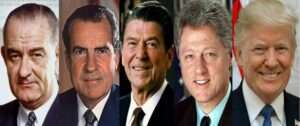
The fourth example is that of President Bill Clinton, who, in his second term in 1996, got involved in the most infamous scandal of his affair with White House intern Monica Lewinsky and his subsequent impeachment. Though he was not pardoned, he shamelessly continued as US President for the remainder of his term with a Senate cover-up. Height of US high moral standards!
The list could be long, but let me come back to the incumbent Donald Trump in his second term, starting 2024. President Trump became desperate and fell to his overarching ambitions and greed in his second term. He realised that it is his last chance to have a go at the Nobel Peace Prize and be at par with his bête noire, former President Barack Obama, a Nobel Peace Prize recipient. Because India cold-shouldered his dream despite his claims of stopping a nuclear war during Operation Sindhoor and seven other wars, he invited failed Marshal Munir for lunch at the White House and got himself nominated for the Nobel. Speaks volumes of Trump’s frustration.
President Trump will be remembered for all the wrong reasons, especially as a man driven by arrogance for power and greed to enrich his family business and benefit his close friends and cronies. With no regard to the common American people, he brought the US economy to the brink of collapse, adding trillions of dollars in debt. He lacked the intelligence to comprehend the need to work with the rest of the world. The world’s opinion of the United States took a beating in his second term, shattering the façade of American invincibility in the ongoing Iran war where he is now looking for a face-saving exit. America suffered a loss of faith and respect among its allies in Europe, Asia and elsewhere, with his mindless tariffs, blackmail, and invasion of Iran. The severe damage to the infrastructure in Middle East suffered in the reciprocal bombing by Iran disturbed the energy supply chain, resulting in major economic upheavals globally.
This leads to a very pertinent question: Is the Presidential form of government with a term-limit good for the country? My answer is an emphatic NO! Though for and against views can be debated. We have seen from the US experience how the Presidents holding independent power could be counterproductive due to their desperation in making the proverbial “hay” in a limited time. On the contrary, India has a parliamentary democracy that has in-built structural and constitutional safeguards intended to prevent a leader from becoming a dictator, though opposition leaders keep on shouting otherwise. Indian Prime Ministers derive legitimacy solely from holding the confidence of the people and the legislature and can be removed if that support vanishes during regular elections, every 5 years or even before.
So, if a nationalist Prime Minister like the incumbent Narendra Modi, who is leading India to a fast-paced development with his decisive leadership and transformative governance aimed at empowering the marginalized, then why bind him in terms of limits? We have an excellent example of Lee Kuan Yew, who served as Singapore’s Prime Minister for 31 years (1959–1990) over seven consecutive terms, transforming Singapore from a developing, resource-deficient colony into a prosperous, highly developed first-world nation by building a robust economy and ensuring political stability. So, a Parliamentary democracy is any day superior to a Presidential form of government with a term-limit.
At the state level, too, elections every 5 years are an in-built safeguard that discourages chief ministers from becoming dictators. However, in some rare cases when leaders intoxicated with a sense of invincibility succeed in fooling people either through appeasement or coercive politics, their time starts ticking before the masses make them bite the dust at the very first opportunity. The leaders cannot fool all the people all the time. A recent example of the former Chief Minister of Delhi, Arvind Kejriwal, would suffice to illustrate the point.
I rest my fingers after penning this article with some advice to our political leaders in the country with a shloka from chapter 16, verse 4 of Shrimad Bhagavad Gita: दम्भो दर्पोऽभिमानश्च क्रोधः पारुष्यमेव च | अज्ञानं चाभिजातस्य पार्थ सम्पदमासुरीम् || (dambho darpo ’bhimānaś ca krodhaḥ pāruṣyameva ca:// ajñānaṁ cābhijātasya pārtha sampadam āsurīm://)
The shloka translates to: “Pride, arrogance, conceit, anger, harshness, and ignorance, these qualities belong to those of demoniac nature, O son of Pṛthā (Arjuna). So, if you want to be leaders and serve the country, then shun these traits and follow pearls of wisdom; otherwise, your fate will be similar to those that will unfold tomorrow, the 4th May 2026. Exit TMC, Welcome BJP in West Bengal.


whatever may be the conditions in USA from time to time people all over the world r still crazy about settling in US.
let us hope that atleast the next presidents of US bring peace all over the world.
very nice article sir
Superbly written Dr Chadda Saab, explicitly stating the facts, & giving excellent advice for the present & future law makers. Kudos to you. NN
Well written, simple and interesting. The historical parallels drawn are eye-opening, and the comparison between Presidential and Parliamentary democracy brings a fresh perspective. A good read from start to finish.
Very good article, covering factual interesting historical and knowledgeable information. Hats off to you.
Hats off to you. Nice article, covering factual interesting historical and knowledgeable information.
A well written article providing comprehensive knowledge about the present President Trump’s tactics and ingenuity. I particularly liked the choice of words, idioms and phrases that the author choose, for example, MAKE HAY WHILE THE SUN SHINES etc. Concluding with an appropriate Gita sloka.
I always look forward for the Sunday article by Chadda Sir.
An interesting article. Actually many voters now want to term limit Congress. Both houses, senate and Representatives. Without term limits, these politicians are becoming career politicians with vested interests. There is big nexus between bureaucrats and politicians as they almost become permanent partners in crime. This is what many called big government, apart from size of uncontrolled growth of government employees. Trump in his first term did not engage in any war and still lost. George Bush had initiated a war in Afghanistan and Iraq and still won his second term. There are many such examples. From my experience Indians voted for Trump mainly due to a very bad law and order situation created by Biden administration in addition to allowing millions of refugees etc. Modi factor added to it may be little bit but it is not major factor. No doubt, Trump has high superiority complex and considers it below his dignity to go to congress and ask for permission. This attitude made many people turning away from him. But, I sincerely feel term limits and reduced perks for the lawmakers, as the to contest in an election is voluntary, and good debates between the candidates at all levels brings best to the democracy.