



Krishna counselled Arjuna that he should cast aside grief when facing enemies, and that even the slaying of great men, when demanded by circumstance, is a rightful duty. Arjuna’s personal calling is that of a leader of his age, summoned to confront an unrighteous force. It is his duty not to waver but to stand firm, to fight, and to defend his sacred royal culture. For one entrusted with the leadership of people, nothing is nobler than receiving a glorious opportunity to fight for a righteous cause. Arjuna was therefore urged to engage in a just war, in which his opponents were the true aggressors. Such an occasion, it is said, comes only to the fortunate few, and when the hour has ripened, a king must rise to action.
Ancient texts declare that the kshatriya is not a caste but a quality of inner dynamism, found in those who are eager to defend the weak, protect the poor, and preserve the people and the kingdom from external aggression. Such leaders are forbidden to become tyrants or aggressors themselves, according to the moral code of old. Yet, at the same time, a cold, timid, and cowardly non-resistance is not the spirit of the finest warrior. When the call of royal duty compels war upon the principles of righteousness, leaders are commanded to fight in defence of their culture and to regard themselves as privileged to serve their land. Such a battlefield is an open gate to heaven for heroes who fight diligently on the side of virtue and merit.
Krishna, descending gradually from higher planes of philosophy to the practical field of material life, examined the problem from every level and presented Arjuna with a single, logical conclusion: the war must be fought without hesitation. He declared that if Arjuna refused to engage in this glorious conflict, he would renounce his personal character and honour, fail in his duty, and incur sin. Arjuna’s nature is kingly, adventurous, and heroic, marked by an insatiable thirst for honour and glory. To reject the evolutionary opportunity given by life is to refuse the chance for inner purification. By not burning away old tendencies and shrinking before the influx of new demands, Arjuna might flee the field, yet he would surely regret his lost chance, for his mind is fashioned to find solace and fulfilment in the perilous life of the battlefield. A true hero regards dishonour as worse than death.
Krishna therefore urged Arjuna to abandon hesitation and fight the great war. His argument was that withdrawal would arise from cowardice, for the cause of the war was righteous. Beneath his firmness there flowed an undercurrent of sympathy, and he continued his discourse with compassion. He warned that the world would blame Arjuna and history would record his infamy. Warriors and commanders in the enemy ranks would ridicule him, laughing that the great archer had fled the battlefield in fear. They would interpret his conscientious objections to fratricidal war as faint-heartedness. Such dishonour, especially when it comes from one’s equals and inferiors alike, is intolerable.
Seeing that Arjuna was responding to his reasoning, Krishna pressed further, exposing the folly of avoiding battle at a decisive moment. It would be unbearable to endure the slander of enemies who would assail his glory and chivalry with contemptuous speech. It is unworthy even to imagine such disgrace. If Arjuna were to give up his life on the battlefield while fighting for a noble cause, he would enter the heavens of heroes. If he were to win, he would rule the kingdom and thereafter ascend to heaven as a mighty champion of virtue. In either case, he would gain, for he stood on the side of righteousness, and the war of ideals fought by the Pandavas was just. Therefore, for all these reasons, Arjuna was commanded to arise, resolve, and fight.
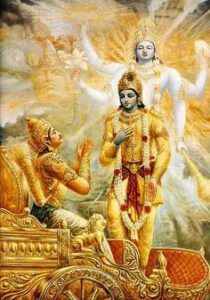
Krishna then turned to the inner discipline by which action is perfected. He explained that one who enters the sea to bathe must know the art, for otherwise the relentless waves will sweep him away. If one knows how to dive beneath the mighty waves and ride upon the gentler ones, one can delight in the ocean. To expect the waves not to trouble is ignorance. Similarly, one who expects life without the waves of pain and pleasure, loss and gain, conquest and defeat, is mistaken, for such a condition would mean stagnation and decay. The art of living lies in remaining unaffected by either the rising crests or the sinking hollows, for to identify oneself with either is to be tossed helplessly upon the surface.
Thus Krishna advised Arjuna that, while entering the contest, he should remain inwardly untouched by the usual mental disturbances that accompany action. This equanimity of mind alone draws forth the light of inspiration and gives achievement the lustre of true success. In all great undertakings, inspired work acquires a texture of divine perfection that cannot be imitated. Whatever the profession, this state arises whenever an individual is at his best, and his masterpiece is then accepted by all. When one works with a thrilling ecstasy born of an unknown source, it is called inspiration, and thoughts, ideas, and actions acquire a ringing beauty of their own. The sages called this the godly destiny of humanity, when one lives in perfect harmony with oneself.
The discourse thus combined sound reasoning, healthy intellect, and dependable judgment. Arjuna’s confusion had arisen from a miscalculation born of sentiment. He viewed the war through the lens of personal emotion, seeing before him relatives on both sides and judging their destruction to be ethically wrong. This emotionalism overwhelmed him, and in his inner chaos, he lost sight of other considerations that could have restored his balance. At this point, he surrendered his mind to Krishna as the inner authority of discrimination. Krishna assumed the role of the discriminative intellect, not merely as an individual counsellor, but as a true guide in practice.
Krishna concluded that Arjuna must fight, and he taught him how to conduct himself in this endeavour. He must wage war with perfect detachment from anxiety, from pain and pleasure, from gain and loss, from conquest and defeat. Such equanimity in mental challenges ensures success in life. The secret of this method lies in keeping the mind open for its natural flow. When the mind is clouded by ego and its allied desires, it becomes blocked, and uncontrolled tendencies rush in. The ego is born when one is disturbed by the pairs of opposites. When action is performed without ego, harmony of mind is achieved, leading to inner purification and the true catharsis of right living and right action. This alone can end sorrow and grief.
The fruits of action, often spoken of as the law of karma, are sometimes mistaken for blind destiny, but the nature of justice is always perfect. Thus Sanjaya reported how Krishna purified the mind of Arjuna, who now stood ready to act, energized by the discipline of resolute determination.

