



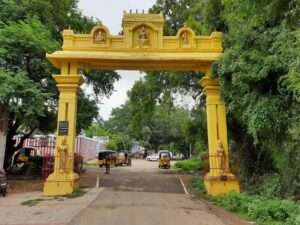
Moongilanai Kamakshi Amman Temple is located in the peaceful village of Devadanapatti in Theni district of Tamil Nadu, at the foothills of the Kodaikanal hills. The temple lies near the Manjalar River and is surrounded by lush green agricultural lands.The name “Moongilanai” comes from “Moongil” (bamboo) and “Anai” (dam), indicating that this region was once filled with dense bamboo forests and had a bamboo-based dam or bund near the river. The calm, natural surroundings make it a spiritually powerful place.
This temple is considered to be very ancient and is believed to be several hundred years old. Though exact historical records are not clearly available, it has been an important place of worship for many generations and continues to attract devotees with strong faith.
The main deity of the temple is Goddess Kamakshi Amman, a powerful form of Adi Parashakti. She is worshipped as a divine mother who protects devotees and fulfills their wishes. In this temple, the Goddess is believed to be in a deep state of penance (tapas), and hence her idol is not visible to devotees. Even without seeing her form, devotees pray with strong belief and experience her blessings.
The temple has a simple structure typical of rural Tamil Nadu temples. It does not have large gopurams, but it carries a strong spiritual presence. The most unique feature of this temple is that the sanctum (garbhagriha) door always remains closed, and devotees worship only the closed door.
The sanctum is opened only once a year during Maha Shivaratri. This is because the Goddess is believed to be in continuous meditation, and her penance should not be disturbed.
Another unique belief is that the ghee offered in the temple never melts and no ants or insects approach it, which is considered a divine miracle. The temple’s simple surroundings, once filled with bamboo groves, further reflect the natural and undisturbed environment chosen by the Goddess for her penance.
The temple has deep roots in local traditions and village culture. It gained importance due to divine events and miracles experienced by devotees over time. The presence of bamboo forests in earlier days and the peaceful riverbank location made it a sacred place, and the temple was established and maintained by local people and rulers.
According to the legend, Goddess Kamakshi Amman destroyed a powerful demon named Vajradanta and then came to this peaceful region, surrounded by bamboo groves and riverbanks, to perform deep penance.
During that time, a cowherd noticed a divine child drinking milk directly from a cow. When he witnessed this mysterious sight, he immediately lost his eyesight. The villagers reported this incident to the local Zamindar.
That night, the Goddess appeared in the Zamindar’s dream and told him that she would arrive in a sacred form through the Manjalar River after a few days. As predicted, a divine basket was found floating in the river, and it was believed that the Goddess herself had arrived in that form.
The temple was then established at that sacred spot. Since the Goddess is still believed to be in deep meditation, the sanctum remains permanently closed, and worship is performed without disturbing her tapas. The natural surroundings, including the bamboo-rich environment of the past, are believed to enhance the spiritual energy of the place.
The most important festival of this temple is Maha Shivaratri, celebrated in the Tamil month of Masi. On this day, the sanctum door is opened, and devotees get a rare opportunity to have darshan of the Goddess. Thousands of devotees gather for this special occasion.
Other festivals include Aadi month special poojas, Tamil New Year (Chithirai), Vijaya Dashami, Deepavali, Karthigai, and Thai Pongal. However, Maha Shivaratri remains the grandest and most significant festival of this temple.

